
It was a busy morning on the Asian economic calendar. While economic indicators from New Zealand, Japan, and Australia drew interest, trade data from China was the market focal point.
China’s dollar trade surplus widened from $88.19 billion to $90.21 billion in April versus a forecasted $71.60 billion. Significantly, imports tumbled by 7.9% year-over-year versus a 1.4% fall in March. Exports rose by 8.5% versus 14.8% in March. Economists forecast imports to decline by 5.0% and exports to increase by 8.0%.
The trade figures drew more interest than usual. In April, China’s manufacturing sector contracted, reflecting lackluster growth following the shift in its zero-COVID policy. Elsewhere, weak demand remains a common theme. In Germany, March factory order and industrial production figures raised recessionary fears. Inflation, monetary policy, and tightening credit conditions weighed on investment.
While strong China export numbers are bullish, the larger-than-expected fall in imports carried the weak demand theme.

AUD/USD Reaction to China Trade Data
Ahead of the China trade data, the AUD/USD fell to an early low of $0.67769 before rising to a high of $0.67834.
However, in response to the trade data, the AUD/USD rose to a post-stat high of $0.67801 before falling to a low of $0.67760.
This morning, the AUD/USD was flat at $0.67794.
US Dollar Index Price Forecast
Every new US Dollar Index analysis as it publishes, today's technical signal and key levels, live price — on one page.
See all US Dollar Index forecasts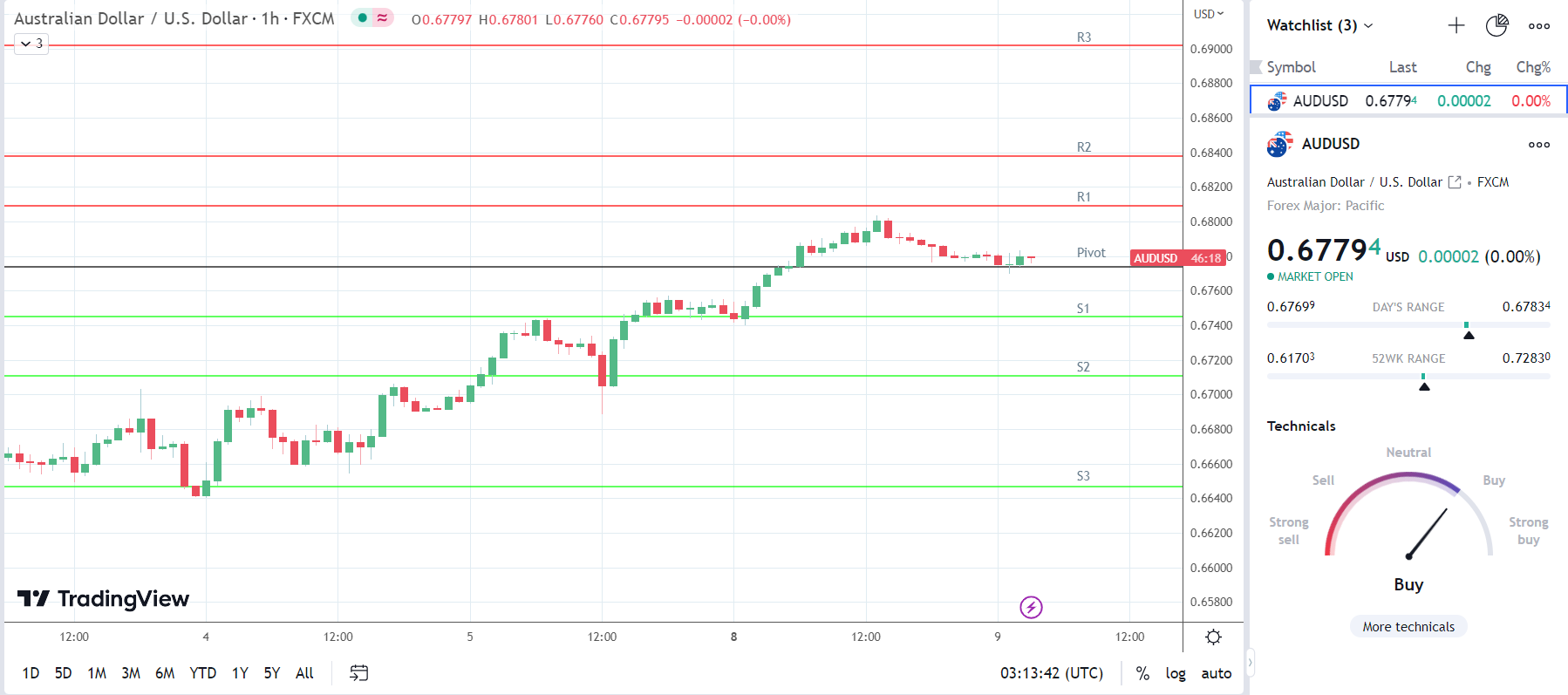
Next Up
Looking ahead to the US session, it is a quiet day on the US economic calendar. There are no US economic indicators for investors to consider. A lack of stats will leave Fed chatter and market risk sentiment to influence ahead of the US CPI Report tomorrow.
Beyond the economic calendar, the banking sector, the US debt ceiling, and corporate earnings also need consideration.