
Trump’s Auto Tariffs Ignite Backdoor Tensions with China
On Wednesday, March 26, President Trump announced a 25% tariff on all foreign car imports, effective April 2. According to the US Commerce Department’s International Trade Administration, Mexico, Japan, South Korea, Canada, and Germany are the largest auto exporters to the US.

However, the data only reflect direct imports and do not account for indirect exports to the US. Mexico and Canada serve as key manufacturing hubs for European and Chinese automakers targeting the US market.

China Ramps Up Auto Production in Mexico Amid Trade Tensions
The Coalition for a Prosperous America (CPA) notes that over 20 Chinese auto parts and vehicle manufacturers have established operations in Mexico. Brands like Chery and MG Motors have reportedly invested $7.06 billion in Mexico, alongside other firms such as BYD, Changan, JMC, Chirey, Jaecoo, and Jetour.
Strategic Relocation: Chinese Automakers Target US Market via Mexico
Since the US imposed Section 301 tariffs in 2018, twelve Chinese auto part makers set up manufacturing plants in Mexico. Under the United States-Mexico-Canada Agreement (USMCA), 75% of auto parts must be sourced within member countries to qualify for free trade. Notably, eligibility is determined by production location rather than ownership or headquarters.
Post-Tariff Investment Surge Signals Long-Term China Strategy
The CPA views China’s investments in Mexico as a calculated move. Its statement read:
“Given its location near the Texas border, and the fact that Mexico is not a sizable car market, especially for EVs at this time, to warrant such big spending, it seems safe to say that the prime target here is for making cars and car parts for US consumers.”
Key data points:
- Eight Chinese firms were in Mexico before Section 301 tariffs.
- Twelve had entered by the end of 2023.
- From 2019 to 2023, the investment growth rate was nearly five times that of the 2000–2017 period.
- The post-2019 investment rate rose over 64%, more than tripling the pre-tariff pace.
Washington Eyes China’s Backdoor Access Through USMCA
While the tariffs directly target foreign automakers, they may also affect China indirectly, potentially triggering a retaliation from Beijing. US authorities have reportedly become increasingly concerned that China is using Mexico as a “back door” to circumvent tariffs.
BYD Leads the Charge as Chinese Automakers Gain Global Traction
BYD reportedly projects global sales to reach 5.5 million in 2025, with plans for mass-market autonomous driving overseas by 2026-2027. BYD’s global expansion underscores China’s inroads into the global market. In 2024, BYD reportedly became the fourth largest automaker, surpassing Japan’s auto giants Honda, Nissan, and Suzuki.
Tech Tensions Rise: US Blacklists Over 50 Chinese Firms
On the same day, the US Bureau of Industry and Security added over 50 Chinese firms to the Entity List to curb China’s progress in AI and advanced computing. China’s foreign ministry reportedly condemned the move, urging the US administration to ‘stop generalizing national security.”
Despite this, China’s tech development will likely remain resilient. CN Wire reported:
“China Mobile and Alibaba signing a strategic cooperation agreement in Beijing, focusing on AI data centers, cloud computing, and AI-related services.”
Markets Shrug Off Tariffs as China’s Auto and Tech Stocks Rally
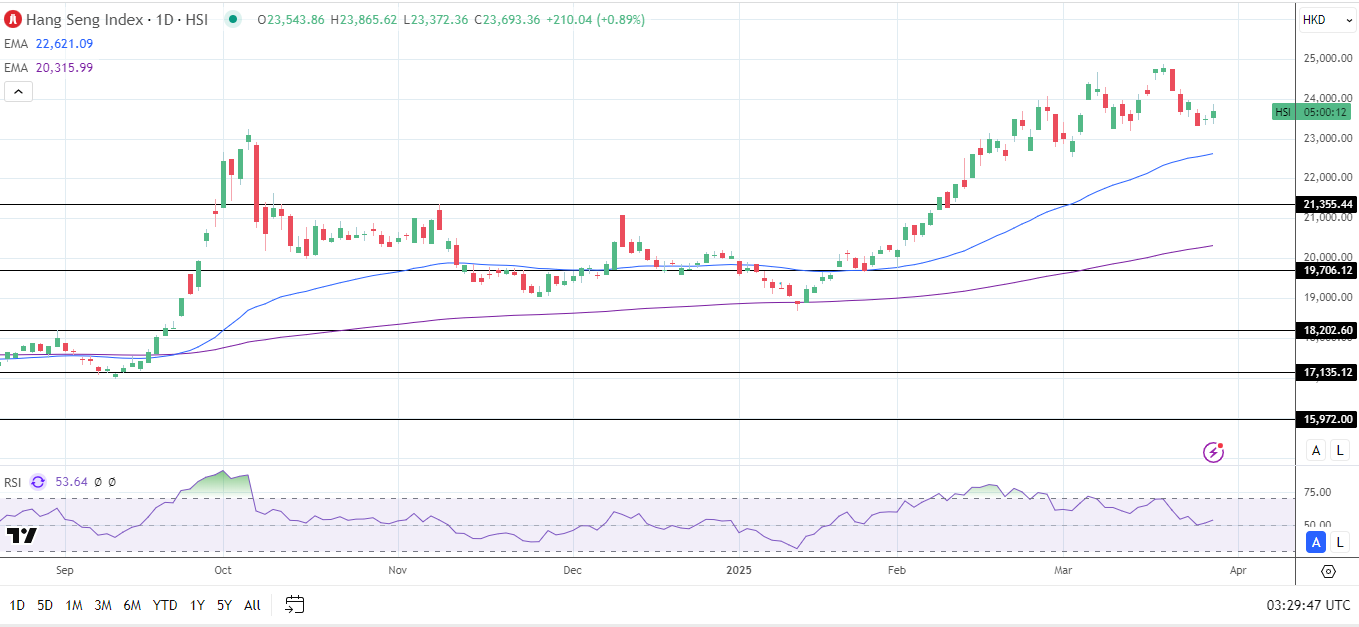
Optimism surrounding China’s auto and tech advancements remains upbeat. The Hang Seng Index rose 0.88% on Thursday, March 27, pushing its year-to-date (YTD) gains to 18%.
Mainland China’s CSI 300 and the Shanghai Composite Index rose 0.45% and 0.35% on Thursday morning, driving the Indexes into positive territory for 2025.
Notably, tech giants Baidu (09888.HK) and Alibaba (09988.HK) advanced 3.27% and 1.93% in Thursday’s morning session. Automakers BYD (0211.HK) rose 2.51% (YTD: +53%), while Li Auto (02015.HK) advanced 4.48% (YTD: +14%).
Wall Street Lags While China Tech and Auto Shares Outperform
In contrast, the Nasdaq Composite is down 7.31% YTD. Tesla (TSLA) shares have dropped 32.6% YTD, and Nvidia (NVDA) is down 15.29%, underscoring China’s growing competitiveness in AI and EV sectors.
Beijing’s Response and the Road Ahead for Global Markets
Investors should watch for possible retaliation from Beijing, which may trigger fears of a full-blown US-China trade war. However, fresh stimulus measures from Beijing could cushion the impact as China continues its shift to a consumption-led economy.
Stay ahead of market trends—explore our latest analysis on China’s economy and global markets here.