
German Trade Surplus Widened in January
On Wednesday, the German economy was in the spotlight. German trade data garnered investor interest early in the European session.
The German trade surplus widened from €22.2 billion to €27.5 billion in January. Economists forecast a trade surplus of €21.5 billion. Notably, exports increased 6.3% month-on-month after sliding by 4.1% in December. Economists forecast exports to rise by 1.5% month-on-month. Imports increased by 3.6% month-on-month in January.
According to Destatis,

- Exports to EU countries increased by 8.9% and imports by 10.8%.
- German exports to euro area member states rose by 7.7%, with imports up 10.2%.
- Exports to EU countries outside the euro area rose by 11.7%, with imports increasing by 12.0%.
- German exports to non-EU countries increased by 3.1%, while imports slid by 4.5%.
- Exports to China increased by 7.8%, while exports to the US declined by 1.7%.
- German imports from China declined by 11.3%, with imports from the US down 5.2%.
ECB Monetary Policy Impact Analysis
The trade figures could draw the interest of the ECB, with a pickup in the demand environment easing recessionary fears. Nonetheless, wage growth, the services sector, and inflation remain the focal points for the ECB.
EUR/USD Reaction to German Trade Data
Before the German trade data, the EUR/USD fell to a low of $1.08420 before rising to a high of $1.08605.
In response to the trade data, the EUR/USD fell to a low of $1.08586 before rising to a high of $1.08637.
On Wednesday, the EUR/USD was up 0.06% to $1.08628.
US Dollar Index Price Forecast
Every new US Dollar Index analysis as it publishes, today's technical signal and key levels, live price — on one page.
See all US Dollar Index forecasts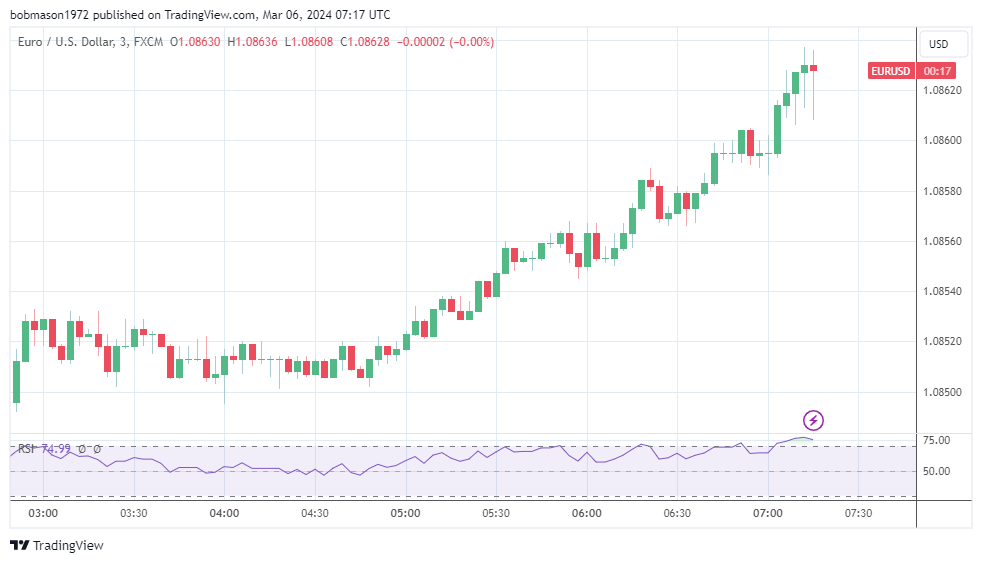
Up Next
Eurozone retail sales figures for January will also need consideration. A larger-than-expected increase in retail sales could temper bets on an H1 2024 ECB rate cut. Consumer spending can fuel demand-driven inflation. Economists forecast retail sales to increase by 0.1% month-on-month after sliding by 1.1% in December.
From the US, ADP Employment Change and JOLTs Job Openings need consideration. Weaker labor market conditions could signal a June Fed rate cut.
Economists forecast the ADP to report a 150k increase in employment in February after a 107k rise in January. However, economists expect JOLTs Job Openings to fall from 9.026 million to 8.900 million in January.
The numbers may influence bets on an H1 2024 Fed rate cut and market risk sentiment. However, Fed Chair Powell will have more impact. The Fed Chair will give testimony on Capitol Hill. Views on the economic outlook, inflation, and the Fed rate path will influence the appetite for riskier assets.