US President Trump Moves to Restrict Chinese Investment in Tech
The global race for AI dominance took a twist as President Trump introduced new measures to restrict Chinese investments in critical US sectors.
On Friday, February 21, US President Trump signed a national security memorandum targeting Chinese investments into strategic US sectors. The directive aims to protect American innovation while limiting foreign adversaries’ access to US capital and expertise.
Key Provisions of the Memorandum
The memorandum outlines specific steps to safeguard US interests:
- The Committee on Foreign Investment in the United States (CFIUS) will impose tighter controls on Chinese investments in critical sectors like technology.
- Establish new regulations to prevent foreign entities, including China, from exploiting US capital, technology, and research.
- Consider further restrictions on outbound US investments in China’s AI, semiconductor, and other industries, aiming to stop US funds from supporting Beijing’s Military-Civil Fusion (MCF) strategy.
The directive comes amid concerns over China’s continued access to US technology through direct investment. President Trump vowed to stop Chinese firms from stealing intellectual property and worker expertise.
US President Trump Changes Tack on China’s Progress in AI
The memorandum signals a shift in Trump’s approach to AI competition with China. In January, Trump stated:
“The release of DeepSeek, AI from a Chinese company should be a wakeup call for our industries that we need to be laser-focused on competing to win.”
However, the rise of DeepSeek AI, a low-cost Chinese AI startup, has challenged the dominance of US tech giants like Nvidia (NVDA), prompting a more confrontational stance.
Meanwhile, there are ongoing concerns that China could leverage Open AI’s ChatGPT platform to get ahead in AI development.
The latest US move against China could fuel speculation about an AI war amid uncertainties surrounding trade tariffs between the two nations.
Market Reaction: Hong Kong Tech Stocks Tumble
Hong Kong-listed tech stocks tumbled in response to Friday’s memorandum, underscoring concerns about the US restricting China’s access to US tech. On February 24, major Hong Kong-listed tech stocks tumbled:
- Alibaba (9988) fell 2.02%, followed by a 4.94% drop on February 25.
- Baidu (9888) declined 3.58% on February 25 after closing the February 24 session flat.
- Tencent (0700) slid 3.22% on February 25.
Brian Tycangco, editor and analyst at Stansberry Research, noted the market’s reaction:
“Hong Kong market takes a tumble at the open Monday following Trump’s memorandum on restricting US investments in Chinese tech, including AI. As usual, emotional reaction to fearful headlines dominate retail sentiment. Weak hands being shaken today.”
Beijing’s Response and Policy Priorities
Beijing condemned the move. The Foreign Ministry reportedly warned:
“US will end up hurting itself if shut out Chinese companies and markets.”
Meanwhile, Beijing reaffirmed its commitment to expanding the tech sector. On February 21, China’s CSRC Chairman Wu Qing declared priority support for tech firms focusing on core technology development through equity and debt financing and mergers and acquisitions.
Earlier, on February 19, Beijing also unveiled plans to boost demand for key sectors, including autos, electronics, and home products.
Stock Market Trends: US Tariffs and AI Escalation
The ongoing US-China trade and AI rivalry has cast uncertainty over mainland Chinese and Hong Kong-listed stocks. Concerns are growing that the US could impose tariffs on semiconductor chips as early as April 2.
Despite recent AI-driven rallies, China’s markets have experienced mixed performance.
- CSI 300: -0.02% year-to-date (YTD).
- Shanghai Composite Index: +0.12% YTD.
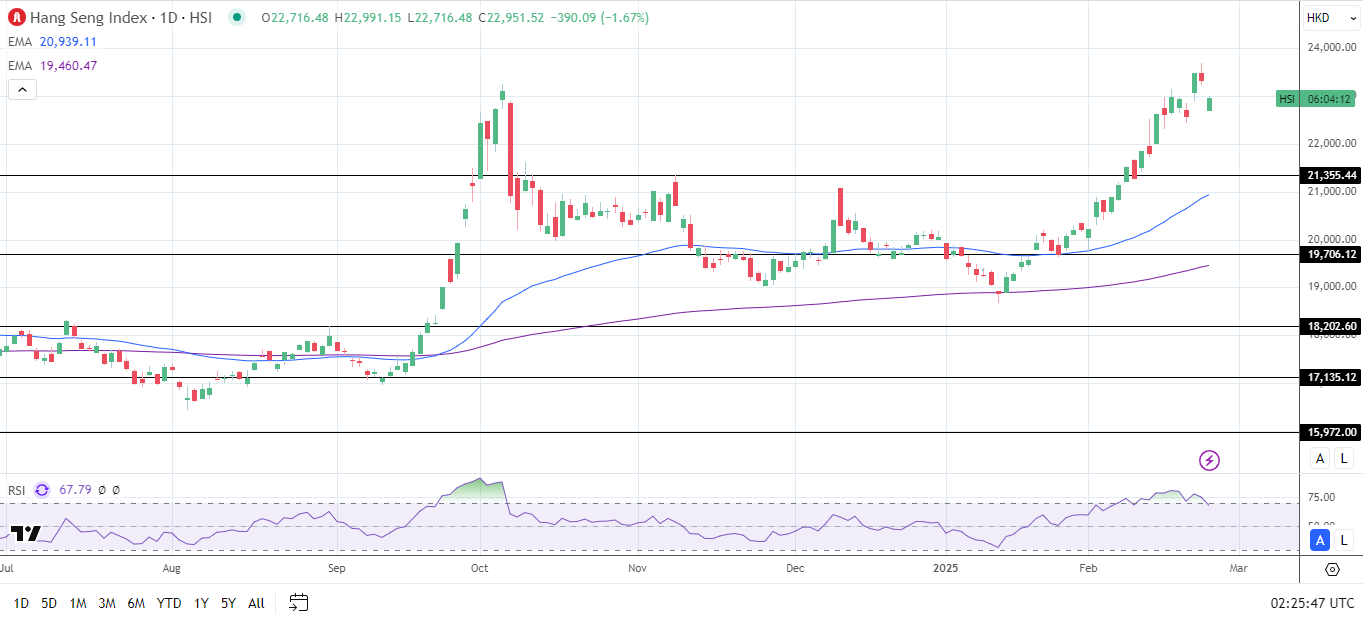
- Hang Seng Index +14.32% YTD.
The Hang Seng Index continues outperforming its Mainland peers, driven by AI-linked gains. Despite this week’s sell-off, Alibaba (9988) has soared 56.31% YTD, while Nvidia is down 2.99%.
Looking Ahead: NPC Meeting and Trade Policy
The National People’s Congress (NPC) Standing Committee Meeting will conclude on February 25. Beijing could release the agenda for the third session of the 14th NPC in March. In March, lawmakers are expected to discuss economic reforms, fiscal policies, and key government initiatives, including the Five-Year Plans. The AI race and US trade policy developments will likely be discussion points.
In the meantime, an escalation in the US-China AI and trade wars could further impact the HK and Mainland China markets.
For an in-depth analysis of China’s economy and financial markets, read our latest reports here.