


Automated Trading with Forex and CFD Brokers – Ultimate Guide
Here's an insight into how we make money. While we strive to be comprehensive, the compensation we receive can influence the products, companies, or services we showcase and review. Not all available options may be featured on this page.
Intro
Key Points:
- Automated trading involves the execution of orders when some predetermined market conditions are met.
- Trading algorithms are the core of automated trading. They are used to opening and closing positions without human intervention, following predefined instructions to capitalize on market opportunities.
- Limit orders represent the simplest form of trade automation. They guarantee trade execution at a specific price level that is different from the current spot price.
- Factors such as low execution speeds, connectivity issues, and other system failures can hinder the performance of an automated trading system.
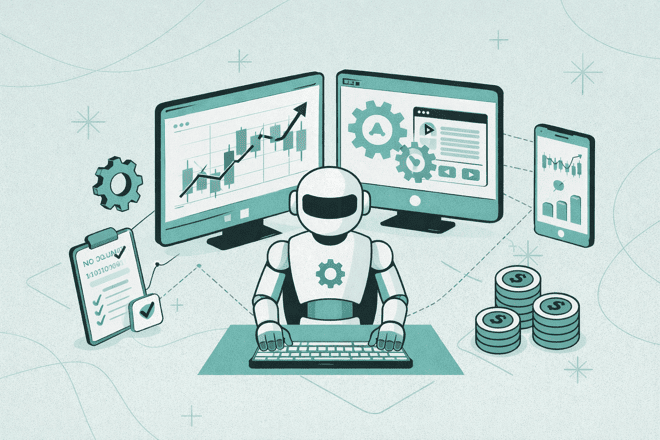
Automated trading is highly popular because it offers greater control and flexibility over trade execution. There are various types of trade automation, ranging from simple tasks like placing limit orders to employing complex trading algorithms.
In this article, we’ll explore the various types of automated trading, their implementation, underlying risks, potential benefits, and more.
What is Automated Trading
Automated trading is a system that allows traders to enter or exit the market based on specific, predefined conditions. Traders use instructions programmed into the platform to determine when and where an order should be opened or closed. The complexity of trade automation can vary widely.
Main Features of Automated Trading
- Predefined Trading Rules: Traders set specific criteria for entering and exiting trades, such as price levels, technical indicators, or time-based triggers. These rules are programmed into the trading system.
- Speed and Efficiency: Automated systems can execute trades instantly when conditions are met, far faster than manual trading, which is crucial in markets where speed can impact profitability.
- Emotion-Free Trading: Automated trading eliminates emotional decision-making, ensuring that trades are executed strictly according to the predefined rules, without hesitation or second-guessing.
- Backtesting Capabilities: Traders can test their strategies on historical data to evaluate how they would have performed in the past, helping to refine and optimize the strategy before live trading.
- Diversification: Automated trading allows for the simultaneous execution of multiple strategies across different markets or asset classes, which can help in diversifying risk.
- 24/7 Market Monitoring: Automated systems can continuously monitor the markets, executing trades even when the trader is not actively watching, which is particularly beneficial in global markets that operate around the clock.
Types of Automated Trading
- Algorithmic Trading: A trading algorithm is a set of instructions for executing trades designed to optimize efficiency and capitalize on market opportunities with minimal human intervention. For example, a limit order is a basic algorithm that directs the platform to place a short or long order at a specific price. More advanced algorithms may include additional conditions based on the values of one or more indicators.
- Custom-Built Algorithms: Traders can create or purchase custom algorithms with detailed entry and exit instructions. For instance, an algorithm might instruct to enter a short position when the 20-day MA crosses below the 50-day MA, and the 50-day MA crosses below the 100-day MA.
cTrader is a great platform for first-time algo traders, as it features several built-in algorithms. The platform also has an online library containing hundreds of custom-built algorithms. Some have free access, while others can be purchased.

- Trading Bots: Trading bots use sophisticated algorithms to place and execute orders. They are designed to follow specific strategies, allowing them to buy and sell assets on behalf of a trader without manual input. Trading bots operate continuously, reacting to real-time market conditions to optimize trading outcomes.
- Expert Advisors: Expert Advisors are automated trading programs for MetaTrader platforms (MT4 and MT5). They use pre-programmed algorithms to analyze market conditions, generate trading signals, and execute trades automatically based on user-defined rules. EAs can also be customized to include complementary orders, such as stop losses and take profits, to manage the primary position.
- Copy Trading and Signal-Based Systems: Copy trading allows less experienced traders to replicate the trades of seasoned traders with proven track records. The concept is straightforward: when a signal follower subscribes to a signal provider’s strategy, any position executed by the provider is automatically mirrored in the follower’s account.
Risks and Challenges of Automated Trading
- Technical Failures: Automated trading relies heavily on technology, making it vulnerable to technical issues such as system crashes, software glitches, and internet outages. These failures can result in missed opportunities or unintended trades.
Use VPS hosting to reduce technical risks. It ensures uninterrupted server connections, low-latency trading, and ultra-fast execution speeds, often below 2 milliseconds.
- Market Anomalies: Even the most well-tuned ATS can’t be entirely foolproof. Market volatility can lead to unexpected behaviors, like triggering a stop-loss by a brief dip or uptick before a trend reversal. Rare, unpredictable events like the 9/11 attacks or Donald Trump’s unexpected election can cause sudden market reactions, adding another layer of risk to any trading strategy.
- Over-Optimization: Also known as “curve fitting,” over-optimization occurs when a trading algorithm is excessively fine-tuned to fit historical data. While this might show impressive results in backtesting, it often fails in live trading due to the algorithm’s inability to adapt to new market conditions.
- Lack of Flexibility: Automated systems follow pre-programmed rules, which means they may struggle to adapt to sudden, unforeseen changes in the market that weren’t accounted for in the algorithm. This rigidity can lead to poor decision-making during volatile market conditions.
- Market Liquidity Issues: In highly volatile or low-liquidity markets, automated trading systems may execute orders at unfavorable prices due to slippage. This can significantly impact profitability, especially in high-frequency trading.
- Dependence on Historical Data: Automated trading systems are often based on historical data, which may not accurately predict future market behavior. Markets can change due to new regulations, economic events, or shifts in investor sentiment, making historical models less reliable.
- Security Risks: Automated trading systems can be vulnerable to cyberattacks. If a hacker gains access, they could manipulate the trading system, leading to unauthorized trades or data breaches.
How to Choose the Right Forex Broker for Automated Trading
- Regulatory Considerations: Always choose a licensed and regulated broker. Ensure they are transparent and comply with essential safety measures, such as segregating client funds and offering negative balance protection.
- Trade Automation Support: Choose a broker whose platform supports Expert Advisors (EAs), custom EA development, and includes a strategy tester for backtesting.
- VPS Hosting: Look for brokers that offer reliable VPS hosting for low-latency execution, ideally free or at a low cost for high-volume traders.
- Trading Costs: Evaluate spreads, commissions, and swap rates, as these costs significantly impact profitability in automated trading.
- Market Access and Liquidity: Ensure the broker offers a wide range of instruments, high market liquidity, and fast execution speeds.
- Broker Reliability: Explore the reviews at FXEmpire Broker Hub to find the ideal partner for successful automated trading.
Conclusion
Automated trading enables traders to achieve greater efficiency, make emotion-free decisions, and capitalize on market opportunities at any time. However, it also brings challenges like technical issues, unexpected market changes, and the need to regularly update strategies. By choosing the right broker, using reliable tools, and staying aware of potential risks, traders can get the most out of automated trading while keeping its downsides in check.
About the Author
Finance writer, analyst, and author of a book for beginner traders "Bulls, Bears and Sharks" with an experience of over 8 years in retail trading and more than 3 years in the finance area.


