


Forex Liquidity Providers – Complete Guide
Here's an insight into how we make money. While we strive to be comprehensive, the compensation we receive can influence the products, companies, or services we showcase and review. Not all available options may be featured on this page.
Intro
Key Points:
- Liquidity providers create a market for financial derivatives instruments by filling traders’ orders.
- Major financial institutions, such as investment banks, market makers, hedge funds, and others, can all be liquidity providers to smaller retail brokers.
- Most retail brokers route their client orders to a pool of liquidity providers, where the provider with the most optimal price quotes fills them.
- Trading orders are filled either by being matched electronically or by the market maker serving as a counterparty to the trader.
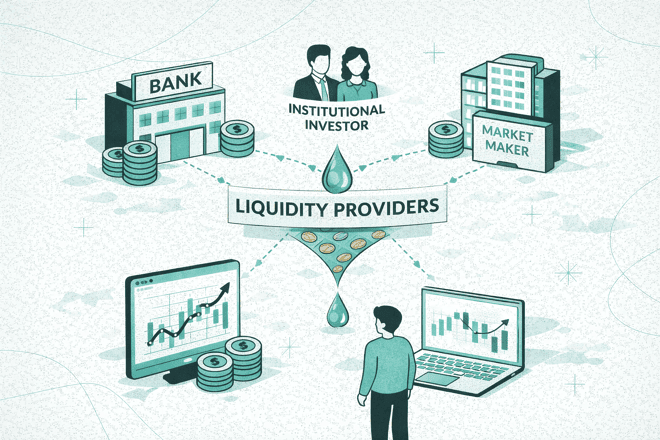
In trading, liquidity refers to the ease with which you can enter and exit trades. When the market is liquid, trading orders are filled relatively quickly. However, in less liquid markets, delays can cause significant discrepancies between the requested entry/exit price levels and the actual execution price.
Liquidity providers play an integral role in the broader trading ecosystem by facilitating derivatives trading in the over-the-counter (OTC) market. They enable online trading with leveraged products, ensuring that trades can be executed efficiently. In this article, we will explore who these liquidity providers are and how liquidity flows from the provider to the trader.
What is a Forex Liquidity Provider?
A liquidity provider is usually a major financial institution that is involved in trading and investing activities on the interbank level. This trading activity creates buying and selling pressures in the market, which typifies market liquidity.
A collection of one or more such institutions forms a pool of liquidity providers from which smaller retail brokers obtain their liquidity, which they then delegate to their clients. Here is how liquidity is usually delegated from a major provider to the retail trader:
- A trader places a buy or sell order with the broker.
- The broker receives the order and then sends it to its pool of liquidity providers.
- One of the liquidity providers fills the order at the best possible price by trading against the trader.
- The trader receives confirmation that the position is now open.
- When the trader decides to close the position, they place an opposite order with the broker (sell if the first order was to buy and buy if the first order was to sell).
- The broker sends the instruction to its pool of liquidity providers, and the one with the most favorable quotes at the time fills it.
- The trader receives a confirmation that the position is closed.
Types of Forex Liquidity Providers
From the point of view of a retail trader in the OTC market, a liquidity provider can be any financial institution that facilitates the filling of their orders. This includes market maker brokers, banks, hedge funds, investment funds, proprietary trading firms, and more.
Unlike most retail brokers, which either route their clients’ orders or match them via electronic communications networks, the liquidity provider usually acts as a counterparty to the trader.
Banks
Banks are the most obvious example of a major liquidity provider because they possess considerable market power and have enough capital to fill significant trading volumes. However, the activities of banks impact the market in other ways, too.

Banks interact with each other on the interbank level, borrowing and lending funds to each other. This process impacts short-term and longer-term interest rates, driving them up and down. Accordingly, the manner in which banks loan capital also affects the retail trader directly because a broker’s overnight charges (swaps) are determined by changing interest rates.
Financial Institutions
Investment Firms and Hedge Funds
These entities operate massive investment portfolios, making them a crucial source of liquidity in capital markets. Their portfolios often comprise a mix of lower-risk securities and higher-yield/risk assets, providing liquidity for various contract-specific derivatives such as ETFs, futures contracts, treasuries, and more.
Proprietary Trading Firms
Unlike investment banks and hedge funds, which invest on behalf of their clients and earn a commission from the profits they generate, proprietary trading firms use their own capital to trade for their own profit.
This allows them to accumulate widely diverse financial securities portfolios comprising assets or groups of assets from different markets. Consequently, proprietary trading firms can serve as liquidity providers for these instruments, especially when supply and demand pressures are strained due to low liquidity in the open market.
Market Makers
Market makers are very important in OTC derivatives trading because they create liquidity for retail traders. Essentially, any broker, bank, hedge fund, or any other financial entity can be a market maker in the OTC market by facilitating derivatives trading (taking the opposite position of the trader). This means they would sell the underlying asset to the retail trader when they wish to buy it and vice versa.
How Liquidity Providers Work
The process of liquidity creation and distribution is complex and involves multiple steps. Here are some of the key steps in the process:
Trading Against Traders (Counterparty Trading)
As mentioned above, in OTC derivatives trading, liquidity is created by the market maker when it takes the opposite position against the retail trader (selling to buyers and buying from sellers).
The market maker is not concerned with whether the retail trader is successful or not. Although it is evident that whenever the trader ‘wins,’ the market maker ‘loses,’ and vice versa, this dynamic is mitigated by a couple of factors. First, the market maker charges a fee for the execution of client orders, regardless of the outcome. Second, the majority of retail traders tend to lose money in the long run.
Order Matching
Order matching systems provide an alternative to counterparty trading. There are two major types of order matching systems: dealing desks and using electronic communications networks (ECNs).
Brokers with dealing desks match buyers and sellers of the same underlying instrument internally. However, this method is now becoming increasingly rare with the advent of online ECN trading.
ECN brokers match buyers and sellers both internally and externally, including clients of other brokers. ECNs significantly reduce execution times and generally offer more competitive trading fees.
Bid/Ask Spread
Most liquidity providers are major financial institutions with considerable market power, enabling them to facilitate margin trading. They also play a significant role in setting the bid/ask spread for the instruments they provide liquidity.
The ‘Bid’ is the price at which the market maker is willing to buy from the trader, while the ‘Ask’ is the price at which the market maker is willing to sell to the trader.
Market Depth
Market depth refers to the underlying liquidity levels for a particular asset. A market with depth allows traders to execute high-volume buying and selling orders with relative ease without significantly affecting the asset’s price.
In other words, greater market depth makes it easier to enter and exit trades. However, decreased liquidity can impede the process. For example, if an asset’s price suddenly drops, prompting mass selling, but there are no willing buyers, the market lacks depth, leading to a liquidity trap.
When major economic releases (e.g., US Non-Farm Payrolls) surprise the market, traders rapidly start to reposition themselves. This sudden shift in buying and selling dynamics within a short period can temporarily disrupt the market depth, potentially causing negative slippage, where an order is filled at a different price than initially requested.
Benefits of Liquidity Providers
Without liquidity providers, trading on margin would not be possible. They bridge the gap between exchange trading, the interbank level, and the OTC market, where retail traders participate. In other words, liquidity providers are essential to online trading. Their benefits include:
- Make trading on margin possible. Brokers obtain liquidity from their providers so that their clients can trade on margin. This allows the broker to ‘lend’ funds to traders necessary to execute particular positions, with the trader setting aside collateral (the margin). In practice, this allows traders to execute much larger positions than they could with just their account equity.
- Remove the need for physical delivery. One of the biggest perks of margin trading is that there is no need for physical delivery. When you are buying or selling, you are not doing so with the underlying asset or commodity. Instead, you are executing positions with derivative contracts. For example, when you buy gold, do not expect your broker to send you a bar of the precious metal to your door. Instead, you are entering into a contract for difference (CFD), which will turn profitable if the price of the underlying commodity appreciates in the future.
- Make markets more efficient. Market makers and ECNs make OTC trading more efficient because they facilitate fast order execution, either by trading against the trader or matching their orders. In addition to instantaneous order execution without the need for physical delivery, another perk of derivatives trading is its accessibility. While exchange trading is usually reserved for large-scale institutional trading, small retail traders can gain access to the OTC market with initial deposits of just several hundred dollars.
- Increase price competitiveness. Last but not least, retail brokers with multiple liquidity providers can offer their clients the most competitive trading conditions. This is achieved by aggregating the bid/ask spreads in the liquidity pool and routing their clients’ orders to the one liquidity provider offering the tightest spread rate.
Make sure your broker has a ‘best execution policy,’ which is a legal mandate by the broker to supply its clients with the most optimal price feed under prevailing market conditions.
Challenges and Risks Associated with Liquidity Providers
Price Manipulation
Untrustworthy entities may manipulate prices to exploit their clients, often by driving the underlying price in the opposite direction of the trader’s position, resulting in a loss. Therefore, it is crucial to sign up with a licensed and regulated broker that adheres to essential safety requirements, such as having a ‘best execution policy.’
Brokers that publish regular ‘Order Execution Statements’ have the lowest risk of price manipulation. This ensures the highest possible transparency regarding order execution.
Counterparty Risk
Retail traders are also exposed to the broker’s credit risk and liabilities. In particular, they risk losing all their deposited funds if the broker becomes insolvent. One solution to mitigate this risk is to choose a broker with a ‘compensation scheme’ or ‘private indemnity insurance.’ Both options guarantee compensation to the trader up to a certain amount in the unlikely event of their broker going bankrupt.
Diminished Liquidity
Retail traders also face the risk of diminished liquidity. When the connection between a liquidity provider, broker, and trader is interrupted for any reason, it can lead to significant discrepancies in order execution. The main risk is that of negative slippage, which occurs when trading orders are not filled at the requested price level.
For example, if you plan to enter into a long EUR/USD trade with a 1 lot (100,000 units) buying market order at 1.0700, but the broker fills the order at 1.0705, the 5-pip difference would result in a $50 negative slippage, as the pip value of a full-sized trade is $10. This slippage is to your detriment.
Quick Recap
In conclusion, liquidity providers are fundamental to the efficient functioning of the OTC trading market, enabling brokers to offer margin trading and ensuring swift order execution. They help maintain market depth and price competitiveness, benefiting both retail and institutional traders. However, it’s crucial for traders to choose licensed and regulated brokers to mitigate risks such as price manipulation and counterparty insolvency.
About the Author
Finance writer, analyst, and author of a book for beginner traders "Bulls, Bears and Sharks" with an experience of over 8 years in retail trading and more than 3 years in the finance area.


