


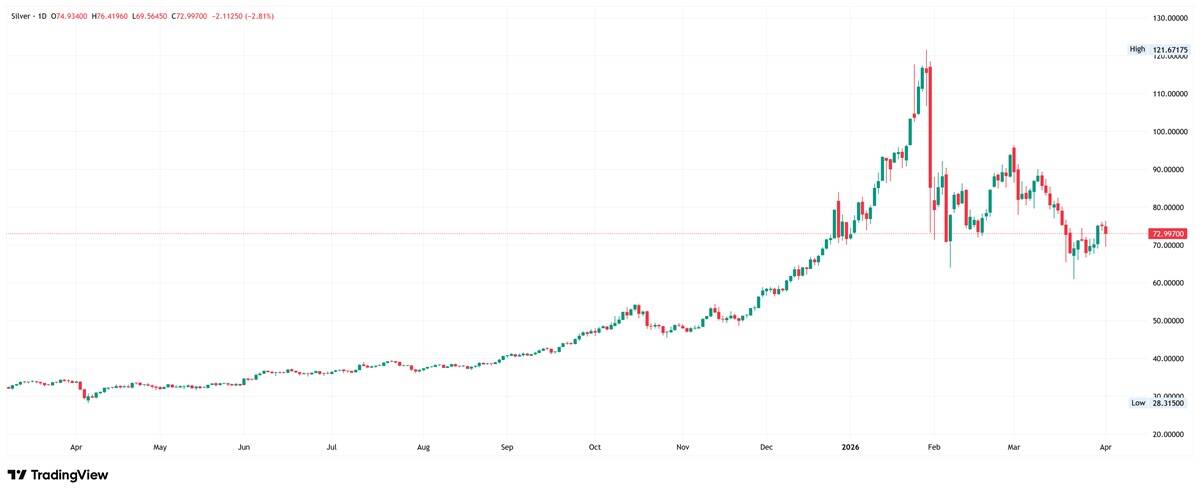
Silver corrected sharply from its January peak, including a roughly 22% decline in March — one of the worst monthly declines of this bull phase. The correction has been real, painful, and well-documented.
What has not changed during that correction: the structural deficit. The Silver Institute and Metals Focus are projecting a sixth consecutive annual deficit of approximately 67 Moz in 2026. The cumulative shortfall since 2021 is approaching 800 Moz — nearly a full year of global mine production. And the supply pipeline, the part of the story that would theoretically fix this over time, just handed us the clearest possible demonstration of why it cannot fix this anywhere near as fast as the market might expect.
This article expands on one of the topics discussed in this week’s premium Silver Catalyst issue.
The Best Numbers Yet — And a 2034 Problem
On March 24–25, Pan American Silver (TSX/NYSE: PAAS) released a revised Preliminary Economic Assessment for its La Colorada Skarn project in Zacatecas, Mexico. Jefferies called it “a meaningful de-risking step.” The headline improvement from the 2023 version is significant across every metric:
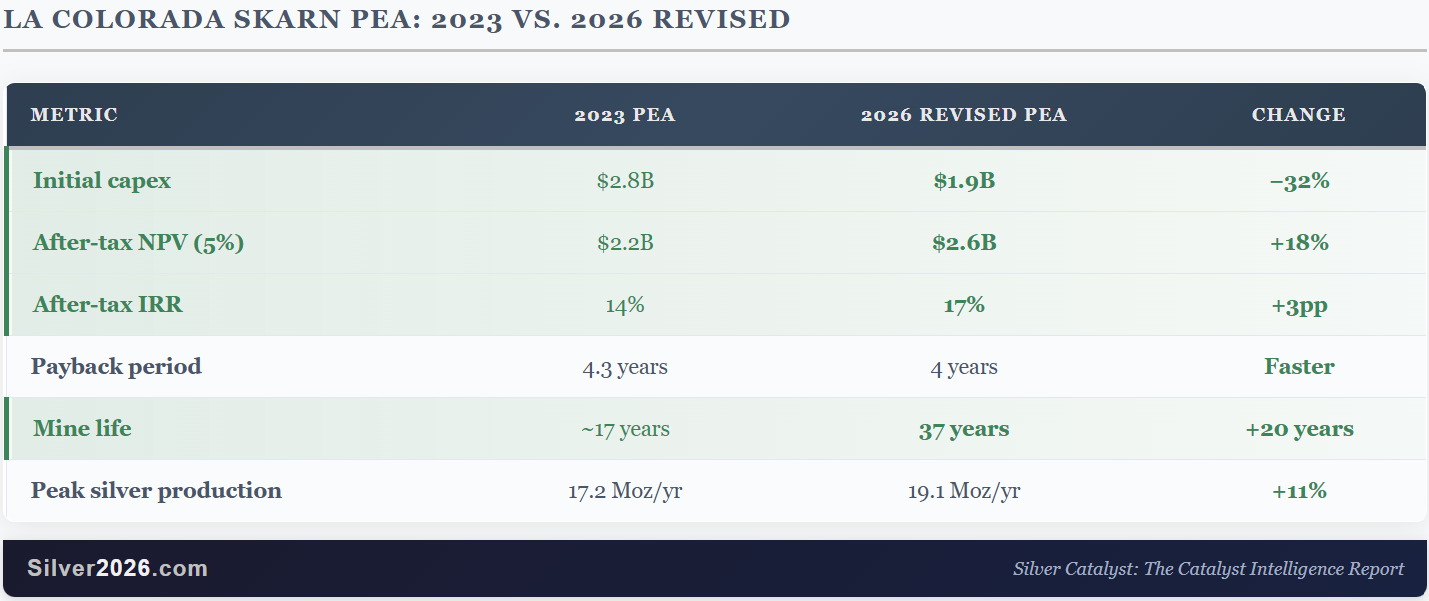
Capex down 32%. NPV up 18%. IRR up three percentage points. Mine life more than doubled. This is a genuinely good set of numbers, and the project now has an NPV 40% above its required capital investment at current silver prices.
There is one number in this PEA that matters more than all of the above, and it is not in the table: first meaningful production is expected to begin around 2034 based on current PEA assumptions.
That is not a pessimistic reading of the timeline. That is the base case in the PEA itself, assuming preparatory decline work begins in 2026, construction runs six years from 2027 through 2032, and a ramp-up year follows in 2033. Full-scale production at 15.8 Moz per year begins in 2034 at the earliest. The timeline looks like this:
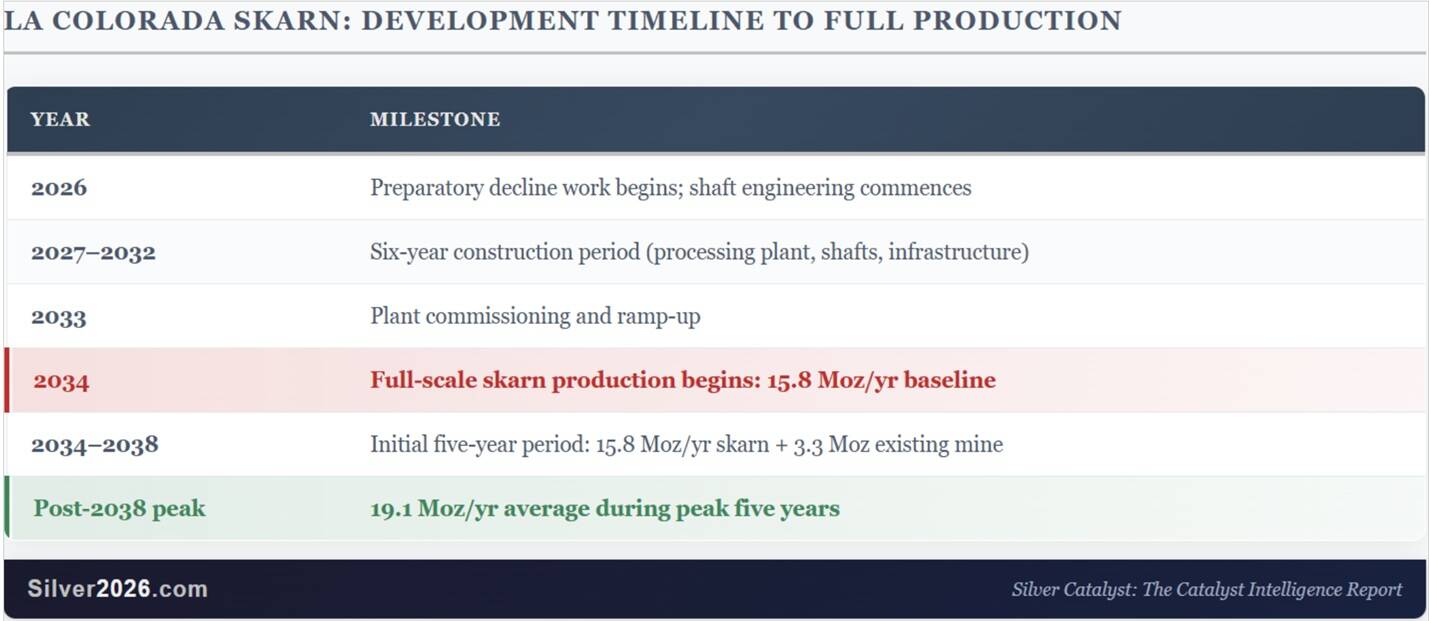
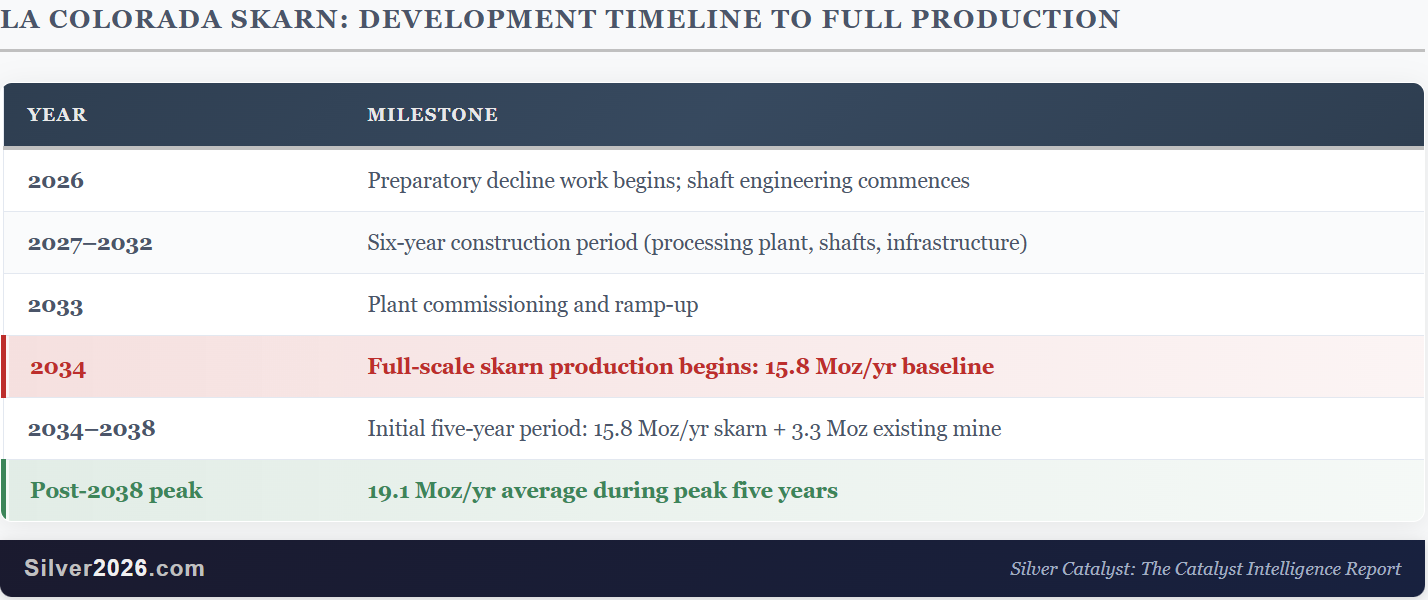
The La Colorada Skarn will not meaningfully contribute to supply before the mid-2030s. The project is excellent. It is also structurally irrelevant to the supply problem as it exists today.
Silver Price Forecast
Every new Silver analysis as it publishes, today's technical signal and key levels, live price — on one page.
See all Silver forecastsWhy This Matters: The Price Signal Cannot Be Heard in Time
The core issue is that even with a strong price signal, the physical cycle of mine development is too slow to respond within the deficit window. La Colorada is not a counterexample to this thesis. It is the thesis, expressed in a single project’s actual numbers.
Silver has gone from approximately $34 at the start of 2025 to an intraday spike above $120 on January 29, 2026. That is a price signal of extraordinary clarity. A $1.9B project with a 17% IRR at current prices should be the kind of development the market responds with, and it is. Pan American Silver is committing. The work is beginning in 2026.
And under the current PEA timeline, the first ounce is not expected until around 2034.
That is the gap at the heart of the silver supply thesis. Projects do not turn on like a switch. They require environmental permits, social licenses, engineering, shaft sinking, plant construction, commissioning, and ramp-up. The entire sequence, even when compressed and de-risked as La Colorada has been, takes eight years from the first serious work to full-scale production.
La Colorada’s 2034 timeline is, notably, better than many projects in the pipeline. AbraSilver’s Diablillos (123 Moz reserve, declared in early 2024) is still in early-stage development. Discovery Silver’s Cordero completed a feasibility study showing a 302 Moz reserve and US$1.2B NPV5, but as of early 2026, permitting remains the key milestone and no construction decision has been made. The World Silver Survey 2025 confirms that global primary silver mine reserves grew 2.4% in 2024 to 3,624 Moz — a number that sounds reassuring until you recognise that only a small portion of those reserves translate into production on timelines relevant to the current deficit.
The Deficit That Cannot Wait for 2034
The structural case does not depend on La Colorada alone. It depends on the cumulative picture: six consecutive annual deficits, approaching 800 Moz in total since 2021, being met by drawing down above-ground stocks rather than by new supply. The Silver Institute’s data shows combined London vault and exchange stocks were 510.5 Moz lower than their 2021 peak by end-2024, broadly tracking the cumulative deficit over that period. Those stocks are not infinite.
For investors, this is the mechanism that matters. A persistent deficit resolved by drawing down finite above-ground stocks — rather than by new supply coming online — means the physical scarcity case strengthens over time, not weakens. Each year the deficit continues, the buffer between current demand and available supply gets thinner.
When that buffer becomes thin enough to affect physical delivery, the price mechanism does the adjusting: buyers who need silver for industrial use (solar panels, electronics, medical devices) cannot defer that need the way a financial investor can defer a trade. They bid the price up until supply and demand balance. That repricing is what investors positioned ahead of the constraint stand to benefit from — not from speculation, but from being early to a physical reality that the supply pipeline, as La Colorada demonstrates, cannot resolve before the mid-2030s.
Against that backdrop, a project that produces 15.8 Moz per year starting in 2034 — 1.9% of current global mine supply — is genuinely valuable over the long run. It just does not address the problem in the timeframe where the problem is acute.
There is a further wrinkle in La Colorada’s specific case: Zacatecas, where the project sits, is a state where security conditions have periodically disrupted mining operations in the region. This is not unique to Pan American Silver, but it is a structural risk to the execution timeline that the PEA’s financial figures do not fully capture. The security situation was detailed in Issue #11 and remains active as of this writing.
The Outlook
A correction of this magnitude from the January peak is painful to sit through. It is also, viewed through the lens of mine development timelines, structurally uninformative about where silver will be in 2027, 2028, or 2030. The deficit does not shrink because the paper price corrects. COMEX inventory trends remain an important signal to monitor. And one of the most significant undeveloped silver projects in the world just told us, in precise engineering terms, that it cannot contribute meaningfully before the mid-2030s.
The April data calendar is unusually dense: March CPI on April 10, World Silver Survey 2026 on April 15, Section 301 comment period closing on April 15, and Warsh taking office as Fed Chair on May 15.
The full Silver Catalyst Issue #12 covers five more Deep Dives beyond this one: China’s elimination of its 9% solar VAT rebate and the two-phase demand dynamic it creates, the US EV (Electric Vehicle) sales collapse (–28% in Q1) against a 57% hybrid surge and what the divergence means for automotive silver demand, India’s SEBI reform and the new institutional demand channel it opens across a $950 billion mutual fund industry, the Iran war’s Phase 2 stagflation dynamic and what the April 10 CPI print will tell us, and Australia’s Davey decision and the legal precedent it sets for mining development costs globally. The convergence of these catalysts in a 15-day window is what makes this issue different from a normal market update.
If you want the full picture — the data, the timing, and what it means from here — you can access it below:
👉 Get Silver Rising with complimentary 2-week Silver Catalyst access
Thank you.
The Silver Engineer