The Australian Dollar is stuck between strong domestic growth and rising global tensions. As AUD/USD was easing its way up to 0.7300, news from the Middle East and a change of course from the RBA pushed the currency down to test the make-or-break 0.7000 level.
Back on March 4th, 2026 – a date traders should mark in their diaries – the Australian Dollar is sending a clear signal to investors that they are ditching the Aussie for the safety of the US Dollar. The outlook remains as murky as it gets.
The Middle East “Black Swan”: Why the Greenback is Choking the Aussie
The main reason behind the recent 0.9% slide in AUD/USD has nothing to do with economics – it’s all down to geopolitics. Coordinated US and Israeli strikes against Iran, which resulted in the reported death of Iran’s Supreme Leader, have sent shockwaves through the financial system like a thunderbolt.
As a result investors are rapidly abandoning riskier assets like the Australian Dollar and snapping up US Dollars. With the Strait of Hormuz closed off since March 3rd, Brent Crude has surged by 30% this year and is now trading at $80.
Although Australia exports energy – and higher global energy prices will inevitably impact the global economy – as an exporter this actually puts even more pressure on the Australian Dollar.
AUD/USD Price Forecast
Every new AUD/USD analysis as it publishes, today's technical signal and key levels, live price — on one page.
See all AUD/USD forecastsThe US Dollar’s Rise:
- Safe-Haven Dominance: The DXY (US Dollar Index) is holding up near a six-week high.
- Warsh Nomination: As Kevin Warsh prepares to take the helm at the Fed as Chair – promising a “hawkish but stable” hand on the wheel – confidence in the USD is on the rise.
RBA’s Michele Bullock: March Rate Hike Possible
While the world’s attention is focused on the Middle East, the Reserve Bank of Australia delivered a surprise to the market. Governor Michele Bullock announced that the March 17 meeting may just see a 25-basis-point rate hike.
Even though the Australian Dollar has taken a hit, the economy’s still doing okay. Q4 GDP came in at 2.6% year-over-year, beating the expected 2.1%. With inflation at 3.8%, the RBA is showing that it’s going to act independently of the global market’s mood swings.
“The board will be actively looking to see if they need to move more quickly,” Bullock warned. “And I’d advise people not to assume we only meet every quarter.”
It’s an unusual situation: the RBA is hiking rates while the global economy is slowing down. This might help the currency in the long run, but it could also cause short-term turmoil as traders weigh up the risk of a sharp economic downturn.
AUD/USD Technical Breakdown: The 0.7045 Line in the Sand
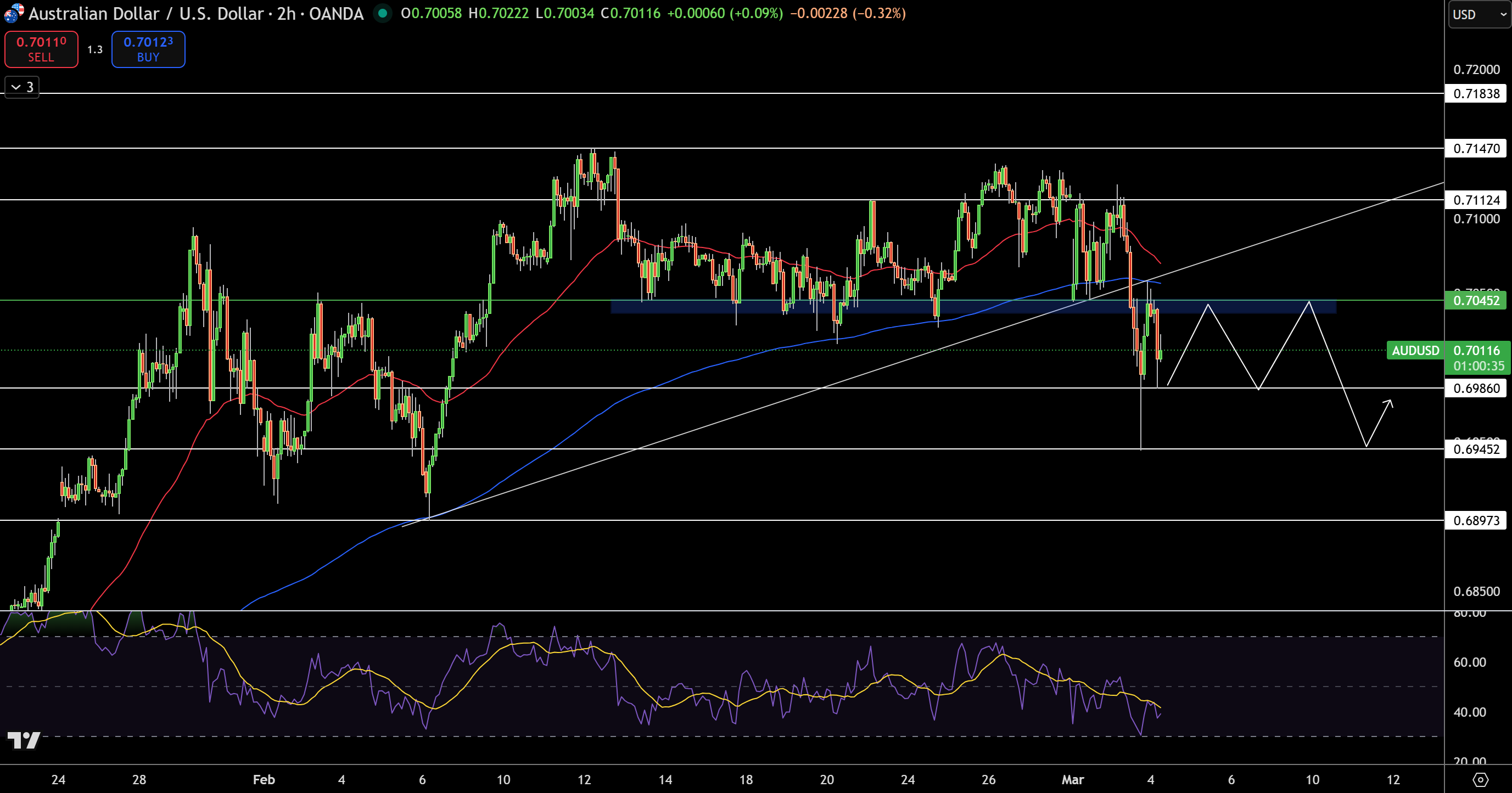
From a purely technical perspective, the AUD/USD has hit a crossroads. The pair recently slipped below a critical rising trendline that had been intact since late 2025.
- The Bear Case: After slipping below the 50-EMA, the price action is now battling it out with the 200-EMA near 0.7045. This level, once a floor, has now flipped into a ceiling. If we fail to reclaim 0.7045, a deeper retracement toward 0.6986 or even 0.6945 is not out of the question.
- The Bull Case: Despite the sell-off, the RSI is holding steady at 35 – not yet in “oversold” territory but showing that the bearish momentum is starting to lose steam. If risk appetite bounces back – as we saw in the recent 4% Bitcoin rally – a “V-shaped” recovery back toward 0.7112 is very much possible.
The Bottom Line: Survivor’s Guide for March 2026
The AUD/USD is no longer a simple carry-trade play – it’s a barometer for global war and inflation risks. Keep a close eye on the 10-year yield differentials. If the RBA hikes to 4.10% by May while the Fed stays put, the yield advantage will eventually force a reversal of the current USD-dominant trend. The “0.7000” level is your anchor.
As long as the pair holds above this, the long-term bullish outlook for 2026 (targeting 0.7300 by Q3) remains intact. However, a daily close below 0.6980 would be a signal to take a step back.