
DAX Slide on Trump’s Tariff Shock and EU Retaliation
German stocks tumbled on Thursday, April 3, with the DAX logging its largest daily drop since March 3’s 3.54% decline. Investors reacted to President Trump’s tariff announcements and the EU’s retaliatory stance, triggering fears of a full-blown US-EU trade war.
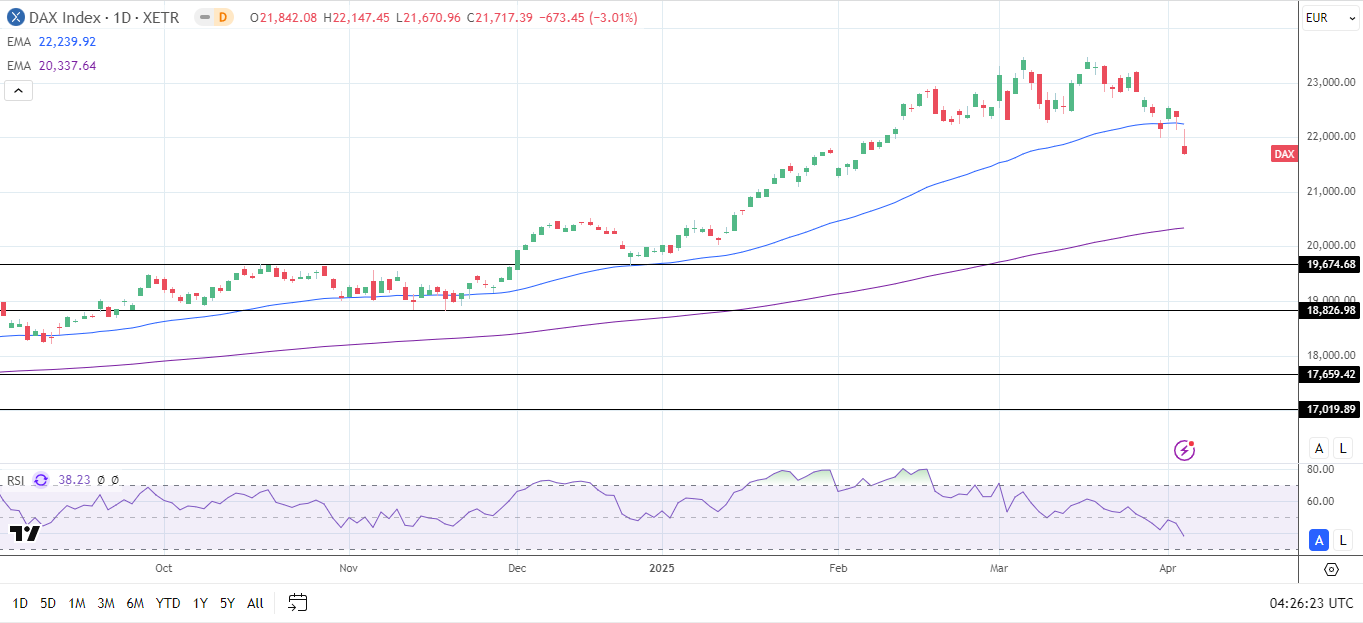
The DAX shed 3.01% after falling 0.66% on April 2, closing at 21,717, its lowest since February 5.
Trump raised EU tariffs to 20%, prompting a strong response. European Commission President Ursula von der Leyen condemned Trump’s tariffs and stated:
“We have always been ready to negotiate with the United States. To remove the remaining barriers to transatlantic trade. At the same time, we are prepared to respond. We are already finalizing the first package of countermeasures in response to tariffs on steel. And we are now preparing for further countermeasures to protect our interests and our businesses if negotiations fail.”
The European Commission President added,
“But there is an alternative path. It is not too late to address concerns through negotiations.”
Despite the rhetoric, von der Leyen emphasized that diplomacy remains an option, suggesting it is not too late to resolve tensions through dialogue. The EU has delayed imposing retaliatory tariffs for one week, hoping to reach a resolution.
Any breakthrough in negotiations will be pivotal for Germany’s export-driven economy and the trajectory of the DAX.

Sportswear Stocks Lead the Decline
The tariff escalation impacted German equities, particularly in the consumer and manufacturing sectors.
Adidas plunged 11.72%. Auto, bank, pharma, and tech stocks also suffered heavy losses. Auto giants Daimler Truck Holding and Volkswagen fell 6.12% and 4.42%, respectively. BMW, Mercedes-Benz Group, and Porsche also ended the session in the deep red. Tech and banking names followed suit, with Infineon Technologies down 7.96%, SAP off 4.07%, Commerzbank sliding 4.68%, and Deutsche Bank tumbling 6.91%
DAX Price Forecast
Every new DAX analysis as it publishes, today's technical signal and key levels, live price — on one page.
See all DAX forecastsFactory Orders Disappoint Amid Heightened Trade Tensions
On Friday, April 4, the German economy was in the spotlight. German factory orders stalled in February after sliding 7% month-on-month in January. The absence of a rebound in orders ahead of US tariffs could test demand for German-listed stocks.
However, tariff-related news will continue influencing risk sentiment. Progress toward reaching an EU-US trade agreement could boost demand for German export stocks. In contrast, a continued escalation in trade war risks could impact risk assets further.
US Markets Reel from Tariff Shock
US equity markets faced intense selling pressure on Thursday, April 3, as Trump’s tariffs fueled US recession fears. The Nasdaq Composite Index plunged 5.97%, while the Dow and the S&P 500 slid 3.98% and 4.84%, respectively.
In the bond markets, 10-year US Treasury yields sank to their lowest since October 2024. Falling Treasury yields sent the EUR/USD to a session high of $1.1145 before settling at $1.10513, a 1.87% April 3 gain.
US economic data took a backseat as markets assessed the potential fallout of Trump’s latest measures.
Outlook: Tariffs, Jobs Report, and Powell in the Spotlight
In Friday’s US session, the focus will remain on tariff developments. However, investors should also consider the US Jobs Report and Fed Chair Powell’s upcoming speech.
- Bullish Scenario: Robust wage growth, lower unemployment, and upbeat nonfarm payroll figures, together with early signs of trade negotiations, could boost demand for German stocks.
- Bearish Scenario: Signs of a cooling labor market and an escalation in the trade war may drive the DAX lower.
Fed Chair Powell’s stance on tariffs, the economic outlook, and monetary policy will also move the dial. Support for rate cuts could ease pressure, but a cautious tone may weigh on sentiment.
Near-Term Outlook: Key Drivers
The DAX remains sensitive to developments across three main fronts: the US labor market, tariff headlines, and central bank signals.
Potential DAX Scenarios:
- Bullish Case: Easing trade tensions, upbeat US labor market data or dovish central bank forward guidance may drive the DAX toward 22,000.
- Bearish Case: An escalation in trade tensions, weak US data, or more hawkish central bank stances could drag the DAX toward 21,000.
As of Friday morning, the DAX futures were down 142 points, while the Nasdaq 100 mini fell 155 points, signaling a challenging start to the session.
DAX Technical Indicators
Daily Chart:
After Thursday’s sell-off, the DAX remains below the 50-day Exponential Moving Average (EMA) while holding above the 200-day EMA. The EMAs signal short-term downside risks.
- Upside Target: A breakout above 21,750 would support a move toward 22,000. A return to 22,000 could bring the 50-day EMA into play.
- Downside risk: A drop below 21,500 could signal a fall toward 21,000. A decisive break below 21,000 could enable the bears to target the 200-day EMA.
With the RSI at 38.23, the DAX remains above oversold territory (below 30), leaving room for a drop to 21,500.
Conclusion: Monitor Key Macro Catalysts
Investors should monitor upcoming US labor market data, tariff announcements, and central bank commentary. These key drivers will dictate the DAX’s price trajectory in the coming sessions.
Explore our latest research here for deeper insights into the DAX, global macro trends, and emerging market opportunities.