
The Bank of Japan’s Summary of Opinions from the December Monetary Policy Meeting (MPM) revealed a more hawkish stance in early trading on Monday, December 29. 10-year Japanese Government Bond (JGB) yields climbed higher, sending USD/JPY lower on expectations of gradual rate hikes. Fears of a more hawkish BoJ rate path weighed on US stock futures.
Notably, the Summary of Opinions contrasted with the absence of clear guidance on future policy adjustments in the BoJ’s Statement of Monetary Policy. A more hawkish BoJ rate path, alongside expectations of the Fed cutting interest rates, would narrow the US-Japan rate differential. A narrow rate differential would make yen carry trades less profitable, weighing on US equity futures.
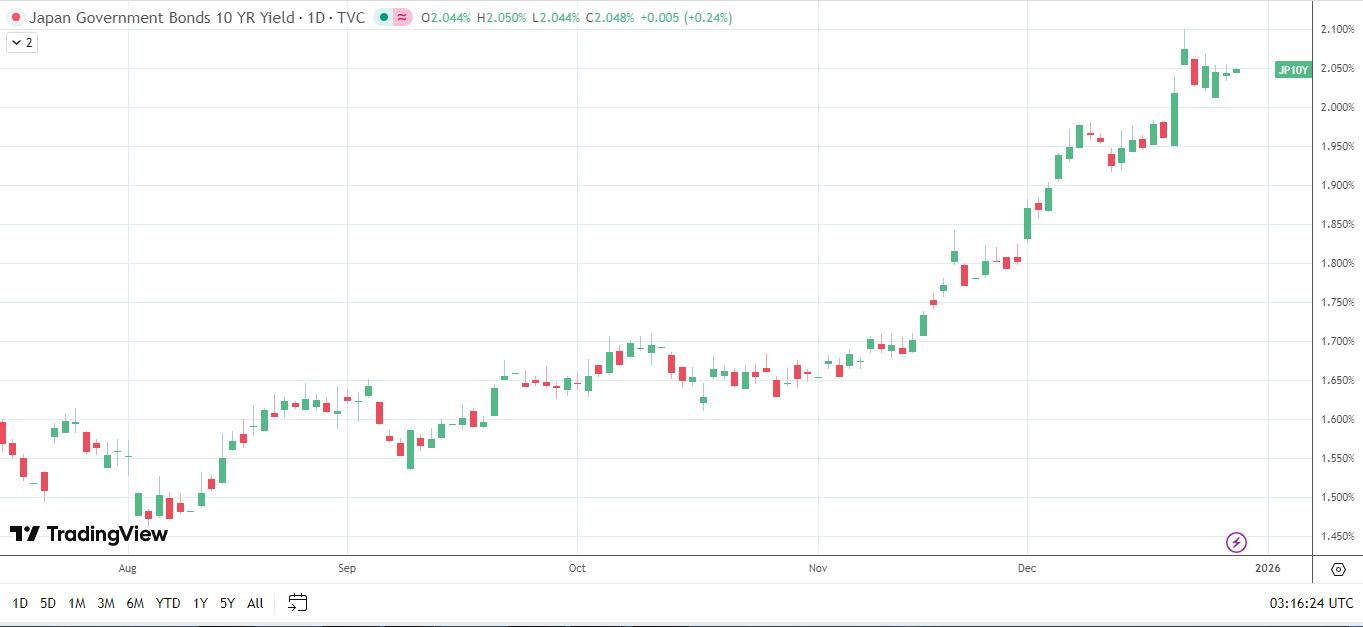
Despite the more hawkish BoJ policy stance, speculation about an incoming Fed Chair favoring lower interest rates continued to support a bullish short- to medium-term price outlook.
Below, I’ll outline the key market drivers, the medium-term outlook, and the key technical levels traders should watch.

Bank of Japan Summary of Opinions Lift Rate Hike Bets
The Bank of Japan raised interest rates by 25 basis points on December 19, but signaled caution over future rate hikes. The less hawkish-than-expected policy stance sent 10-year JGB yields lower and USD/JPY higher, boosting demand for risk assets.
However, the Summary of Opinions highlighted a more hawkish narrative. Policymakers called for steady rate hikes to avoid falling behind the curve, noting that the real policy interest rate was the lowest globally. There was a consensus that further rate hikes would be warranted if the economy and prices move in line with the BoJ’s outlook, given that a sizeable distance from the neutral interest rate remained.
A more hawkish BoJ rate path would indicate a narrowing US-Japan rate differential, reducing the profitability of yen carry trades into risk assets.
USD/JPY fell 0.07 to 156.395 in morning trading, recovering from a post-Summary of Opinions low of 156.058. Notably, the Nikkei 225 was down 0.39%, reflecting the effect of the BoJ’s policy stance on risk sentiment.
Dow Jones Price Forecast
Every new Dow Jones analysis as it publishes, today's technical signal and key levels, live price — on one page.
See all Dow Jones forecasts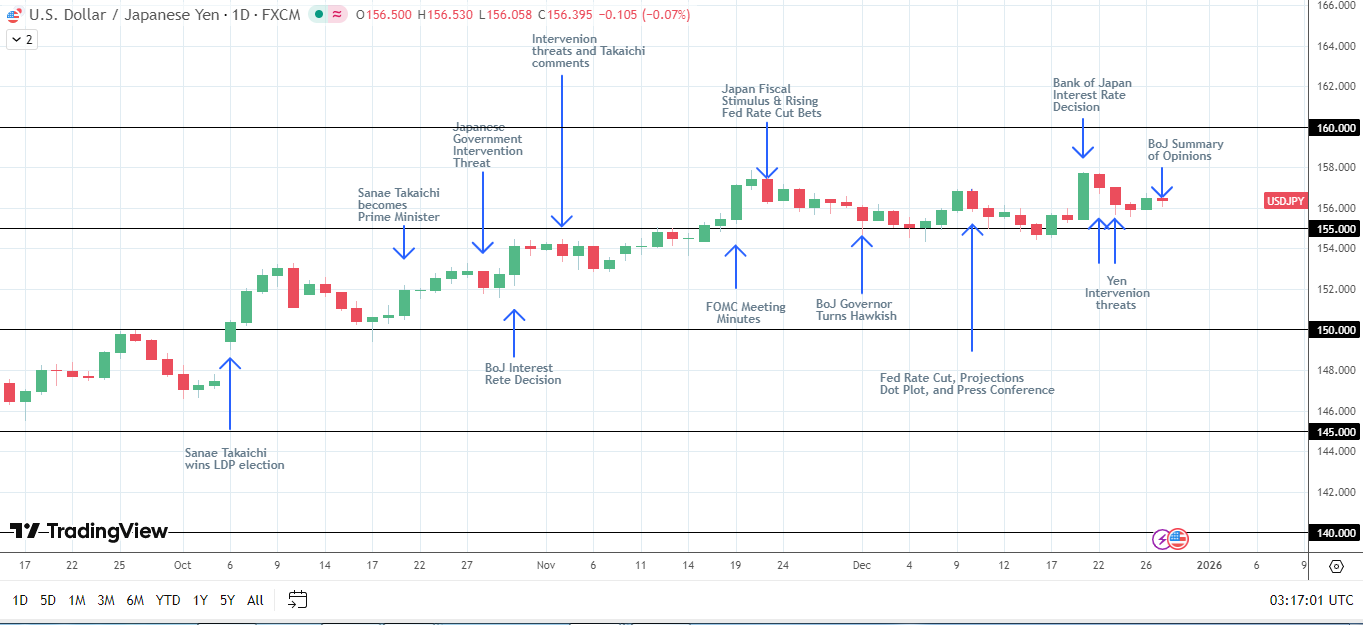
US Economic Data and the Fed in Focus
US futures had mixed performances during the Asian morning session on Monday, December 29. The Nasdaq 100 E-mini and the S&P 500 E-mini fell 16 points and 3 points, respectively, while the Dow Jones E-mini gained 9 points.
Later on Monday, the Dallas Fed Manufacturing Index is likely to influence sentiment toward the US economy and risk appetite. Economists forecast the Dallas Fed Manufacturing Index to rise from -10.4 in November to -2.5 in December. Better-than-expected numbers would suggest improving manufacturing sector activity and a resilient US economy late in Q4, supporting risk sentiment.
However, the report is unlikely to influence market bets on a March Fed rate cut. Traders should closely monitor FOMC members’ speeches following last week’s GDP report, CPI report, and the recent Jobs report. Softer inflation and weaker labor market conditions have bolstered bets on a March cut. However, the Q3 GDP report signaled sticky inflation, fueling uncertainty about Fed policy.
Increased support for further rate cuts would likely boost demand for US stock futures, supporting the constructive short- to medium-term bias. Crucially, gradual rate cuts and gradual BoJ policy rate hikes would keep yen carry trades sufficiently profitable near term to avoid market disruption.
According to the CME FedWatch Tool, the probability of a March Fed rate cut rose from 53.3% on December 26 to 54.8% on December 29. Furthermore, market expectations that a new Fed Chair would favor lower interest rates support a more dovish Fed rate path.
The current market dynamics and increasing investment into AI have lifted investor appetite for US stock futures. The Nasdaq 100 E-mini and the S&P 500 E-mini are eyeing seven-day winning streaks, while the Dow Jones E-mini hovers near its all-time high, reinforcing the bullish sentiment.
Key Technical Levels for Dow Jones, Nasdaq 100, and S&P 500
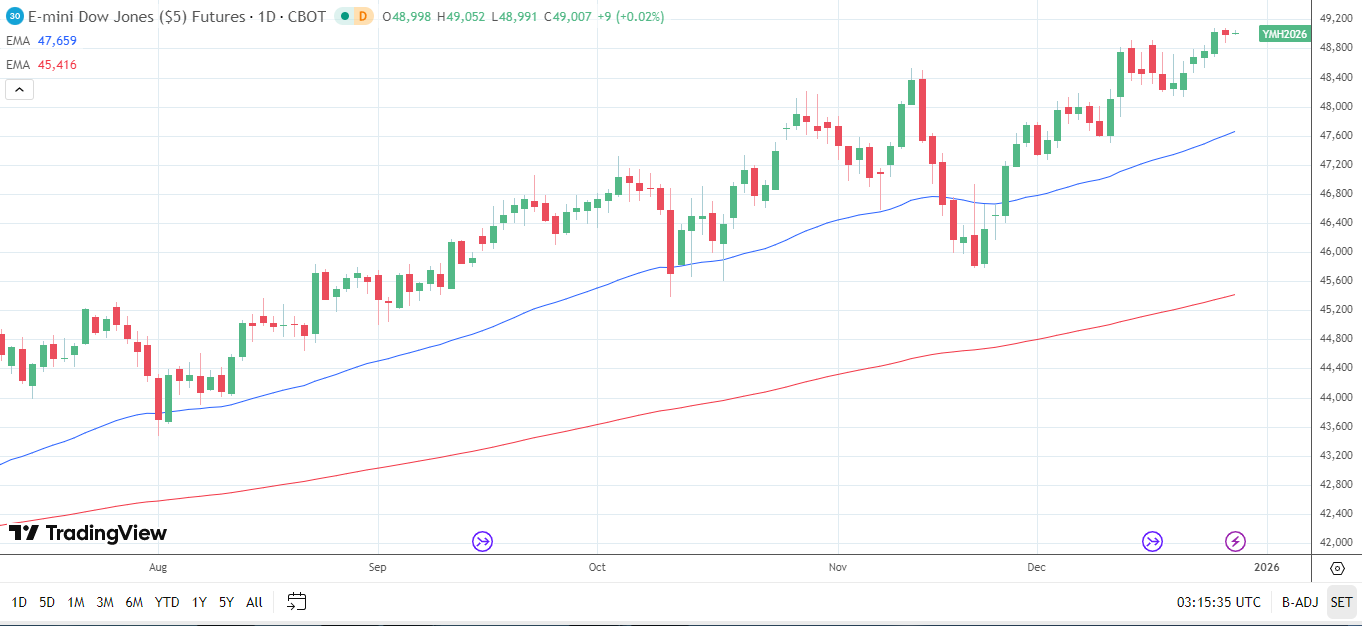
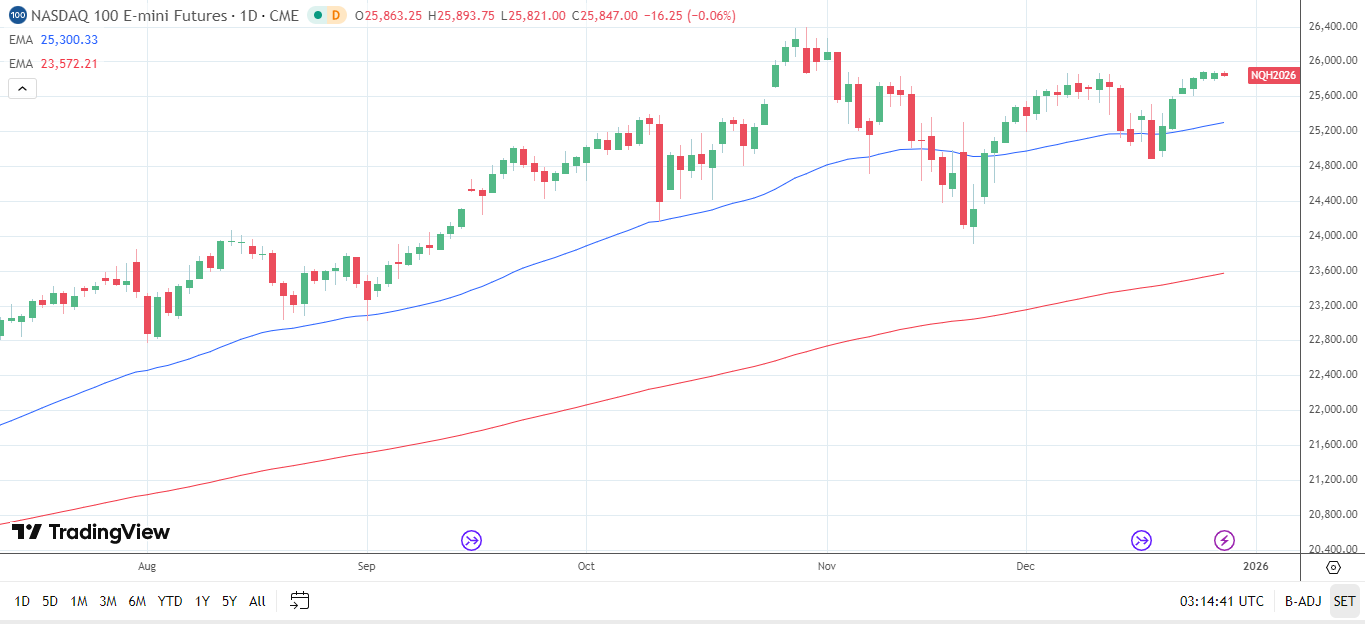
Despite the mixed Monday morning session, the Dow Jones E-mini, the Nasdaq 100 E-mini, and the S&P 500 E-mini remained above their 50-day and 200-day EMAs. The EMAs indicated a bullish short- to medium-term bias, aligning with the positive outlook.
Near-term trends remain hinged on US data, Fed chatter, and BoJ’s policy stance. Key levels to monitor include:
Dow Jones
- Resistance: The December 26 record high of 49,086, and then 49,500.
- Support: 48,500 and then the 50-day EMA (47,659).
Nasdaq 100
- Resistance: 26,000 and then the October 30 record high of 26,399.
- Support: the 50-day EMA (25,300) and then 24,500.
S&P 500
- Resistance: the December 26 record high of 6,988, and then 7,000.
- Support: the 50-day EMA (6,813) and then 6,500.

Bullish Medium-Term Outlook: BoJ and Fed Guidance Key
In my opinion, the short-term price outlook remains bullish, considering the fundamentals and technicals. Additionally, speculation about an incoming Fed Chair favoring loose monetary policy affirms the positive medium-term outlook.
However, several scenarios would likely counter the constructive medium-term bias, including:
- The Bank of Japan announces a neutral interest rate of between 1.5 and 2.5% and hints at multiple rate hikes.
- Strong US data and hawkish Fed rhetoric lower bets on a Fed rate cut.
Conclusion: Outlook Bullish
In summary, a robust US economy, support for further Fed rate cuts, the US-China AI race, and a cautious BoJ support a bullish short- to medium-term outlook for US stock futures.
However, traders should closely monitor USD/JPY, 10-year JGB yield, and Nikkei 225 trends after the Summary of Opinions.
Yen intervention warnings and hawkish BoJ rhetoric could send JGB yields higher and USD/JPY lower, potentially derailing the bullish outlook.
Key moves to watch include a USD/JPY drop below 150 and 10-year JGB yields reaching the December 22 high of 2.1%. These levels would likely drag the Nikkei 225 lower, weighing on demand for US risk assets.
Despite the chances of another BoJ hike, US stock futures have the potential to reach new highs as the year-end looms.
Follow our live coverage and consult the economic calendar for real-time market updates.