
US stock futures edged higher on Friday, January 23, extending their gains from the previous session as the Bank of Japan kept interest rates at 0.75%.
Japanese inflation cooled in December, tempering bets on an April Bank of Japan rate hike. The USD/JPY advanced while 10-year Japanese Government Bond (JGB) yields dipped in the Asian morning session.
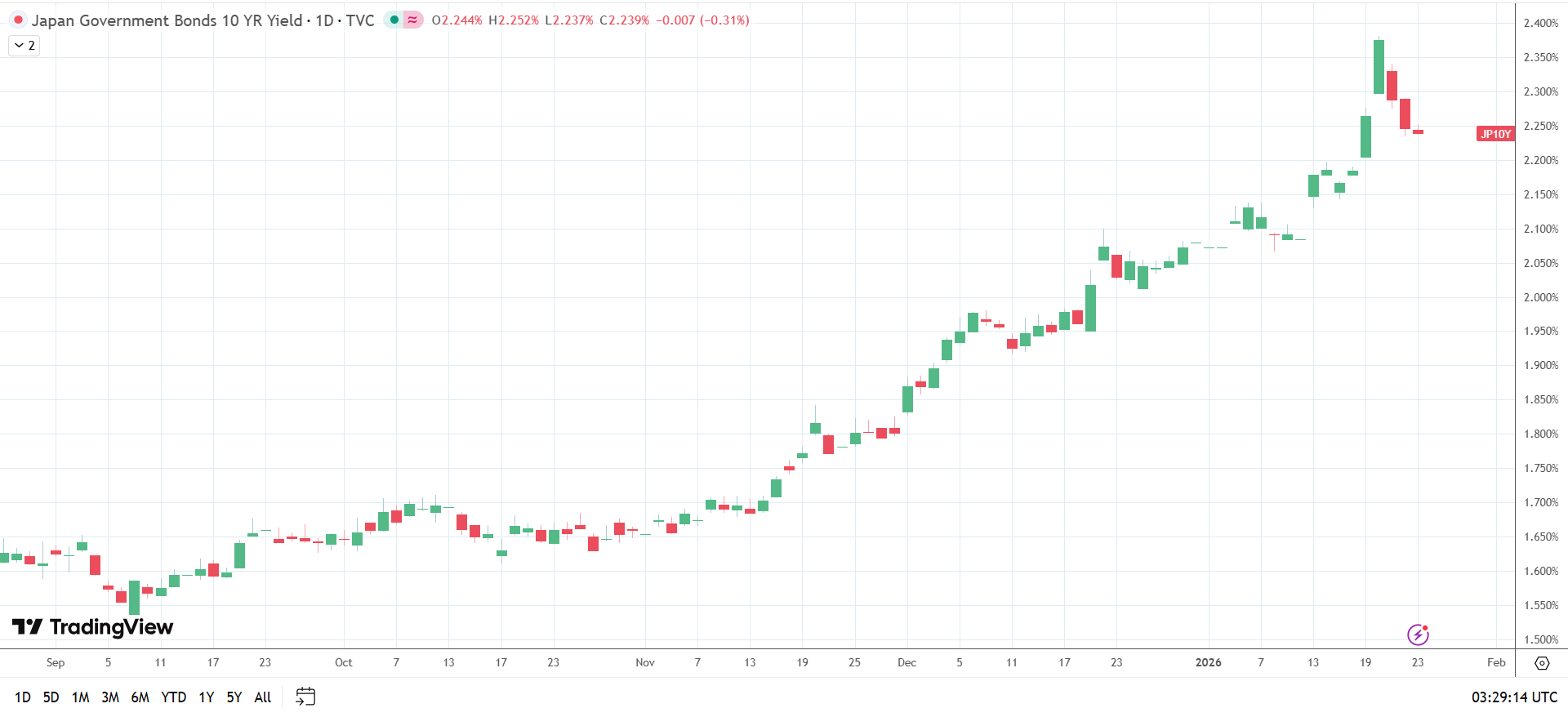
However, a sharp pickup in Japan’s service sector activity, rising employment, and higher prices supported a hawkish BoJ rate path, capping demand for risk assets.
Despite a potentially hawkish BoJ policy stance, expectations of a Fed rate cut in H1 2026, a robust US economy, and optimism toward Q4 earnings continue to support a bullish medium-term outlook for US stock futures.
Below, I’ll outline the key market drivers, the medium-term outlook, and the key technical levels traders should watch.

Bank of Japan Maintains Interest Rates
The Bank of Japan took center stage on January 23 amid speculation of a sooner-than-expected rate hike. While the BoJ left interest rates at 0.75%, the Bank’s Quarterly Outlook Report compared the projections from the previous Outlook Report, stating:
“Comparing the projection with those presented in the previous Outlook for Economic Activity and Prices (Outlook Report), the projected real GDP growth rates for fiscal 2025 and 2026 are somewhat higher, mainly due to the effects of the government’s economic measures; on the other hand, the projected growth rate for fiscal 2027 is somewhat lower. The projected year-on-year rates of increase in the CPI (all items less fresh food) are more or less unchanged.”
USD/JPY briefly dropped to a low of 158.497 before climbing to a high of 158.656 shortly after markets reacted to the decision and the Outlook Report. 10-year Japanese Government Bond (JGB) yields were down in morning trading in the Asian session. However, USD/JPY and 10-year JGB yields saw relatively modest moves, with traders awaiting Bank of Japan Governor Kazuo Ueda’s press conference. The pullback in yields and weaker yen bolstered support for risk assets such as US equity futures.
Dow Jones Price Forecast
Every new Dow Jones analysis as it publishes, today's technical signal and key levels, live price — on one page.
See all Dow Jones forecasts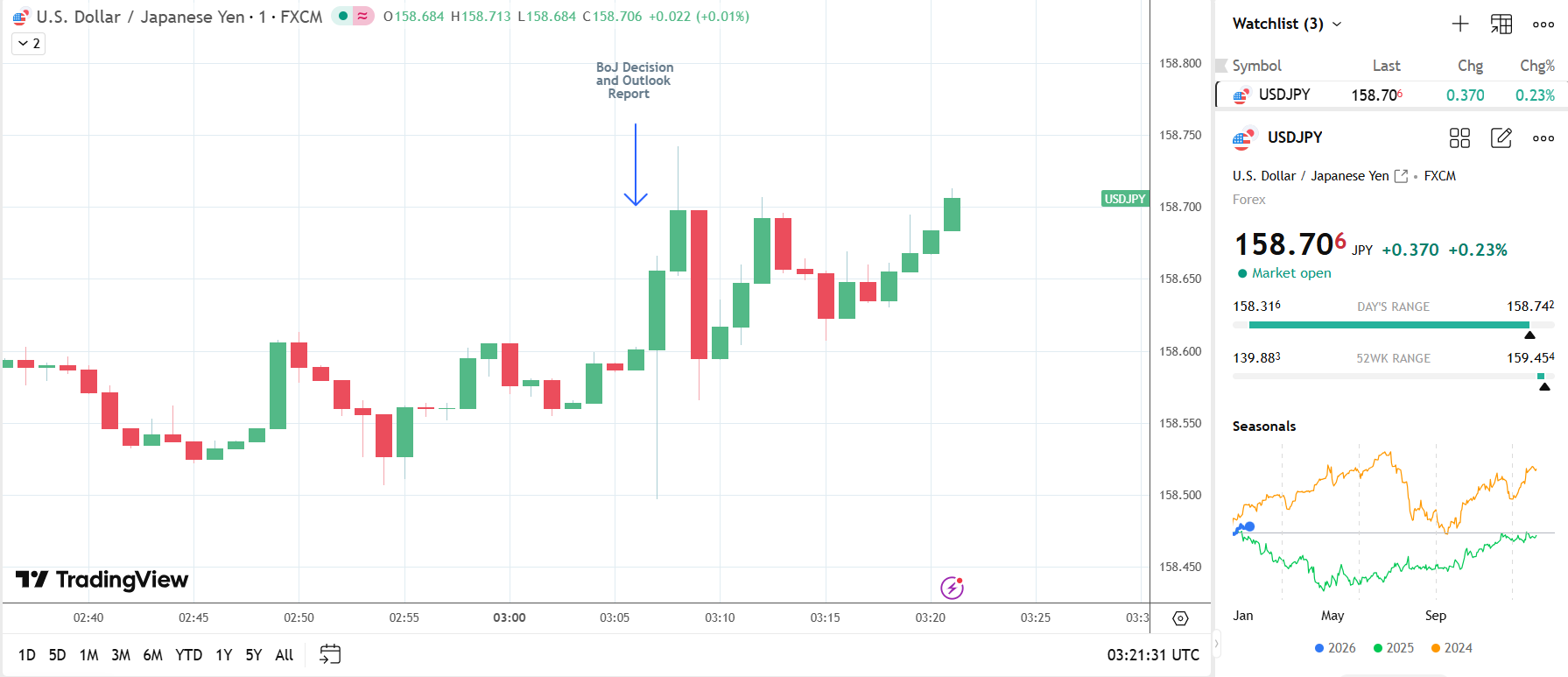
Japanese Inflation and PMI Numbers Support a Hawkish BoJ Policy Stance
Ahead of the monetary policy decision, Japanese economic indicators sent mixed signals, fueling uncertainty about the BoJ’s rate path.
Headline inflation dropped from 2.9% in November to 2.1% in December, while ‘core-core’ inflation slipped from 3% to 2.9% in December. Meanwhile, the S&P Global Japan Services PMI rose from 51.6 in December to 53.4 in January. Importantly, labor market conditions tightened, with selling prices higher, supporting a more hawkish BoJ policy stance.
Ahead of the BoJ monetary policy decision, East Asia Econ commented on the PMI numbers and the monetary policy, stating:
“With the tariff impact being weaker than feared, and consumer confidence bouncing back strongly, today’s PMI suggests economic momentum in Japan is accelerating. Politics aside, lots of room for BoJ to sound more hawkish today.”
Crucially, a hawkish BoJ Governor Ueda press conference would likely influence risk sentiment. The prospect of narrower US-Japan rate differentials would make yen carry trades into US assets less profitable, potentially triggering a yen carry trade unwind as seen in mid-2024.
For context, Prime Minister Sanae Takaichi’s fiscal policy goals and the weaker yen are expected to fuel inflationary pressures. These factors have raised expectations of a hawkish BoJ policy stance.
US Services Sector and Earnings in Focus
US futures eyed a three-day winning streak during the Asian morning session on January 23. The Dow Jones E-mini and the Nasdaq 100 E-mini advanced 39 points and 32 points, respectively, while the S&P 500 E-mini advanced 11 points.
Later Friday, US services sector PMI data will influence market bets on a June Fed rate cut. Economists forecast the S&P Global Services PMI to increase from 52.5 in December to 52.8 in January. A higher PMI reading would signal a pickup in economic momentum, given that the services sector contributes roughly 80% to US GDP. The US economy expanded 4.4% quarter-on-quarter in Q3, up from 3.8% in the second quarter.
Beyond the headline PMI, traders should consider employment and price trends. Importantly, weaker prices charged would overshadow the headline PMI and signal lower consumer prices. A softer inflation outlook would support a more dovish Fed rate path, boosting demand for US equity futures.
Other economic data on Friday includes the S&P Global US Manufacturing PMI and finalized US consumer sentiment numbers for January. However, the Services PMI will likely be the key driver.
Key Technical Levels for Dow Jones, Nasdaq 100, and S&P 500
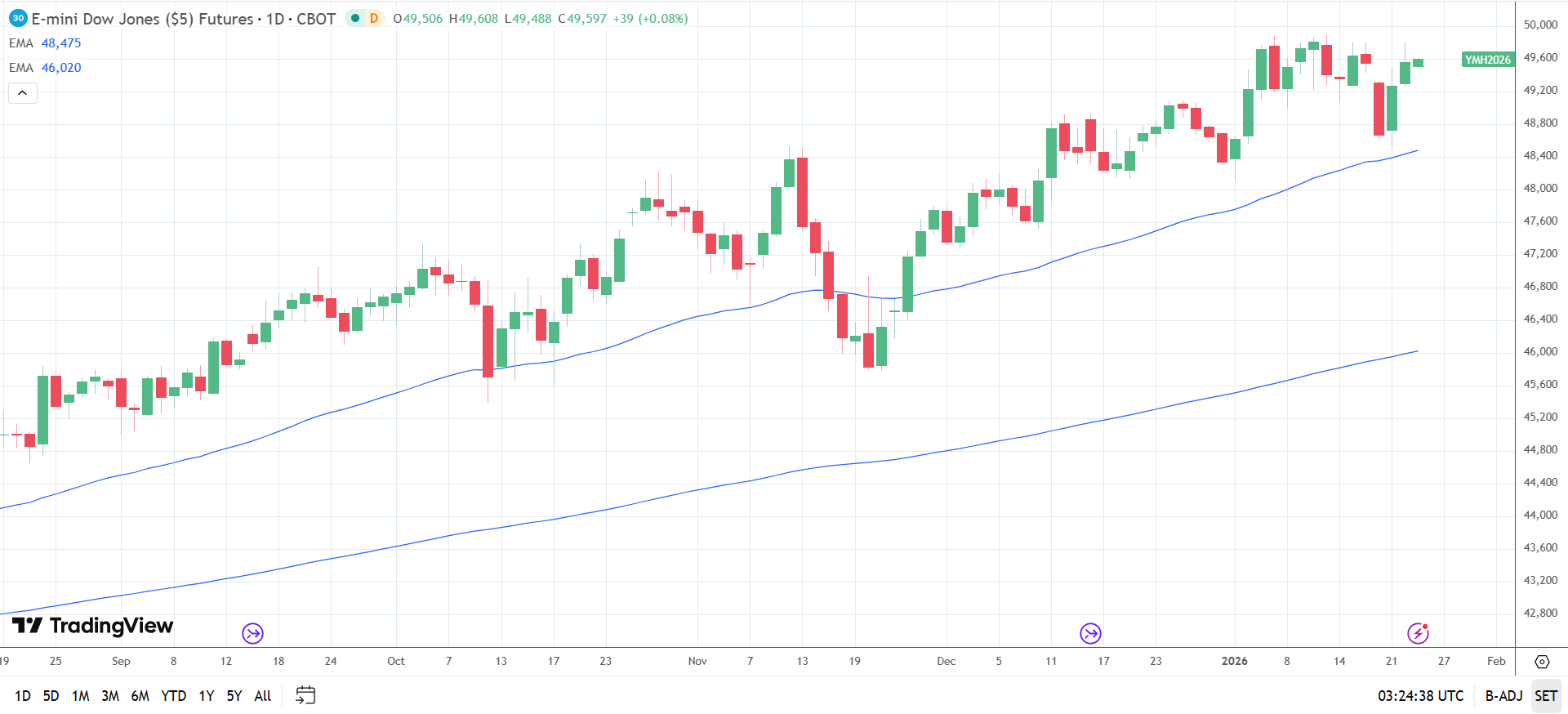
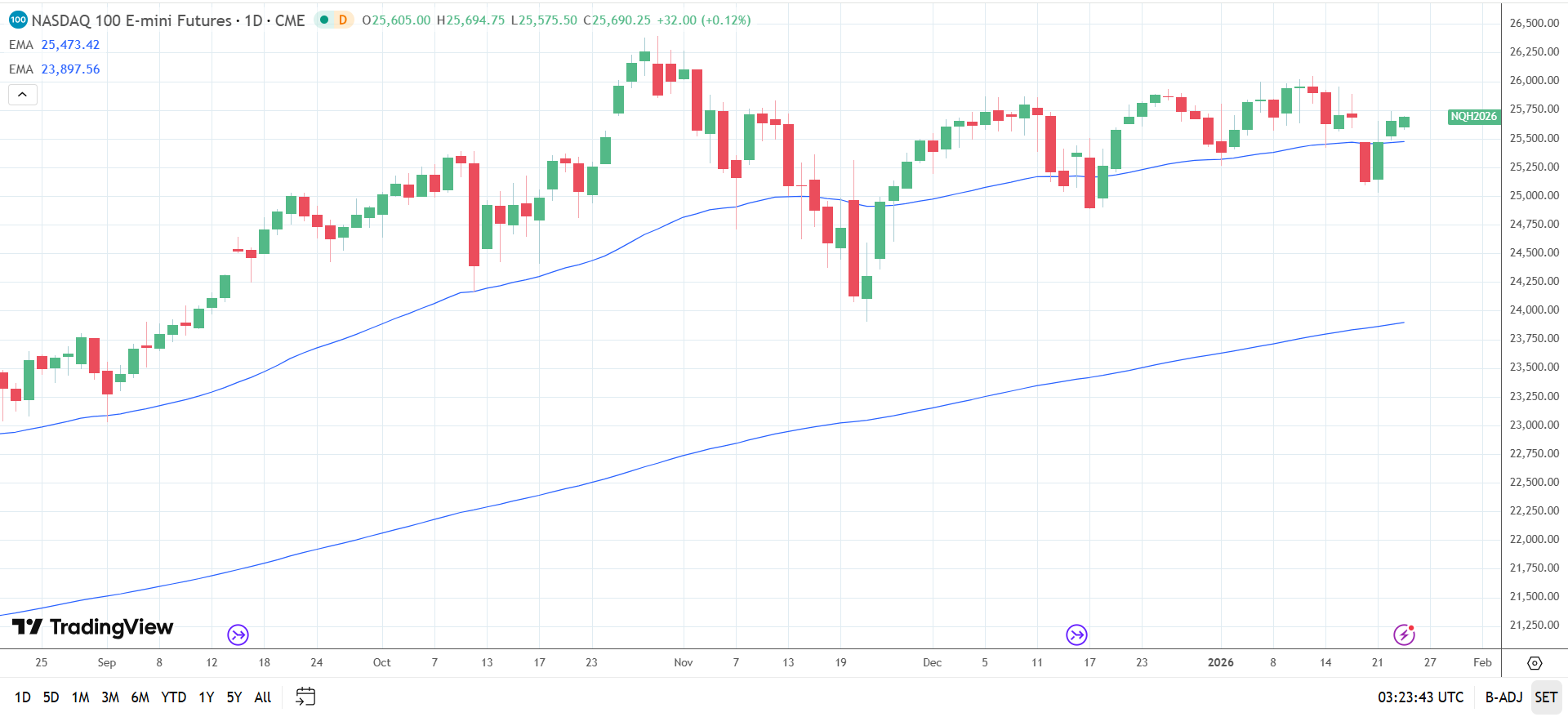
Following the morning gains, the Dow Jones E-mini, the Nasdaq 100 E-mini, and the S&P 500 E-mini remained above their 50-day and 200-day EMAs. The EMAs signaled bullish momentum, aligning with positive fundamentals.
Near-term trends will hinge on geopolitical headlines, the BoJ’s forward guidance, earnings, and US economic data. Key levels to monitor include:
Dow Jones
- Resistance: the January 13 record high of 49,901, and then 50,000.
- Support: 49,000 followed by the 50-day EMA (48,475).
Nasdaq 100
- Resistance: 26,000, followed by the October 30 record high of 26,399.
- Support: the 50-day EMA (25,473), 25,000, and then 24,500.
S&P 500
- Resistance: the January 13 high of 7,036, followed by 7,500.
- Support: the 50-day EMA (6,881) and then 6,500.
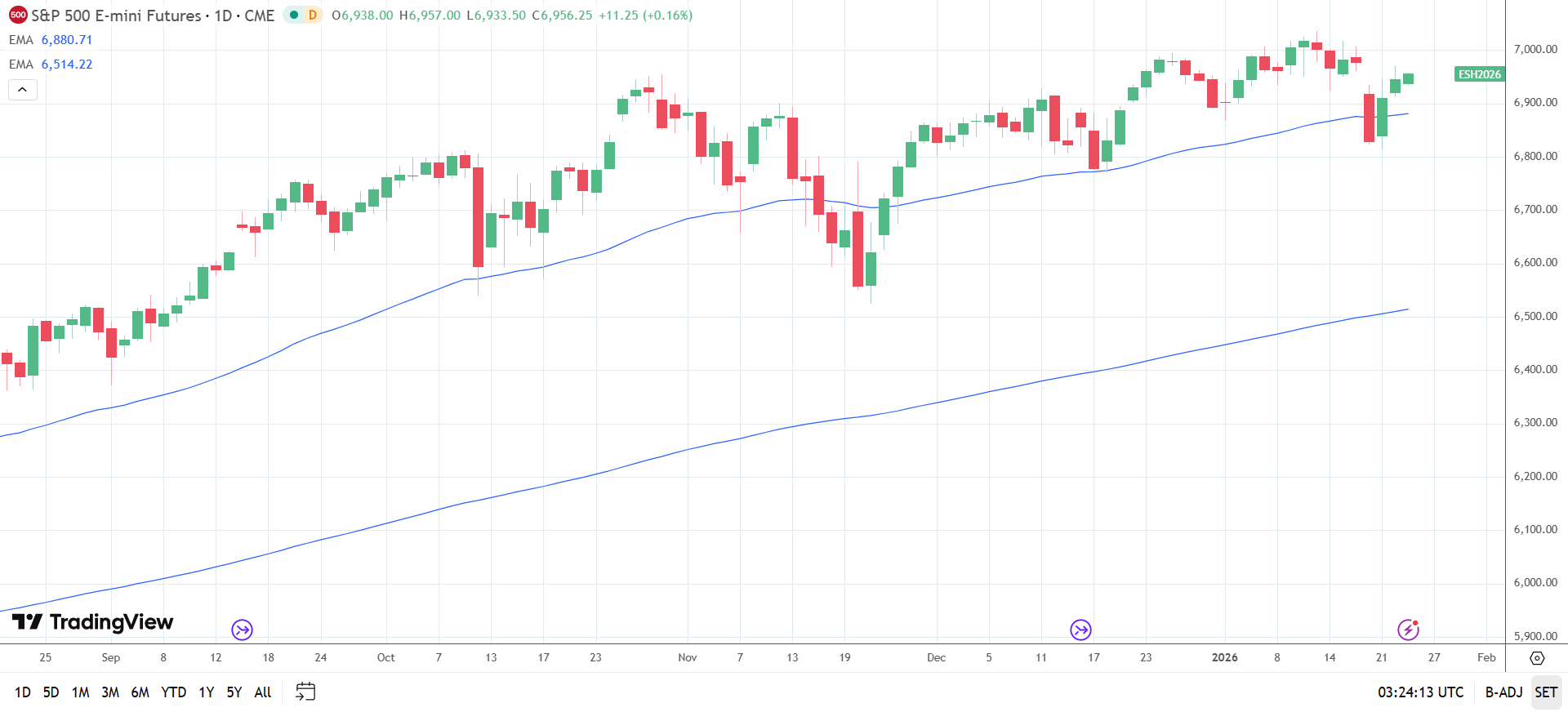
Outlook: Fed Rate Cut Bets, Economic Momentum, and Earnings Maintain Bullish Bias
In my opinion, the short-term price outlook remains bullish. Market expectations of a Fed rate cut in H1 2026, and optimism over Q4 earnings, reaffirm the constructive bias. These fundamentals align with bullish technicals for US equity futures.
However, several events would derail the bullish medium-term outlook, including:
- Increased geopolitical risk.
- The Bank of Japan announces a hawkish neutral interest rate (potentially 1.5%-2.5%). A narrower US-Japan rate differential may trigger a yen carry trade unwind, as seen in mid-2024. A yen carry trade unwind would invalidate the short-term outlook.
- Strong US data and hawkish Fed forward guidance would cool bets on multiple Fed rate cuts.
- Corporate earnings and outlooks disappoint.
Conclusion: Bullish Bias Intact
In summary, the strong US economy, a dovish Fed rate path, and upbeat earnings affirm a bullish short- and medium-term outlook for US stock futures.
However, traders should closely monitor Bank of Japan Governor Ueda’s press conference. A hawkish monetary policy outlook and signals of a higher neutral rate could raise the risk of a yen carry trade unwind.
Despite the risk of a hawkish BoJ outlook, US stock futures remain on target for new highs if US economic data fuels expectations of a June Fed rate cut. Fed rate cuts would have a more lasting influence on stocks than a hawkish BoJ policy stance.
Follow our live coverage and consult the economic calendar for real-time market updates.