Latest developments show that US forces struck boats and missile sites in Iran – what it called ‘self-defence strikes’ – which Tehran has described as a ‘gross violation’ of the ceasefire.
Oil Prices Lower, Stocks Gaining & Yields Bull-flattening
Oil prices were bid higher following yesterday’s developments, largely buffeted by complex negotiations between Iran and the US. However, both Brent and WTI are on the back foot in early European trading this morning, down more than 1%, respectively.
In the equities space, US benchmarks largely continued to march higher, seemingly overlooking geopolitical risks and focussing on optimism around AI. Both the S&P and Nasdaq 100 notched fresh records, while the Dow fell by around 0.2%.
For bonds, global yields bull flattened amid hopes of a resolution in the Middle East, with the benchmark 10-year yield closing Tuesday at 4.49%. Bond investors seem to be pricing in a near-term resolution here – I guess as long as there is optimism, yields will continue to fall as concerns for inflation expectations ease.
The US Consumer Remains Concerned
Following the University of Michigan’s May consumer sentiment survey, which came in much lower at 44.8 (from 49.8), the Conference Board’s May consumer confidence report yesterday was 93.1, above the consensus of 92.0 but below April’s upwardly revised reading of 93.8.
Yesterday’s numbers painted a slightly less alarming picture, albeit one of deterioration. Despite this, both reports underscore that while consumers are still spending, there is clearly a growing reluctance, shrinking confidence, and rising anxiety. Unsurprisingly, key concerns among consumers are elevated oil and gas prices and the conflict in the Middle East.
Soft Aussie CPI & Hawkish RBNZ Set Up AUD/NZD Shorts
Overnight, we had quite a busy session. First to land was the April Australian CPI inflation data, which showed the YY headline number easing to 4.2% from 4.6% in March, while the YY trimmed-mean gauge rose by 3.4% from 3.3% – above the RBA’s 2-3% target band.
Clearly, while traders focussed on the headline number, the rise in the core measure does underscore that possible second-round effects may be beginning to materialise. The report immediately sent the AUD southbound against major peers as markets priced out tightening expectations for June’s meeting, with around 20 bps now implied by year-end.
On top of this, an update from the RBNZ made the airwaves shortly after the Aussie CPI print, with the central bank keeping the official cash rate unchanged at 2.25% for a third consecutive meeting. For those who read my preview yesterday, my base case was a hawkish hold, with a focus on statement language, which played out.
However, what did catch me off guard was the three members voting for an immediate hike, with RBNZ Governor Breman’s casting vote alone keeping rates on hold. This was notably more hawkish than markets had anticipated, given that there was only around a 20% probability (6 bps) of a hike ahead of the meeting. It was certainly a close call.
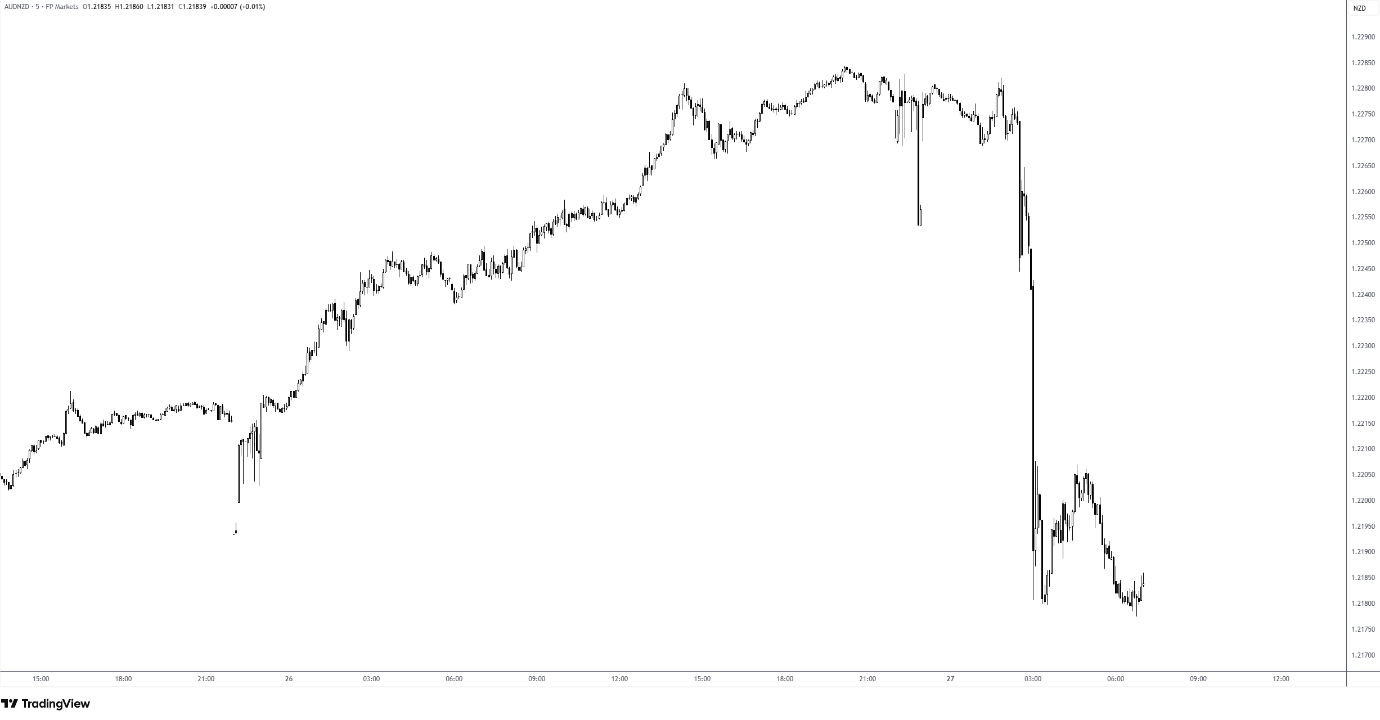
Additionally, all members agreed that the future holds further policy firming, which was key, and that this sent the NZD northbound. This, alongside the weaker-than-expected Aussie headline CPI and the hawkish RBNZ, opened the door to a solid opportunity to scalp out of these events, as shown below on the M5 AUD/NZD chart.
Day Ahead
Despite Dallas Fed President Lorie Logan and Governor Lisa Cook speaking today, the day ahead offers a thin data slate, with traders now looking forward to the April US PCE price index figures.
Written by FP Markets Chief Market Analyst Aaron Hill