
Equities Tread Water as Headlines Dominate
We are well and truly beholden to the evolving developments in the Middle East conflict, with sentiment driven by geopolitical headlines rather than macro fundamentals. It seems today is once again going to be about weighing up de-escalatory and escalatory news flow!
US stocks continue to deal with hopes and fears as President Trump claimed ceasefire talks were underway, only for Iran to flatly deny any such dialogue. Equities are clearly trying to find their footing amid the back-and-forth headlines.
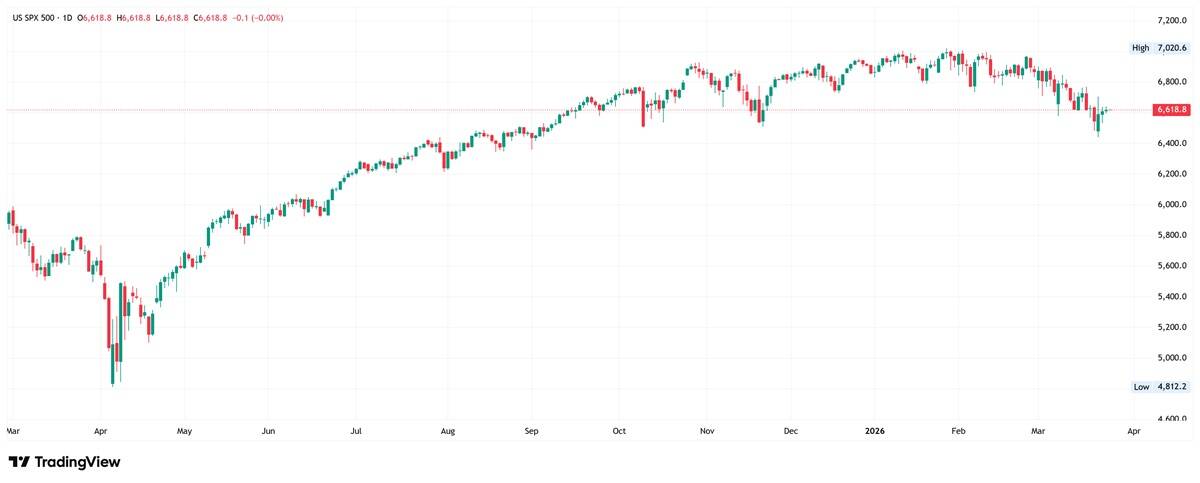
The S&P 500 dipped 24 points (0.4%) to 6,556. Under the hood, 286 names ended the session higher, and 217 printed losses. Sector performance showed more green than red, with energy getting a bump – up around 2.0% – while communication services led losses.
Elsewhere, the Nasdaq 100 was down 186 points (0.8%) to 24,002, while the Dow Jones shed 84 points (0.2%) to 46,124. Of note, said indexes are exploring space south of their 200-day SMAs; however, it must be said that we are quite a way off from seeing a ‘Death Cross’, which ‘can’ signal a long-term downtrend – time will tell.

Oil and FX
Oil prices are lower this morning; Brent Crude dipped back under the widely watched US$100/barrel mark and is down 3.6% to reach US$96 as of writing. This came on the heels of Iran signalling that transit through the Strait of Hormuz was possible, but only under certain conditions. Reports that the US delivered a 15-point ceasefire plan to Tehran also recently made the airwaves.
In FX, the USD index wrapped up Tuesday’s session off best levels; this followed Monday’s 0.4% fall. The USD – like most of us – is clearly hesitant, with FX remaining broadly rangebound for now. US Treasury yields rose after a weak two-year auction, with the two-year yield reaching 3.963% intraday.
AUD/USD Price Forecast
Every new AUD/USD analysis as it publishes, today's technical signal and key levels, live price — on one page.
See all AUD/USD forecastsMacro Space
The March S&P Global PMIs were in focus yesterday – particularly across Europe, the UK, and the US – and collectively saw manufacturing activity strengthen while the services sector underperformed. I think this simply boils down to how the conflict and surging energy prices impact different sectors.
Aussie inflation eases, but the war distorts the picture
Overnight, the February Australian CPI inflation data showed YY price pressures marginally eased both on the headline front – 3.7% from 3.8% in January – and the trimmed mean, which is the RBA’s preferred core measure, cooled to 3.3% from 3.4%. As you would expect, the market reaction witnessed a modest spike lower in the AUD, before swiftly regaining some poise. The issue is that these data fail to reflect the disruption caused by the war in the Middle East.
This report also follows the RBA hiking the cash rate by 25 bps to 4.10% at its second consecutive meeting, a move largely driven by higher inflationary expectations. Although the RBA’s hawkish stance should underpin the AUD, you have to account for the fact that the last decision was a narrow 5-4 vote split, and given the USD’s strength since early February and volatility in the commodities complex, it is far from a one-way street for the AUD.
UK CPI Inflation: A Steady Reading Before the Storm?
Finally, the February UK CPI inflation numbers landed earlier this morning and barely moved the markets. We have seen a moderate dovish repricing since GILTs opened this morning, but it is really nothing to write home about. The BoE is still widely expected to increase the bank rate in April to 4.00% from 3.75% (investors are now assigning a 70% probability). Much like the Aussie inflation print, the UK data are backwards-looking, and you will expect the March inflation picture to be different, as it will factor in the Middle East disruptions.
Ultimately, headline YY inflation remained steady at 3.0%, while YY core inflation – which excludes energy, food, alcohol, and tobacco – rose modestly to 3.2% from 3.1% in January. The widely watched YY services figure, however, eased to 4.3% from 4.4%. Overall, this was a steady reading, with motor fuels dragging price pressures lower.
In theory, rate-hike expectations should support the GBP, as higher yields tend to attract capital inflows. With that said, the market is also expecting economic damage from the elevated energy prices, which, of course, could undermine a hawkish BoE. The net effect is a currency under pressure from both directions: geopolitical risk and growth concerns on one side, and potential hawkish policy on the other. Until more clarity on how sustained the oil spike will be, expect continued volatility.
Written by FP Markets Chief Market Analyst Aaron Hill