It was an eventful week, chock-full of central bank announcements. Last week’s policy decisions were ultimately shaped by the Middle East conflict and its inflationary impact through energy markets. Brent crude has topped US$119/barrel this month and is up about 50%, while WTI – although remaining elevated – has been somewhat contained south of US$100.
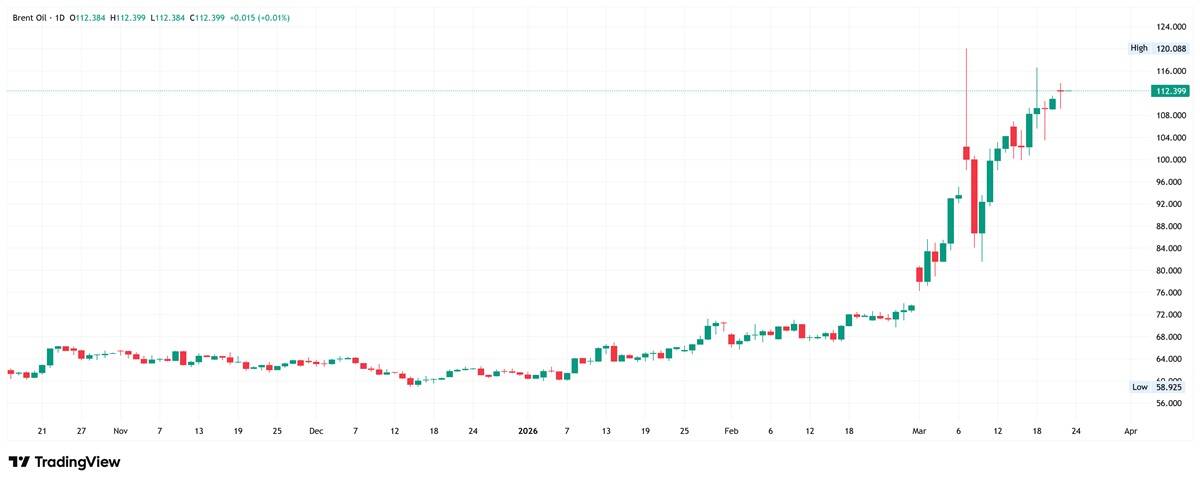
While we all have our own views on current developments, there are two principal ways the Middle East conflict could play out. First, a resolution, or ceasefire. Second, there is a prolonged conflict.
A de-escalation would obviously be the better of the two options, not only on a humanitarian ground, but also from the market’s perspective. A resolution would prompt an unwind in rate-hike expectations and, of course, energy prices would fall. Naturally, the quicker a resolution, the faster the market moves. A prolonged conflict will likely keep energy prices elevated and heighten stagflation risk, as global growth would take a sizeable hit, triggering a risk-off move that would benefit safe havens.
As of writing, and unless I missed something over the weekend, the conflict is not slowing, and it is now in its fourth week. US President Donald Trump, despite his comments, appears to be caught between a rock and a hard place, and it is all about the Strait of Hormuz.
Central Banks Do Not Have a Crystal Ball
Aside from the RBA – which raised its cash rate by 25 bps to 4.10%, albeit just with a narrow 5-4 vote split – several central banks also kept their policy rates steady.
While we did have some central bank officials comment on rate hikes, I cannot help but think the week was a case of markets writing cheques the central banks had not signed. Frankly, not one bank explicitly committed to policy tightening.
Ultimately, central banks do not have a crystal ball, and unless you are privy to the inner workings of the Department of War, you (we) have absolutely no idea how long this conflict will last. This is what will determine the medium-term outlook for inflation. If a resolution comes in thick and fast, this will be a temporary price shock and follow-on effects should be minor. However, a prolonged war and continued elevated energy prices would be particularly destructive, feeding through to the broader economy and causing ripple effects on wages and food, for example, which would likely lead central banks to actually increase rates. Time will tell.
We have to remember that this price shock is effectively out of the control of central banks; they cannot print oil.
Central bank rate decisions are fundamentally a demand-side instrument. But the inflationary pressure we are facing is supply-side in origin. Raising rates does not pump a single extra barrel out of the ground or re-route a pipeline. At best, it destroys demand enough to offset the price shock; at worst, it kills growth while prices remain elevated – the very definition of stagflation.
AUD/USD Price Forecast
Every new AUD/USD analysis as it publishes, today's technical signal and key levels, live price — on one page.
See all AUD/USD forecastsIt Is a Case of Wait-and-see for Central Banks Now
Federal Reserve
The Fed stood pat on rates, holding the target range at 3.50-3.75%. The updated economic projections from the quarterly SEP drew some attention as PCE inflation was revised higher this year and in 2027, with the 2% target expected to be hit in 2028. Surprisingly, real GDP growth was raised across all horizons, but the dot plot still shows one rate cut this year, with a follow-up cut next year. Investors have priced out all cuts for this year and moved the first 25-bp reduction to March 2027, pushing back from nearly three cuts at the beginning of this year.
Chairman Jerome Powell was obviously questioned on the Middle East conflict, and his response, quite understandably, was essentially it is anybody’s guess how long this goes on from. He declined to offer specifics, echoed a wait-and-see stance, and noted that the Fed is monitoring ‘leakage’. This is a term used to describe the ‘indirect effects’, or mechanical pass-through of energy as an input cost to show up in core PCE, which excludes direct energy sales.
For the USD, the bias remains bullish for now, bolstered by safe-haven demand, reduced expectations of Fed easing, and the fact that the US economy is positioned as a net oil exporter. As long as the conflict continues and headlines remain flowing, the USD will likely remain bid.
The data docket is rather thin stateside this week, but we do have the US March S&P Global manufacturing and services PMIs landing on Tuesday. These data provide a snapshot of the US economy following last week’s Fed meeting and will include the initial impact of the war in the Middle East. As usual, the prices paid, employment, and new orders sub-indexes could be worth noting, and may feed into USD upside if prices come in strong (employment lower), though conflict-driven headlines will remain the dominant driver this week.
Bank of England
Out of all the central bank announcements last week, the BoE was perhaps the most eventful. From a 5-4 vote to hold the bank rate at 3.75% in February to a clean 9-0 sweep to hold last week, markets were firmly tilted hawkishly.
Uber dove Swati Dhingra shifting to the hold camp likely catching the market’s attention. Not only was Dhingra voting to cut a surprise – and even noted the prospect of rate hikes – but it was also the first time in more than four years that the MPC voted unanimously.
The front end of the GILT curve sold off sharply, and investors have now priced in more than three rate hikes by year-end. This is quite something, as a little over two weeks ago, markets were pricing in two cuts! The GBP did not offer much of a reaction. The 9-0 vote was the trigger, but the reason markets repriced so violently is that the UK’s underlying inflation dynamics – driven heavily by gas dependency – mean the BoE has a harder and longer job ahead of it than its peers. A resolution in the Middle East could reverse the hawkish repricing quite quickly. Ultimately, no one knows how long the conflict will last, and the BoE is clearly keeping its options open ahead of the April meeting.
Following the announcement, I noted the following:
‘Hiking the BoE bank rate when output is low, inflation high, and the jobs market softening is unlikely to end well for the UK economy. I believe this could be beneficial for GBP in the short term due to the rate-differential story, but the sustainability of that support entirely depends on how the energy shock develops’.
In terms of macro drivers this week, we have the UK March manufacturing and services PMIs out on Tuesday, along with the February CPI inflation report on Wednesday. While I think the inflation data is unlikely to offer little, the PMIs could be a print to watch because this will be one of the first since the US-Iran war broke out and follows the BoE’s hawkish stance last week. Ultimately, prices and employment sub-indexes will be key to watch.
European Central Bank
The ECB also left all three key benchmark rates unchanged for a sixth consecutive meeting and offered little in the way of explicit guidance. The central bank offered updated Staff projections that include the ripple effects of the conflict, showing inflation increasing to 2.6% this year and growth revised lower to 0.9%. In other words, Europeans face the prospect of higher energy prices and producing less: stagflation.
The Council stressed it is well-positioned to navigate the uncertainty, given that inflation had been running around target and expectations remained well anchored, but flagged that a prolonged supply disruption could push inflation further above target and growth further below the baseline. As with the BoE, the ECB is keeping its options open, reaffirming its data-dependent, meeting-by-meeting approach and explicitly declining to pre-commit to any rate path.
Although there was a somewhat hawkish tilt to the event, the overall message was one of calm with nothing said to offset current market pricing. Note that the week ended with pricing a whopping 76 bps of tightening by year-end. You can assume that if the ECB does push forward with rate hikes that we will see the deposit rate nudge north of the estimated neutral range of 1.75-2.25%.
Despite headline-driven flow still front and centre for the market, the March eurozone S&P Global manufacturing and services PMIs on Tuesday will be an interesting watch on the back of the recent scenarios put forth by the ECB. Ultimately, talks of a resolution in the Middle East should underpin the EUR, while prolonged conflict should weigh on Europe’s shared currency.
Written by FP Markets Chief Market Analyst Aaron Hill