



Gold (XAU) surged above $3,400 on Tuesday due to increased safe-haven demand. Chinese markets reopened after a long holiday, boosting liquidity and trading activity. Moreover, rising geopolitical tensions between India and Pakistan fueled the rally. Reports of Indian strikes on terrorist camps and warnings from Pakistan’s defense chief heightened fears of war. Investors turned to gold as a protective asset amid the growing uncertainty.
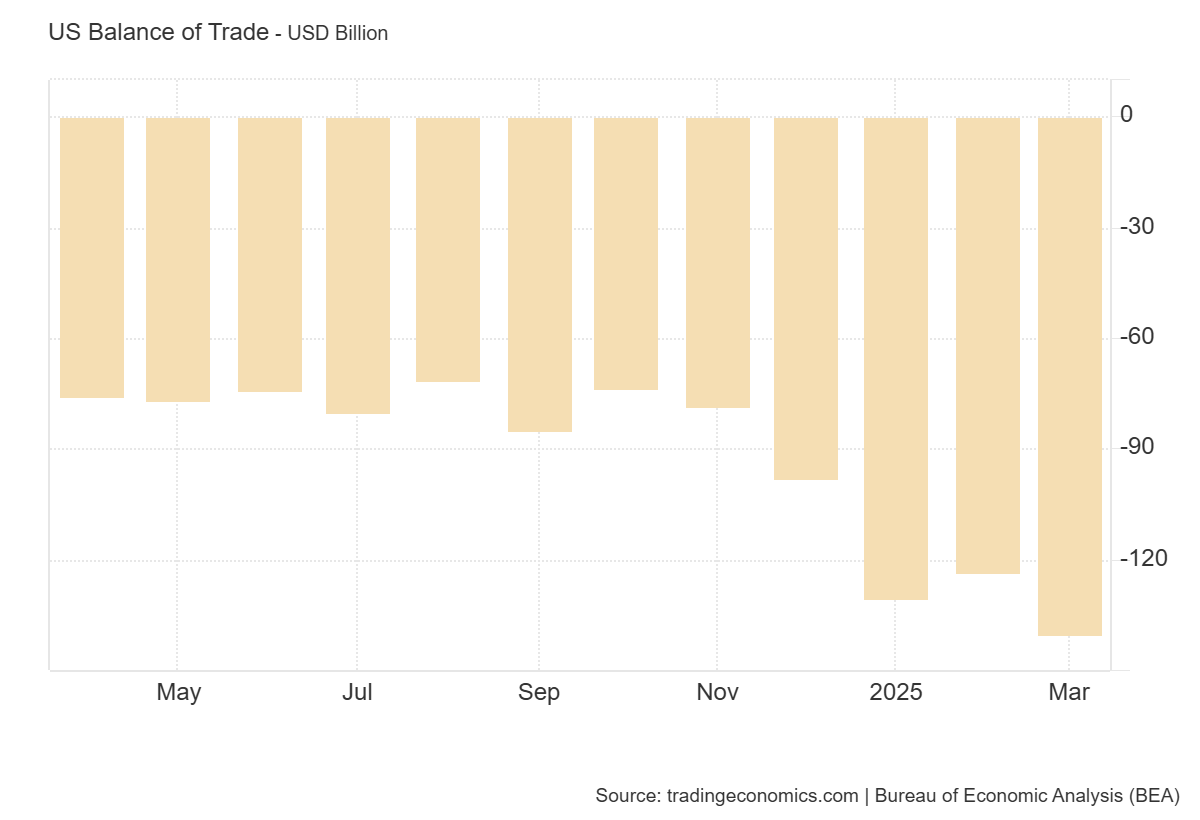
On the other hand, US trade policy also supported gold’s rise. President Trump’s remarks about dictating tariff levels created market anxiety. The chart below shows that the US trade deficit widened to over $137 billion, exceeding February’s $123.2 billion. This weak economic data further boosted gold’s appeal as investors priced in trade instability.
Moreover, US Treasury yields show uncertainty, fluctuating from 4.0% to 4.5%, further strengthening the bullish case for gold. Markets expect the Fed to keep rates steady, while attention shifts to Jerome Powell’s tone during the press conference. With rising global conflicts and uncertainty around US trade policy, gold continues to attract defensive flows.
Gold (XAU) Technical Analysis
Gold Daily Chart – Price Surge
The daily gold chart shows that the price remains uptrend within a rising channel. The correction from $3,500 found support at $3,200 and faced resistance near $3,370, aligning with the upper boundary of an ascending broadening wedge. The chart shows multiple bullish patterns, confirming strong upward momentum.
Moreover, the RSI bounced near 50 and approached overbought levels, indicating solid buying pressure. However, bearish divergence on the RSI and rejection at the upper channel show the risk of a potential short-term pullback. A break above $3,500 would open the door toward the $4,000 level.

Gold Price Forecast
Every new Gold analysis as it publishes, today's technical signal and key levels, live price — on one page.
See all Gold forecastsGold 4-Hour Chart – Bullish Price Development
The 4-hour chart for gold shows that the price continues to move within a rising channel. It formed complex inverse head-and-shoulders patterns before breaking above $3,350. This indicates that the next move in gold could be higher toward the $3,500 region.

Silver (XAG) Technical Analysis
Silver Daily Chart – Resistance of 50-Day SMA
The daily chart for silver (XAG) shows that the price remains above the 50-day and 200-day SMAs, indicating medium-term bullish strength. Recent support near the $28–$30 range held firmly during the sharp drop in April. The RSI remains above the mid-level, indicating a positive trend. The price is heading toward $35 in the short term. However, a breakout above $35 will confirm further upside, while a failure to hold $32 could trigger a retest of the 200-day SMA near $31.

Silver 4-Hour Chart – Positive Development
Silver trades near $32.89 after bouncing from strong support at $31.80. The chart shows a double bottom pattern, confirming a bullish reversal from the April lows. The price now faces resistance near $34.50, which marks the next key breakout level. RSI remains above 50, indicating steady bullish momentum without being overbought. A sustained move above $33.00 may lead to a retest of the $34.50 resistance. However, a break below $31.80 could trigger a deeper correction.

US Dollar (DXY) Technical Analysis
US Dollar Daily – Bearish Pressure
The daily chart for the US Dollar Index shows that the rebound from 98 has stalled near the 100.65 resistance, and the index continues to move lower. The chart displays a completed head and shoulders pattern, confirming a long-term bearish reversal from the 107 level. The 50-day and 200-day SMAs are trending downward, reinforcing bearish momentum.
Additionally, the RSI hovers near 40, indicating weak buying interest and limited upside potential. If the US dollar fails to break above 100.65, it may retest the recent lows around 98. A drop below 98 could extend the decline toward 96.

US Dollar 4-Hour Chart – Inverted Head and Shoulders
The 4-hour chart for the US Dollar Index shows that it trades within a descending channel. Despite a rebound driven by an inverse head-and-shoulders pattern, the index failed to break above 100.65, signaling continued bearish pressure. A break below 98 would likely extend the decline toward 96.
