Market Overview
Gold (XAU/USD) slipped for a tenth session in a row yesterday and is still teetering on the edge of 4,347 level, only just avoiding a intraday low of 4,307. Nevertheless, one key factor making that bearish trend so convincing is the hawkish tone being taken by the main central banks.
With Iran tensions simmering ever closer to a all out war, inflation concerns are creeping up and combined with expectations of tighter monetary policy from the major banks as a result, its no surprise the gold’s being driven downwards. And then theres the US dollar – which is currently looking stronger than ever – that’s only making things worse on the gold front.

Iran Tensions Push Oil Prices Higher and Keep Gold Under Pressure
As of right now, the latest word is coming out of Iran: no talks with the US about calling off the war says the new statement – and in stark contrast – Donald Trump suggesting only yesterday that a deal might be on the cards. Whats more a senior adviser Mohsen Rezaei, is also saying that the war wont be over until Iran gets full pay for the damage its suffered
Meanwhile , the war of words is escalating with Iran’s energy sites coming under fire, and the Strait of Hormuz closing, sending oil prices spiking higher and higher.
And if that’s not enough to drive prices up, it will only add to the inflation picture which will push central banks to raise interest rates – remember we mentioned how that was putting pressure on the gold price… earlier.
Strong US Dollar and Rate Hike Expectations Keep Gold Under Pressure
Back in the US, traders are now seriously starting to think that the Federal Reserve will not cut interest rates any further – and may even start raising them by the end of the year. The end result being US bond yields are going up which makes gold a much less attractive option for investors as the US dollar gets stronger.
Gold Price Forecast
Every new Gold analysis as it publishes, today's technical signal and key levels, live price — on one page.
See all Gold forecastsStill, worries about the Middle East situation aren’t going to fade away anytime soon – and all that adds up to gold being a safe haven for nervous investors.
Gold Price Forecast: XAUUSD Breaks 0.236 Fibonacci, $4,111 in Focus
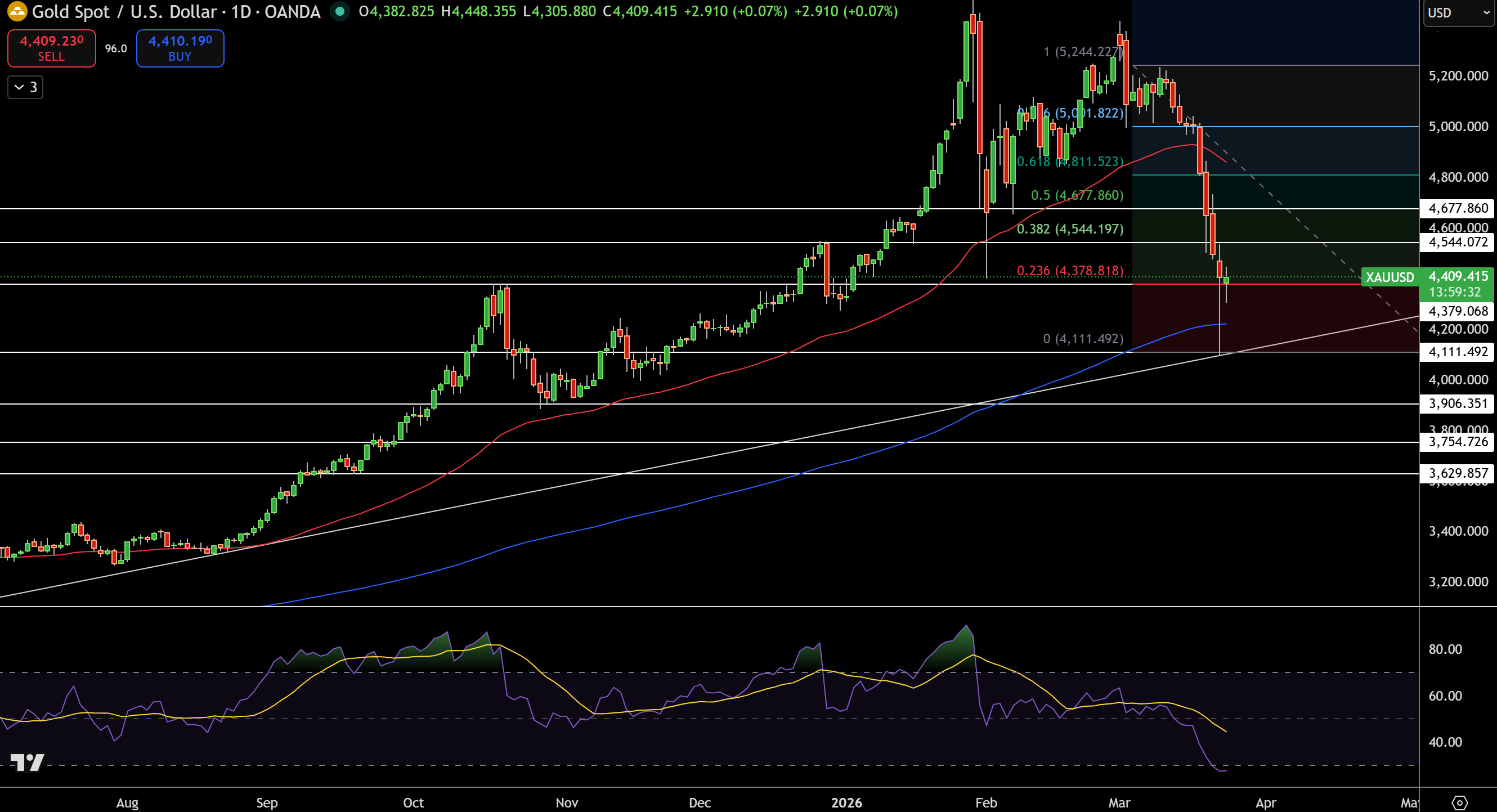
Gold on the daily chart is sitting around $4,409. Yesterdays fall below the 0.236 Fibonacci level at $4,378 suggests a deeper pullback from the price peak of $5,244. Those recent dark bearish candles aren’t doing much to ease peoples minds now that price has slipped below the 50 Day Moving Average. we do have the 200 Day Moving Average of $4,111 looming as the next big support level
The bigger picture, and this trend that’s been running since last year, is still looking good as long as price stays above that trend line, but things are getting a little hairy short term. we’re seeing a real slowdown in momentum. The Relative Strength Index is hovering just below 30 – that could be a near oversold signal, but until we see some decent bullish divergence, were not going to get too excited
A close below $4,378 and we have the possibility of sliding down towards that 200 Day at $4,111. On the other hand, getting above $4,544 could be what it takes to calm things down and get the price moving in the right direction again.
Silver Price Forecast: XAGUSD Pressures $61 Support After Trendline Break
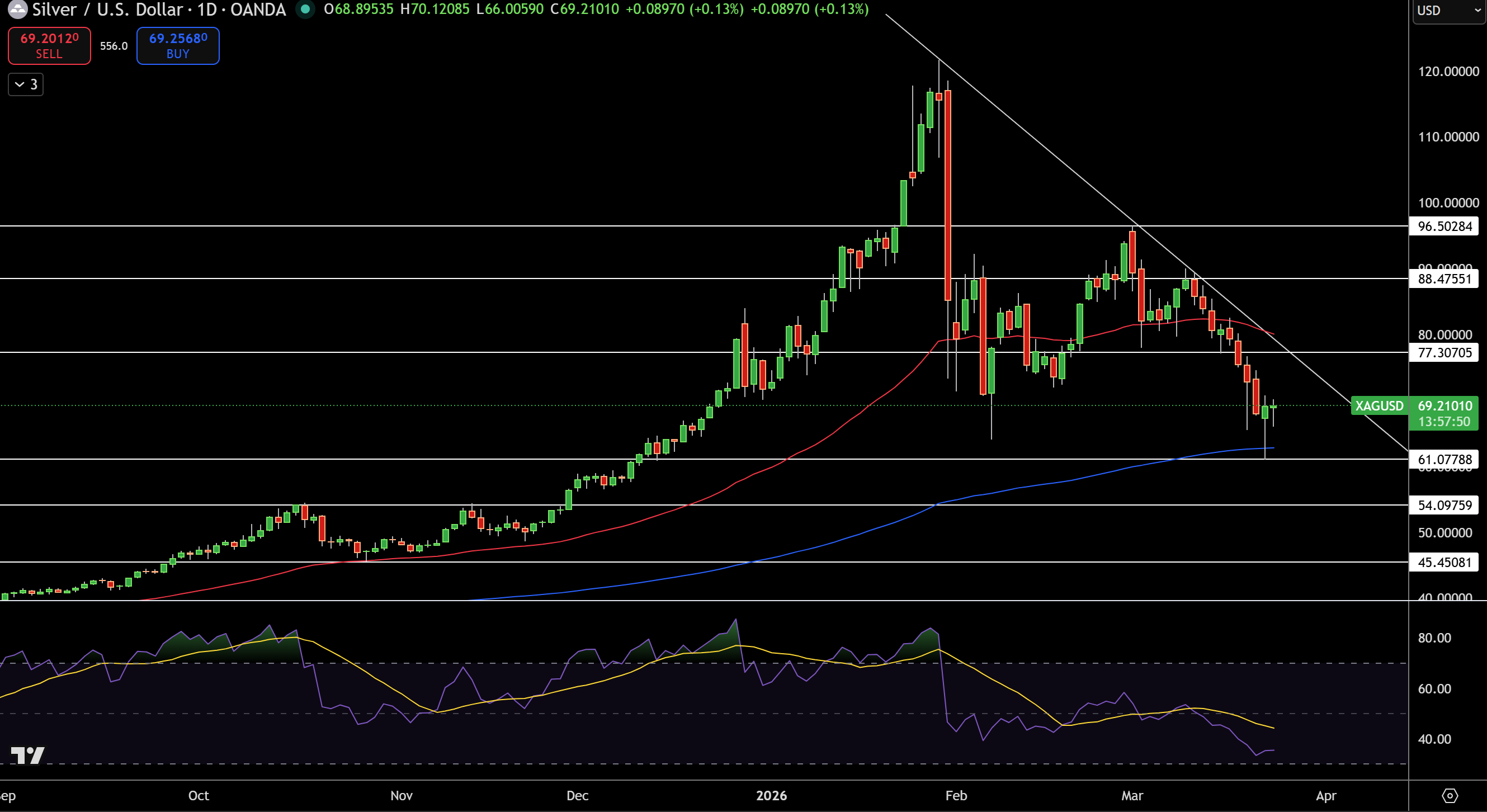
Silver (XAGUSD) is currently hovering around $69.21 on the daily chart following a sharp break below a stubborn descending resistance line & crashing under the 50 day Moving Average just above $80 bucks. The real turning point came when silver careened off the $96-$100 zone – that’s a major swing high – & after that, the momentum began to tumble hard in favor of the bears..
We’re now seeing price action put a test in on the 200 day MA at $61.07 which is a pretty key long-term support level. The recent run of lower highs & lower lows really is shaping up to be a developing bear market.
The Relative Strength Index is coming in around 35, getting close to oversold territory, but still hasn’t given us any clear signal that a reversal is on the cards.
The chances are that if silver stays below $61 for a bit longer, it’s going to open up a possible route down to $54.09 and on the other hand, if we see it pop above $77.30 then that’ll give us a bit of relief on the downside.