Gold Price Holds $4,800 as US-Iran Talks Cap Safe-Haven Surge
Gold is back at $4800 after a wild ride of late – and for now, it seems to have settled down. Market players are getting a better sense of geopolitical risk and that’s causing gold to trade in a tight range of $4810-$4830. Underpinning the metal is a US dollar that’s losing ground and the demand from central banks, but there’s still a nagging feeling that US-Iran diplomatic talks might just bring some sense of calm to the Middle East.
With the immediate danger of war receding – particularly when it comes to the Strait of Hormuz – there’s been a bit of a pullback in the rush to safe-haven assets, and that’s capping gold’s upside at the $4840-$4860 level. On the other hand, investors still have to worry about stagflation and rising energy prices, so the longer-term picture for gold remains pretty positive.
Overall, gold right now is all about balance. People aren’t getting too excited, but the underlying drivers such as global uncertainty and investors seeking diversification are keeping a lid on any serious downside – which seems to be around the $4780-$4800 level.

Silver Near $80 as Dollar Weakness Offsets Industrial Concerns
Silver is trading in the $78-$80 range, holding onto its gains from a big rally earlier this week. Like gold, it’s getting a boost from a weaker dollar, and also from changing expectations around US-Iran tensions. But the gains are still pretty measured.
One thing that’s different for silver compared to gold is its link to industry. On one hand, the economic slowdown might weigh on demand, but on the other hand, industries like electric vehicles, solar and data infrastructure are still giving silver a bit of a boost.
The gold-silver ratio has silver lagging gold by a good 60 or so. That suggests there’s still room for silver to catch up if things really heat up. But – and it’s a big but – silver’s price action is super-sensitive to the big macro picture, particularly when it comes to oil and risk sentiment.
Right now, silver is more of a consolidation than a trend in the making – and the next direction it goes will likely depend on what happens with US-Iran and other global developments.
Gold Price Forecast
Every new Gold analysis as it publishes, today's technical signal and key levels, live price — on one page.
See all Gold forecastsGold Holds $4,800 Support – Safe Haven Momentum Still Intact?
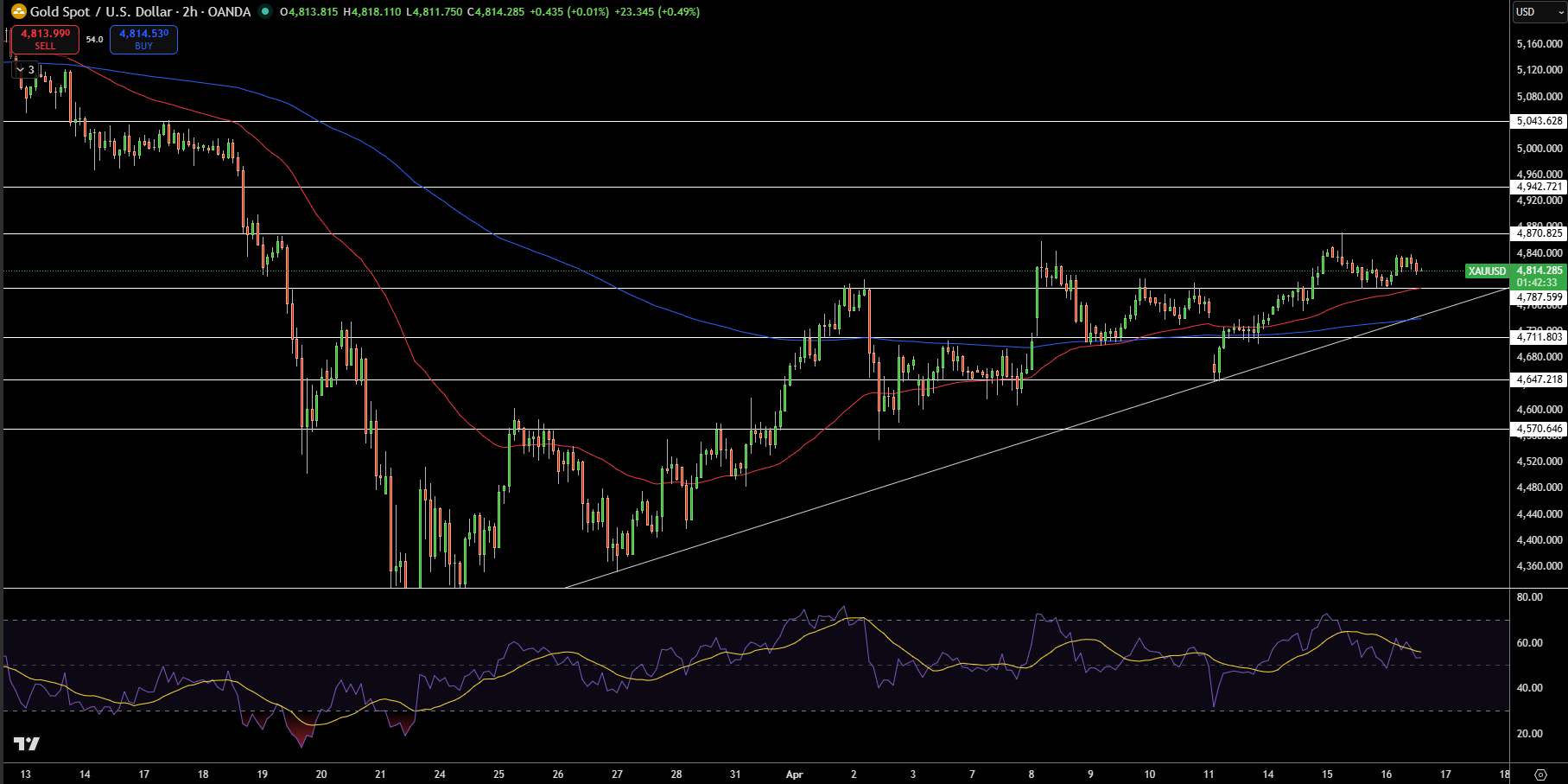
Gold (XAUUSD) is hovering around the $4810-$4820 mark, staying in its short-term uptrend after a pretty solid bounce-back from $4300-$4400 levels. Price is still respecting an upward trendline and more importantly, staying above its 50-SMA (around $4780), all of which says its still got that solid bullish momentum going on. But a glance below $4860 – and we can see the momentum slowing down, with past rejection candles at that level suggesting there’s still some resistance around.
RSI is starting to cool down now from being pretty overheated to around the mid-50’s – which is just indicating that this might be a bit of a consolidation, rather than a full blown reversal. Now if gold can break those $4860 level up, you might see a bit of an uptick towards $4940 – but if it can’t hold on above $4780-$4750, then that could trigger a slightly bigger pullback down towards the trendline support.
Trade idea: Buy if you see gold break above $4860, aim for $4940, but stop if you see it go below $4750.
Silver Tests $80 Barrier – Breakout or Bull Trap?
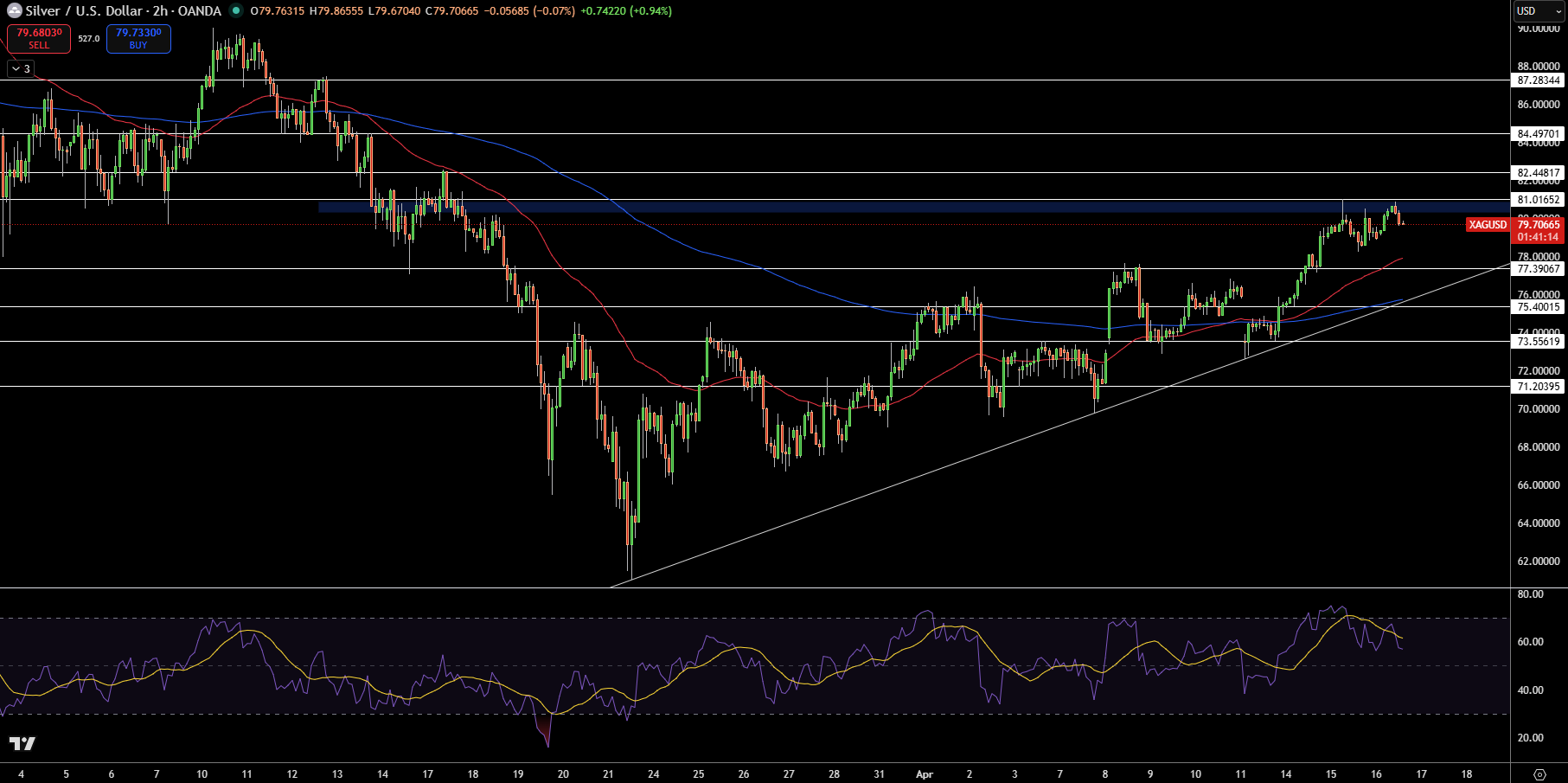
Silver (XAGUSD) is pootling around the $795-$80 mark, right on the cusp of a key resistance zone just above $80-$81 – after a pretty good recovery from that low point at $62. The overall picture is still looking pretty bullish – with higher low formation, trendline, and even the 50-SMA and 200-SMA all supporting this view.
But those repeated rejections at $80 look like hesitation to me. RSI’s coming down a bit from being overbought, suggesting those short-term buyers are starting to lose their steam. So if we see a clean break above $81, you might see a bit of a run towards $84-$87, but if it doesn’t happen – the pullback towards $77-$75 support zone could be on.
Trade idea: Buy if silver breaks above $81, target $84, but stop if you see it drop below $77.