
Japan Wage Growth Data: Will BoJ Finally Raise Rates?
On Monday, March 10, crucial wage growth figures from Japan will influence USD/JPY trends and the Bank of Japan rate path.
Economists forecast average cash earnings to rise 3.2% year-on-year in January after surging 4.8% in December. While wage growth may slow, overtime pay is projected to increase.
A higher-than-expected wage reading could fuel speculation about an H1 2025 BoJ rate hike. Rising wages could support household spending and drive inflation higher, potentially prompting the BoJ to tighten monetary policy.
However, weaker wage growth could shift focus to the upcoming spring wage negotiations (Shunto). The outcome of wage negotiations may play a key role in influencing the BoJ’s policy stance.
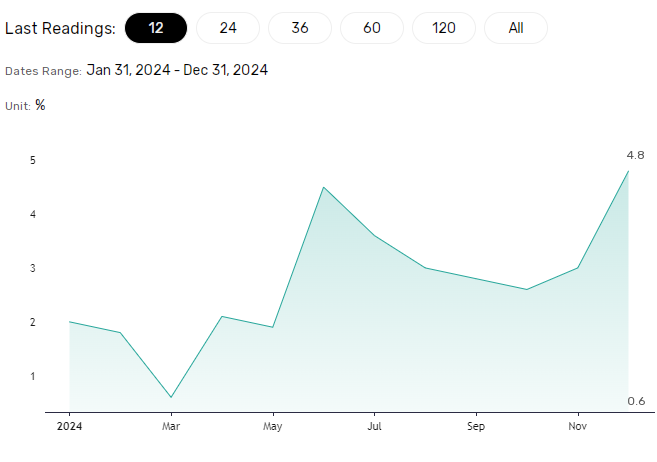

Market Focus Intensifies on Japan’s Wage Growth
Market focus on Japan’s wage trends has intensified after Rengo, the country’s largest trade union center, revealed its member trade unions are demanding an average wage hike of 6.09%. This was the first time unions have called for wage increases above 6% in over 30 years, pressuring the USD/JPY pair.
AUD/USD Price Forecast
Every new AUD/USD analysis as it publishes, today's technical signal and key levels, live price — on one page.
See all AUD/USD forecastsExpert Views on the Bank of Japan Rate Path
On March 7, Traders Community, a community for all traders and investors, remarked on the Rengo news:
“Overnight Japan’s largest trade union is seeking a 6.09% general wage hike first year, up from last year’s 5.85% increase, (biggest in over 20 years. Also was speculation the Bank of Japan will announce another rate hike at the end of April after a pause.”
A more hawkish BoJ policy stance could impact global markets, particularly if a stronger Yen triggers a Yen carry trade unwind. The USD/JPY saw extended losses, falling to 139.576 in September 2024, its lowest level since July 2023, after the BoJ surprised the markets with a more hawkish-than-expected policy move in July 2024.
However, the BoJ could downplay the chances of a near-term policy move to avoid market disruption amid increasing economic uncertainty. This could limit the downside for the USD/JPY pair.
USD/JPY Trends: Consumer Inflation Expectations in Focus
Later in the US session, consumer inflation expectation trends could influence US dollar demand. Economists forecast consumer inflation expectations to increase from 3% in January to 3.2% in February.
A higher-than-expected reading could temper bets on an H1 2025 Fed rate cut. A more hawkish Fed rate path may drive the USD/JPY pair toward the 149.309 resistance level, possibly testing 150.
Conversely, a lower inflation outlook might fuel speculation about a Fed rate cut in June, dragging the pair toward last week’s low of 146.935.
Beyond the inflation data, investors should monitor US tariff policy and FOMC members’ commentary on inflation, the labor market, and the Fed’s rate path.
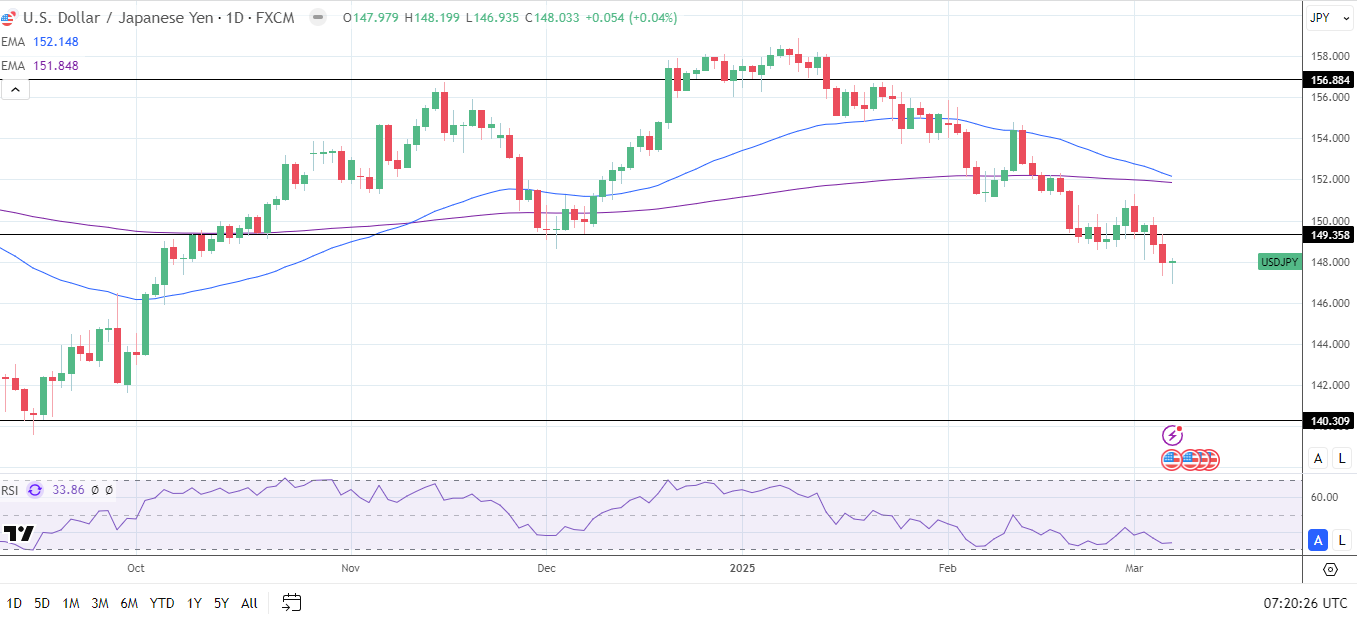
Explore expert forecasts and trade setups for USD/JPY in our latest market analysis here.
Aussie Dollar at Risk: US Trade Tensions vs. China’s Stimulus
While Japan’s monetary policy remains in focus, broader trade risks are also weighing on major currencies like the Aussie dollar. US-China tensions and Beijing’s stimulus efforts are influencing AUD/USD trends.
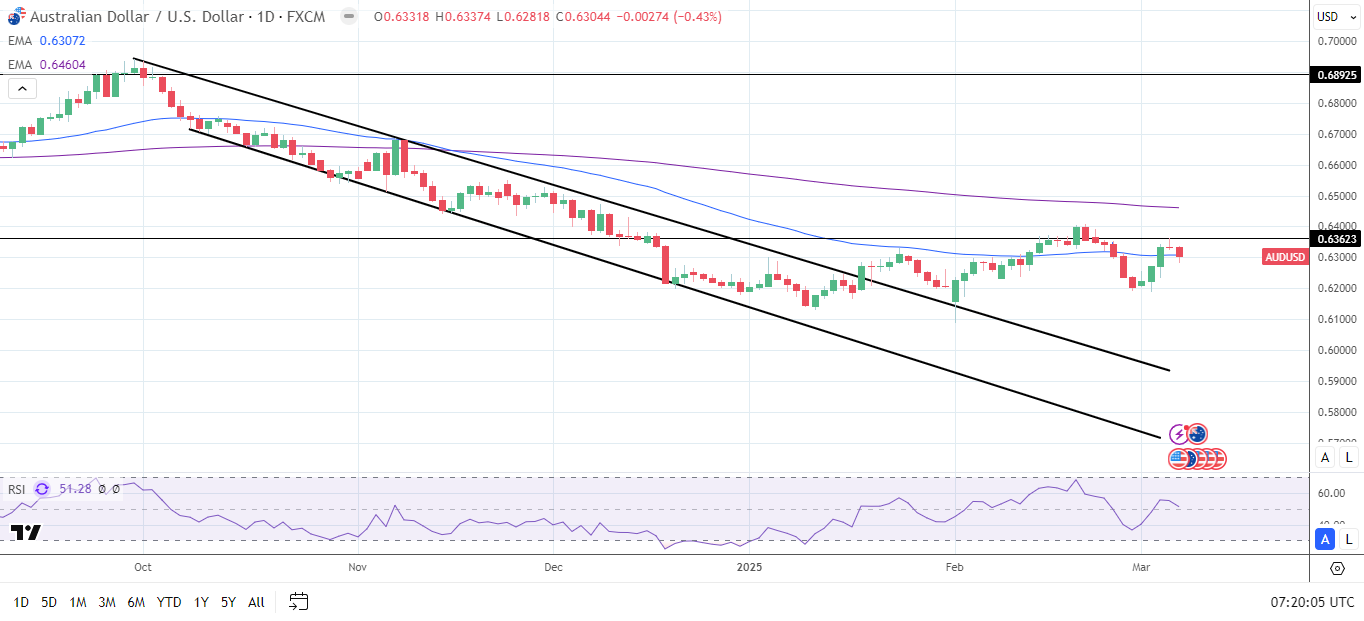
AUD/USD trends hinge on market risk sentiment after last week’s 1.63% rise to $0.63044. Rising tariff risks could impact sentiment toward global trade terms, potentially weighing on Aussie dollar demand. Australia has a trade-to-GDP ratio above 50%, underscoring the impact of weaker global demand on the Australian economy and the Aussie dollar.
Meanwhile, China’s stimulus efforts could help mitigate tariff-related risks. Given China accounts for one-third of Aussie exports, an improving Chinese economy may boost Aussie dollar demand.
RBA Governor Michele Bullock recently emphasized the potential risks associated with US tariff policies, stating;
“Global trade uncertainties and tariff threats remain unpredictable, with economic impacts dependent on implementation and market reactions.”
If global trade tensions escalate or China’s stimulus measures fall short, AUD/USD could decline toward last week’s low of $0.61867. However, easing tariff risks and stronger Chinese stimulus could drive the pair toward the March 6 high of $0.63637.
For a comprehensive analysis of AUD/USD trends and trade data insights, visit our detailed reports here.
Australian Dollar Daily Chart
Later in the US session, consumer inflation expectations will be a key driver for AUD/USD. A higher reading could lower expectations of an H1 2025 Fed rate cut. A more hawkish Fed rate path would widen the US-Australian interest rate differential, pulling the AUD/USD pair toward $0.62, a crucial support level.
Conversely, a softer inflation outlook could narrow the rate differential, potentially driving the pair toward the $0.63623 resistance level, with a possible move to $0.64.
Market Trends: Central Banks and Trade Policies in Focus
Key macroeconomic drivers influencing currency markets include:
- BoJ Forward Guidance: wage growth, GDP, household spending, and inflation data will influence the BoJ’s rate path.
- US Economic Data and Tariff Policies: The CPI Report and tariff developments remain critical for market sentiment.
- AUD/USD Outlook: Beijing’s stimulus measures and US-China trade tensions will affect RBA policy expectations and Aussie dollar demand.
Read expert USD/JPY and AUD/USD forecasts here for deeper insights.