RBA Governor Michele Bullock Dampens Further Rate Cut Expectations
RBA Governor Michele Bullock held a highly anticipated press conference after the Bank decided to cut the cash rate by 25 basis points. Uncertainty about the RBA’s policy outlook fueled AUD/USD volatility ahead of her remarks.
Key Takeaways from the Q&A:

- The RBA is waiting for more evidence that inflation is returning to the target range before we consider further rate moves.
- Housing costs are starting to decline, and business margins are being squeezed, suggesting firms can’t pass costs onto customers as demand wanes.
- A slowdown in wage growth, disinflation in market services, a sustained decline in housing costs, and a partial recovery in supply-side conditions could support another rate cut.
- The February rate cut was small, supporting people with mortgages. Softer inflation is beneficial for renters.
- Signs are positive. Inflation is coming down, with the trimmed mean expected to return to the band in the first half of next year.
- The Board is alert to upside risks to inflation.
- Trend growth has stepped down due to productivity, which has not been as strong as hoped.
- The 2.7% trimmed mean forecast is based on three interest rate cuts. However, targeting the middle of the (2-3%) band is important.
- If inflation reversed course, the Board would consider hiking rates.
- Global trade uncertainties and tariff threats remain unpredictable, with economic impacts dependent on implementation and market reactions.
- While mortgage holders are a focus, rising prices have affected all consumers. Bringing inflation to normal levels is essential, and the extent of future rate cuts will depend on inflation trends.
RBA Rate Statement Highlights Upside Risks and Board Member Caution
Earlier on Tuesday, the RBA cut the cash rate by 25 basis points to 4.10%, aligned with market expectations. However, the RBA Rate Statement set the stage for Governor Michele Bullock’s press conference.
Key points from the RBA Rate Statement included:
- Inflation has fallen significantly from the 2022 peak as higher interest rates brought demand and supply closer towards balance.
- Continued subdued growth in demand and wage pressures have eased, also boosting the Board’s confidence that inflation is moving sustainably to the midpoint of the 2-3% target range.
- An unexpectedly strong labor market poses upside risks.
- Private domestic demand is recovering more slowly than expected, adding uncertainty over household spending trends.
- Global geopolitical and policy uncertainties are more pronounced and could impact activity if households and firms delay expenditures.
- Trade policy changes may slow growth and push inflation higher in some economies.
- The Board deems monetary policy restrictive and intends to maintain this stance despite inflation risks moderating.
- RBA forecasts that disinflation could stall if monetary policy is eased too much too soon.
- Future decisions will be data-dependent, with a focus on global economic trends, domestic demand, inflation, and the labor market outlook.
Expert Views on the RBA Rate Path
Shane Oliver, Head of Investment Strategy and Chief Economist at AMP, commented on the RBA Statement:
“RBA revised down slightly to 2.7% its trimmed mean inflation for this year and sees it staying at that level = hence its caution. Now sees slightly lower unemp but still sees wages growth slowing to 3.1% next yr. “
RBA Forecasts:
AUD/USD Price Forecast
Every new AUD/USD analysis as it publishes, today's technical signal and key levels, live price — on one page.
See all AUD/USD forecasts- GDP: 2.4% in calendar year 2025, up from a previous projection of 2.3%.
- Unemployment rate: 4.2% for December 2025, down from a previous forecast of 4.5%.
- Trimmed mean inflation: 2.7% year-ended December 2025, down from 2.8%.
AUD/USD Reacts to Governor Michele Bullock’s Q&A Session
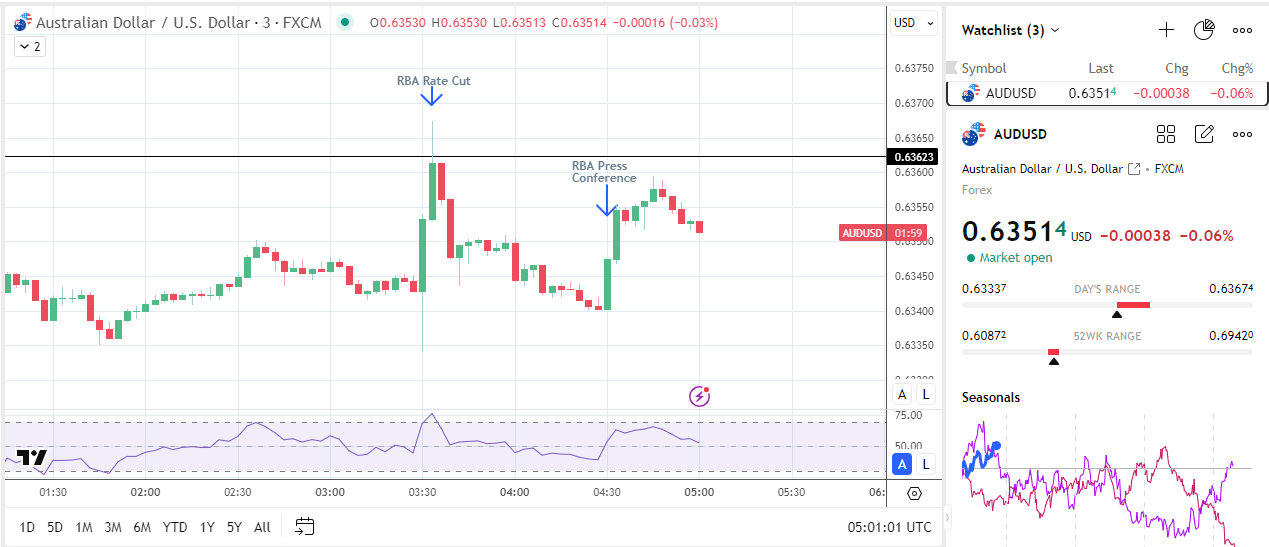
The AUD/USD pair had a choppy reaction to the RBA rate statement, initially falling to a low of $0.63340 before climbing to a high of $0.63674. Ahead of the press conference, the pair eased back below $0.63500.
AUD/USD trended higher during the RBA press conference, rising from $0.63403 to a high of $0.63595 before easing back. The market reaction reflected lower bets on another RBA rate cut, narrowing the US-Australia interest rate differential in favor of the Aussie dollar.
On Tuesday, February 18, the AUD/USD was down 0.06% to $0.63514.
For a comprehensive analysis of AUD/USD trends and trade data insights, visit our detailed reports here.