



Japanese producer prices fueled speculation about a December Bank of Japan rate hike on Wednesday, December 10. Producer prices signaled sticky consumer price inflation midway through the fourth quarter. USD/JPY dropped in response to the uptick in producer prices, partially reversing the previous day’s 0.63% loss on the hot US JOLTs Job Openings report.
While the November figures bolstered bets about a December BoJ rate hike, traders faced a higher degree of uncertainty on the Fed’s monetary policy outlook. Market bets on a December Fed rate cut remained firm despite solid overnight US jobs data.
However, the absence of October inflation and labor market data, canceled because of the US government shutdown, has left the Fed flying blind on crucial reports needed to make an informed interest rate decision and offer meaningful economic projections.
Given these dynamics and USD/JPY’s return to 156, the short-term outlook looks cautiously bullish, while the medium-term outlook remains bearish, hinged on the Fed cutting and the BoJ raising rates.
Below, I’ll discuss the macro backdrop, the near-term price catalysts, and technical levels traders should closely watch.
Japanese Producer Prices Give BoJ Hawks a Strong Footing
Producer prices increased 2.7% year-on-year in November, mirroring October’s trend, lifting demand for the Japanese yen. November’s producer prices indicated rising import prices, forcing producers to pass higher costs on to consumers. Higher prices may also signal stronger demand, enabling producers to raise prices and fuel demand-driven inflation.
The BoJ has raised previously concerns about the weaker yen pushing import prices higher, adversely affecting household purchasing power. Rising producer prices will give the BoJ hawks a stronger argument to raise interest rates on December 19.
USD/JPY responded, briefly falling from 156.840 to 156.795 after the data.
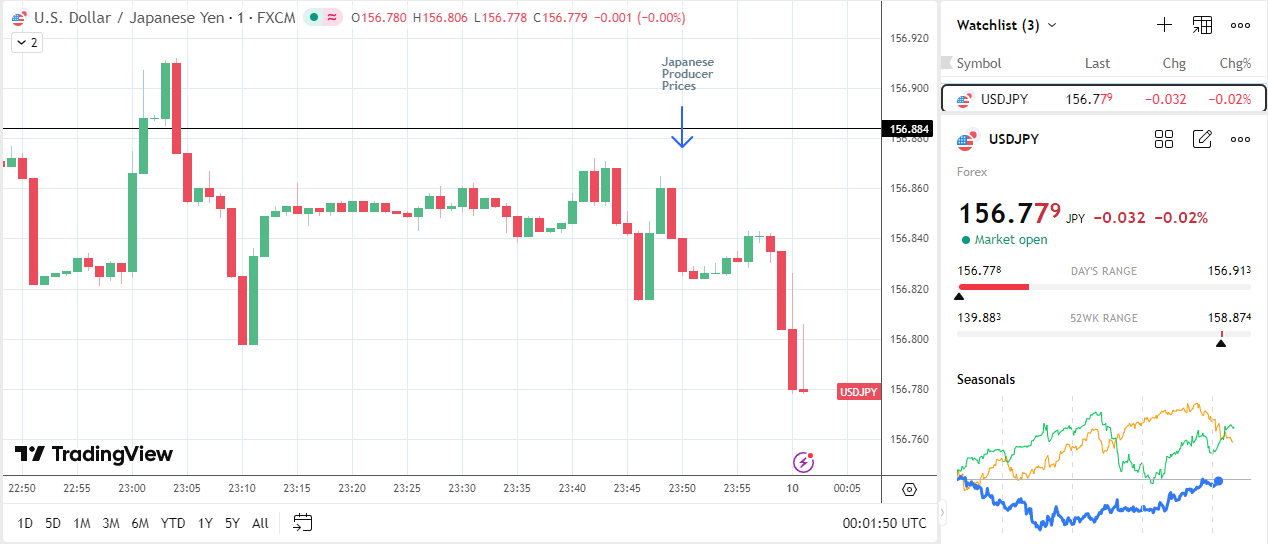
The November data followed BoJ Governor Kazuo Ueda’s optimistic economic outlook. He stated that the economy will return to growth in the fourth quarter and beyond, reinforcing his recent bullish pivot. Last week, Governor Ueda supported a rate hike, citing strong wage growth, fading US tariff risks, and FX weakness.
While expectations of a BoJ rate hike are strengthening yen demand, the FOMC interest rate decision, FOMC Economic Projections, and Fed Chair Powell’s press conference will dictate buyer appetite for the US dollar.
USD/JPY Price Forecast
Every new USD/JPY analysis as it publishes, today's technical signal and key levels, live price — on one page.
See all USD/JPY forecastsFOMC Interest Rate Decision Looms
Later on Wednesday, the Fed will take center stage as investors await its highly anticipated interest rate decision and Economic Projections. Economists expect the Fed to lower interest rates by 25 basis points, with the CME FedWatch Tool giving an 87.6% chance of a rate cut.
Barring an unexpected hold or a surprise 50-basis-point cut, the market focus will be on the Economic Projections and the dot plot on rate expectations. Notably, the chances of a Q1 2026 rate cut declined overnight.
The FOMC Committee has divided into two camps in recent months. On one side, members support further policy easing to bolster a cooling labor market, while on the other, voters view sticky inflation as a reason to pause further cuts. Given the division among voting members, a hawkish cut looks likely, where the Fed downplays further easing in the near-term, but remains data dependent.
Economic Projections and Dot Plot to Spotlight the Greenback
The Economic Projections and dot plot will provide the crucial insights into the Fed’s outlook and potential rate path. For context, the September dot plot projected a 3.25%-3.50% Fed Funds Rate (FFR) by the end of 2026.
A 25-basis-point rate cut today would leave two further rate cuts to align with the September dot plot, the baseline for traders. A dovish Fed rate cut would be a lower FFR by the end of 2026, while a hawkish cut would be a higher 2026 FFR forecast.
Notably, the projections will be based on outdated inflation and jobs data, given the cancellation of October data. The absence of October’s government reports may downplay the influence of inflation, unemployment, and GDP projections on US dollar demand. However, given the USD/JPY sensitivity to September’s JOLTs job openings, the pair will be exposed to heightened volatility.
Meanwhile, there is also a potential announcement on bond purchases (quantitative easing).
With increased uncertainty about the post-December Fed rate path, the short- and medium-term outlook hinges on the Fed and the BoJ’s interest rate decisions and policy outlooks. Despite the uncertainty, the Fed’s easing and the BoJ’s tightening support a bearish medium-term outlook for USD/JPY.
Technical Outlook: USD/JPY on a Downward Trajectory
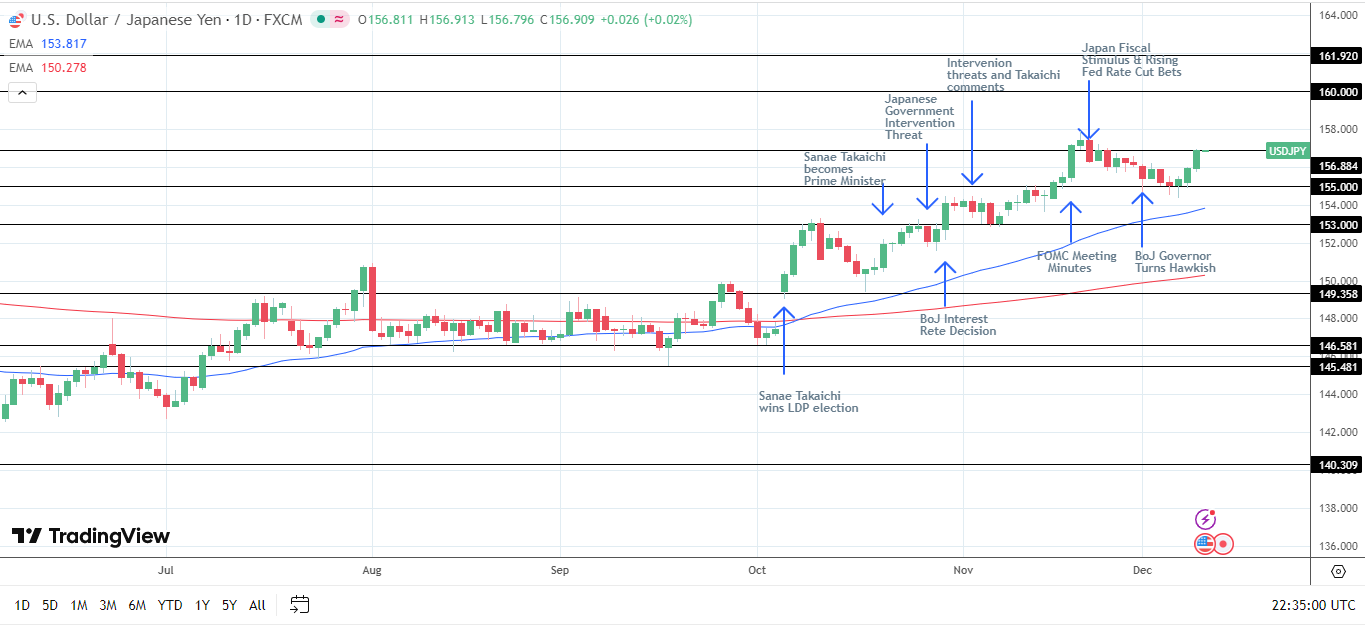
Looking at the daily chart, USD/JPY traded above the 50-day and 200-day Exponential Moving Averages (EMAs), signaling a bullish bias. However, fundamentals have begun to shift from the technical trend, supporting a bearish medium-term outlook.
A break below the 155 support level would bring the 50-day EMA into play. If breached, the 153 support level would be the next key support. Significantly, a sustained fall below the 50-day EMA would signal a bearish trend reversal, supporting a near-term drop toward 150.
Position and Upside Risk
In my view, a narrow US-Japan rate differential supports a bearish medium-term outlook. A sustained USD/JPY drop below the 50-day EMA would signal a fall toward the 200-day EMA. Breaching the 200-day EMA would affirm a bearish trend reversal.
However, upside risks could derail the bearish momentum. These risks include:
- Dovish BoJ rhetoric.
- A hawkish Fed rate cut.
- Fewer than two Fed rate cuts on the dot plot.
Nevertheless, yen intervention warnings are likely to cap the upside around the November 20 high of 157.893, based on past communication.
Read the full USD/JPY forecast, including chart setups and trade ideas.
Conclusion: Longer-Term Fall to 140 Hinges on the Dot Plot
In summary, the BoJ’s support for a December rate hike leaves the Fed in the driving seat. A dovish Fed rate cut, projecting two to three policy adjustments in 2026, and QE would align with the bearish medium-term outlook for USD/JPY. Furthermore, a dovish Fed rate cut could pave the way toward 130 over the 6-12 month time horizon.
For more in-depth analysis, review today’s USD/JPY trading setups in our latest reports and consult the economic calendar.