
As Micron Technology prepares to unveil its fiscal first quarter 2026 results on Wednesday, December 17, investors face a critical moment in assessing whether the Idaho-based memory semiconductor giant can sustain its extraordinary momentum.
The company’s stock currently trades around $241, having more than tripled since the beginning of 2025, though it remains below the $260 peak reached earlier this month. This strong and rapid annual gain encapsulates both the promise and peril of investing in a business deeply intertwined with the cyclical semiconductor industry and the burgeoning artificial intelligence revolution.
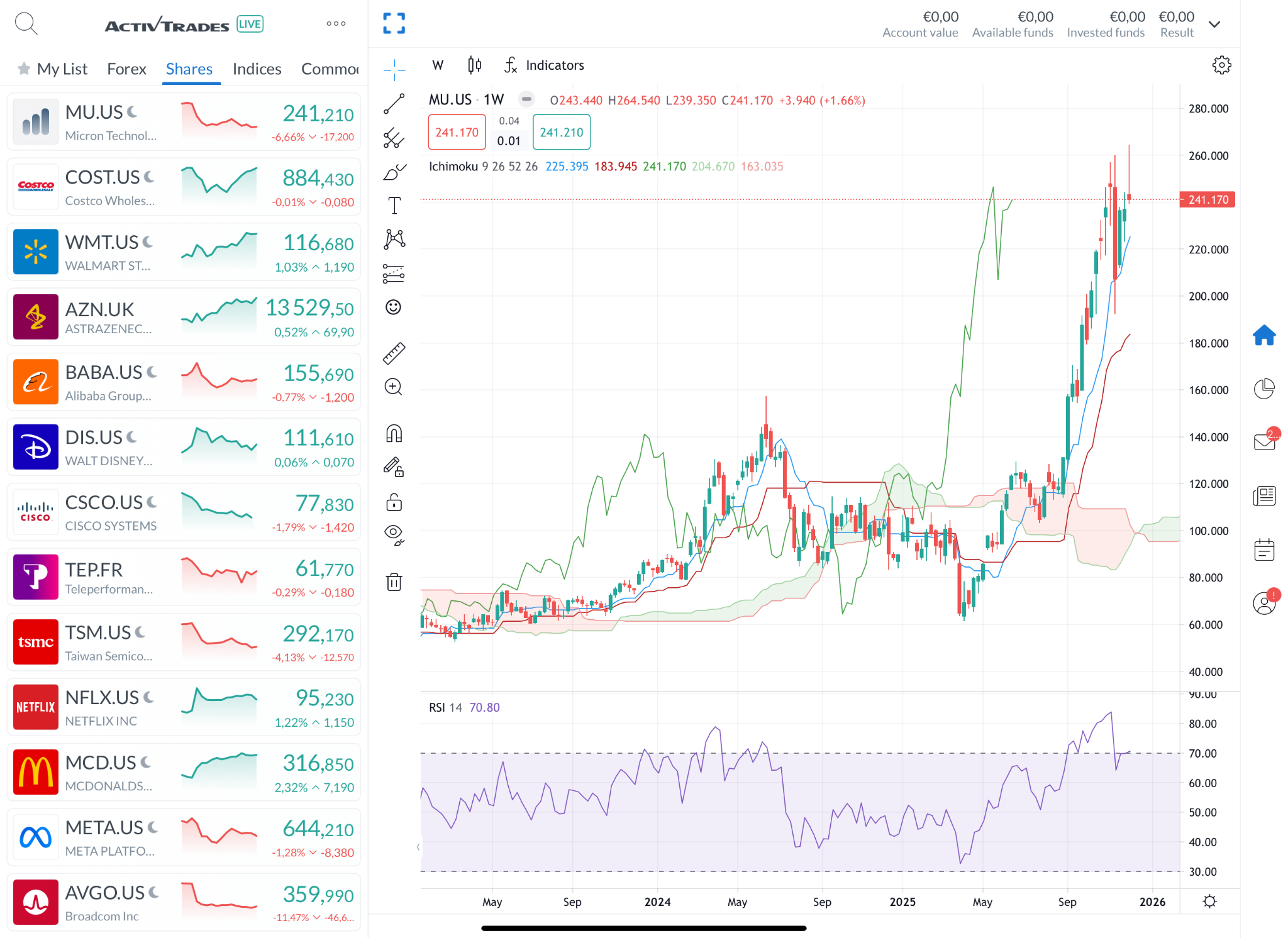
Wall Street expects Micron to report earnings per share between $3.77 and $3.94, representing more than double the $1.79 posted in the same period last year, with revenue projected around $12.6 billion to $12.8 billion compared to $8.7 billion a year earlier. These figures would mark another record-breaking quarter driven primarily by explosive demand for high-bandwidth memory chips used in AI processors and data center applications.
The fundamental thesis behind Micron’s dramatic valuation expansion centers on the company’s positioning at the intersection of several converging technological megatrends.

Riding the AI Wave: HBM Market Dominance and DRAM Recovery
Artificial intelligence workloads require massive amounts of memory to process training data and run inference models, creating unprecedented demand for advanced memory solutions. Micron has successfully capitalized on this shift by ramping production of High Bandwidth Memory (HBM) technology, the specialized high-performance memory essential for AI accelerators from companies like Nvidia.
The company achieved a significant milestone by securing the number two position in the HBM market during the second quarter of 2025 with approximately 21% market share, overtaking Samsung’s 17% and trailing only SK Hynix’s dominant 62% position. This represents a remarkable achievement for a company that held barely 5% of the HBM market at the end of 2024.
Micron has reported that its HBM inventory is completely sold out through calendar years 2025 and 2026, and the company recently began shipping 12-layer HBM3E chips for Nvidia’s Blackwell Ultra platform after successfully passing quality verification, making it only the second supplier alongside SK Hynix to achieve this qualification.
The company expects to ship several billion dollars worth of HBM products in 2025, with analysts projecting continued rapid expansion in this segment. Beyond HBM, Micron’s broader Dynamic Random Access Memory (DRAM) business has experienced remarkable recovery from the industry downturn that plagued 2022 and 2023. DRAM revenue reached $7.1 billion in the fiscal third quarter, representing 76% of total revenue and marking 51% year-over-year growth.
For the full fiscal year 2025, which ended August 28, Micron posted revenue of $37.4 billion compared to $25.11 billion the previous year, translating to 49% annual growth. The company’s fourth quarter revenue of $11.32 billion exceeded analyst estimates of $11.11 billion, while adjusted earnings per share of $3.03 surpassed expectations of $2.77 by more than 9%. Critically, gross margins have expanded dramatically, reaching 59% in the fourth quarter, from 49% in Q4 2024, demonstrating improved pricing power as advanced memory technologies become increasingly scarce.
Operating cash flows of $5.73 billion in the fourth quarter, highlighted exceptional cash generation capability. Industry analysts project quarterly DRAM contract price increases of 45% to 55%, with bit demand growth expected in the high teens percentage range for calendar year 2025, driven primarily by data center expansion and AI infrastructure deployment.
Strategic Investments and Technological Leadership
The company’s technological roadmap further strengthens its competitive position.
Micron is advancing its 1-gamma DRAM technology node using extreme ultraviolet lithography, which offers a 30% improvement in bit density, power consumption reduced by more than 20%, and performance gains up to 15% compared to the previous 1-beta generation. Management has indicated that yield improvements on 1-gamma are progressing faster than the already record-setting pace achieved on 1-beta. In NAND storage, where Micron competes alongside its memory products, the company is developing next-generation technologies that enable increased capacities while reducing manufacturing costs.
To support long-term growth and secure supply chain resilience, Micron announced a colossal $200 billion investment plan in the United States over the next 20 years, including $150 billion in manufacturing and $50 billion in research and development. The company expects its first Idaho fab to begin DRAM wafer production in the second half of calendar year 2027, followed by additional facilities in Idaho and New York. While its U.S. projects benefit from CHIPS Act funding designed to bring production back home, Micron is also expanding abroad. The company announced a $7 billion HBM fab in Singapore and accelerated the launch of its Japanese facility in Hiroshima, with both sites targeted to open in 2026.
Strategic decisions further underscore management’s confidence in the AI-driven memory boom. Micron announced plans to exit the Crucial consumer memory business entirely by February 2026, abandoning a well-known brand to redirect all manufacturing capacity toward the more lucrative AI server chip market. This move signals management’s conviction that data center and AI applications represent the optimal allocation of limited fab capacity.
The company also disclosed plans to cease supplying server chips to Chinese data centers following the 2023 Chinese government ban on its products, effectively writing off what had been an important market in favor of focusing on customers in regions where political risk is lower. These calculated exits from lower-margin or higher-risk segments demonstrate disciplined capital allocation as Micron concentrates resources on the highest-value opportunities.
In the second part of this analysis, we will shift our focus to the challenges ahead. We will delve into the specific risks inherent in Micron’s business model and outline the critical metrics and information investors should monitor during the upcoming earnings report on December 17th.
Sources: Wall Street Journal, Reuters, CNBC, SeekingAlph, Micron Technology, Nasdaq, TradingView, Yahoo Finance, CounterPointResearch