



Stocks Edge Higher as Ceasefire Hopes Compete With Ongoing War Risks
The S&P 500 is moving higher to start the week, building on strong gains from last week. Investors are focused on one big question, whether the war between the U.S. and Iran could be nearing a pause. Even though the market is rising, there’s still uncertainty hanging over everything, especially with headlines changing quickly, making the benchmark index vulnerable to a near-term retest of its recent low.
Technical Analysis
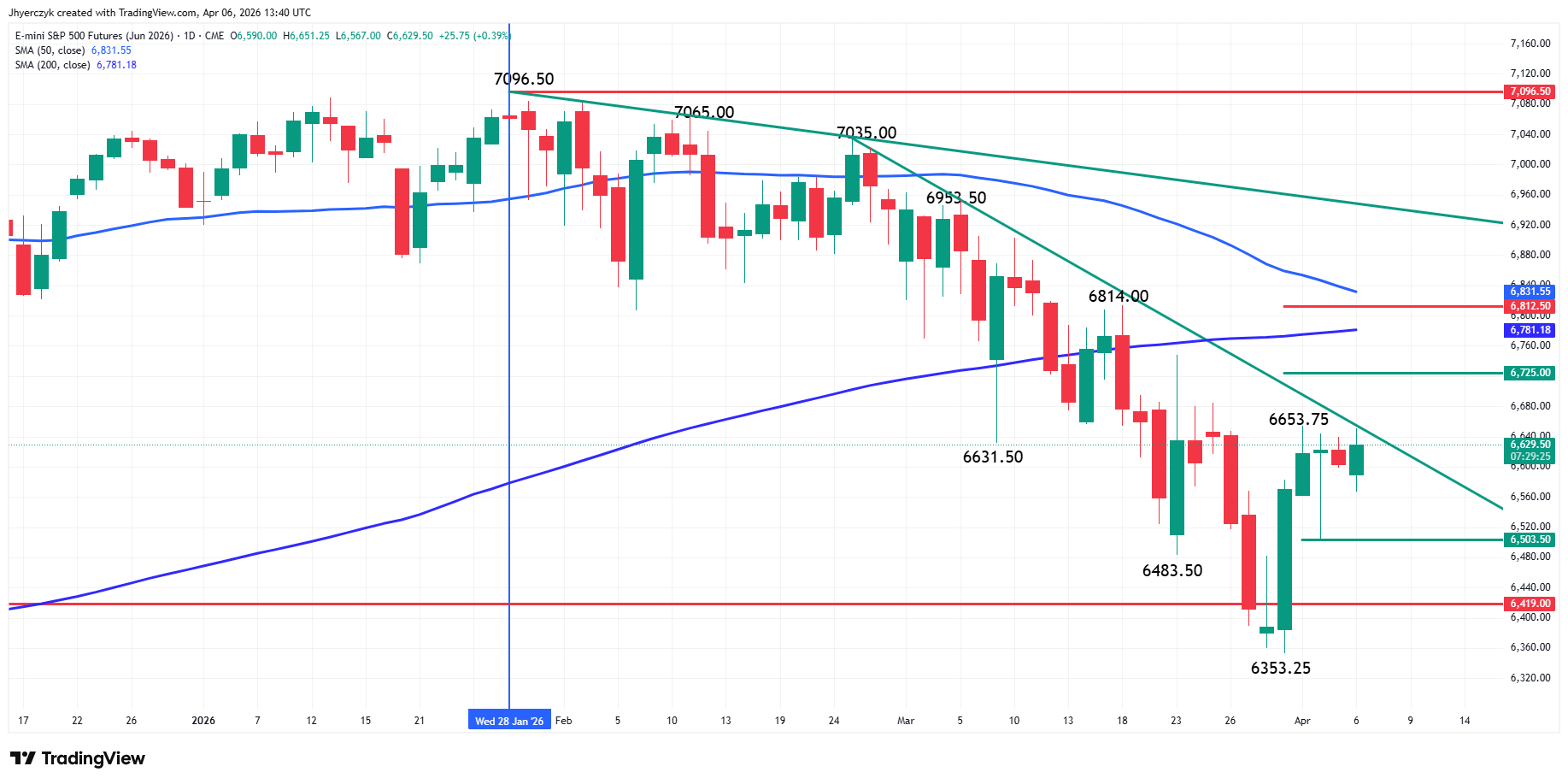
June E-mini S&P 500 Index futures are edging higher early Monday after an early test of last week’s high at 6653.75. The index is in a downtrend according to three metrics, a trendline, swing chart and moving averages.
Last week, the index hit a multi-month low at 6353.25 before reversing to the upside. The follow-through rally confirmed the chart pattern, but the rally stalled at 6653.75. Taking out this level will change the minor trend to up and shift momentum to the upside.
The change in momentum could trigger a breakout through the trendline at 6655.25. This could spark an acceleration to the upside with a retracement zone at 6725.00 to 6812.50 the next major target area. Another target zone is being formed by the 200-day moving average at 6781.25 and the 50-day moving average at 6831.75.
The best target area is the resistance cluster formed by the 50-day MA, the 61.8% level at 6812.50 and the 200-day MA. Look for sellers on the first test of this area, and a potential upside breakout if buyers can overcome the 50-day MA.
The current short-term range is 6353.25 to 6653.75. This opens up the possibility of a near-term retracement into the pivot at 6503.50. This will become the line in the sand. If new buyers come in to defend it then we’re likely to start a rally. If it fails to hold then 6353.25 could be tested again.
NASDAQ 100 Price Forecast
Every new NASDAQ 100 analysis as it publishes, today's technical signal and key levels, live price — on one page.
See all NASDAQ 100 forecastsCeasefire Talk Is Lifting Sentiment but Nothing Is Confirmed
The headlines this morning are pointing toward a possible 45-day ceasefire between the U.S. and Iran. There’s also talk of a plan to reopen the Strait of Hormuz. Nothing is confirmed and the chances of a quick deal look slim. That’s why the market is rangebound. Traders want to believe it but they’re not ready to bet on it yet.
Tech Leads Early Gains While the Dow Sits Flat
Shortly after the opening the S&P 500 is up about 0.37% and the Nasdaq is leading with a 0.60% gain driven by chipmakers and tech. The Dow is mostly flat. Last week all three major indexes snapped five-week losing streaks but the gains came with sharp swings in both directions. War headlines and shifting expectations kept traders on edge the whole way up.
Oil Above $112 and Trump’s Warning Keeps Pressure on Markets
Oil prices remain volatile at the start of the week, moving up as tensions continue. Nearby U.S. WTI crude is holding above $112 per barrel, showing that supply concerns are still real. President Trump also raised the stakes by warning of possible strikes if the key shipping route, the Strait of Hormuz isn’t reopened. That is the key issue keeping pressure on markets and adding to uncertainty, in my opinion.
Jobs Data Strong but Services Cool as Fed Stays on Watch
Friday’s jobs report beat expectations and the labor market is still in good shape. Today’s ISM services number was a different story. The PMI dropped to 54% from 56.1% in March. New orders improved but the employment index fell hard. Two reports, two different signals. The labor market says the economy is holding up. The services data says growth is starting to cool. The Fed is watching inflation and so is everyone else. If prices stay elevated rate cuts stay off the table and that matters more than the ceasefire headlines for longer term market direction.
More Information in our Economic Calendar.