Traders are increasingly focused on the company’s long-term strategic choices and the optionality embedded in its business model. Gaming, post-flagship content strategy, and the potential acquisition of Warner Bros. Discovery all represent asymmetric outcomes that could materially influence how Netflix is valued beyond the next few quarters. This part of the earnings discussion is less about precision forecasting and more about confidence in direction. Management’s commentary will be scrutinised not for detailed guidance, but for signals on capital allocation, execution risk, and whether Netflix can continue expanding its ecosystem without undermining its margin discipline.

Gaming: From Strategic Experiment to Long-Term Growth
Netflix’s gaming initiative remains one of the most debated components of its growth narrative. For now, it contributes little to revenue, but management has consistently framed it as a long-term engagement and ecosystem play rather than a near-term profit centre. The core ambition is clear: Netflix wants to remove friction from gaming in the same way it did for streaming, making discovery and access effortless for a global audience.
Rather than targeting traditional console or PC gamers, Netflix is building around four key categories: kids, mainstream, party, and narrative-driven games. These titles are integrated directly into the Netflix app, eliminating hardware requirements, downloads, and upfront costs. Strategically, this positions gaming as an extension of Netflix’s content universe rather than a standalone business.
For intellectual property owners, this approach creates additional ways to monetise franchises and deepen fan engagement. For Netflix, it reinforces the value of its subscription by increasing time spent within the ecosystem and strengthening emotional attachment to its brands.
What Does This Mean for Traders?
From a trading perspective, the key variable is not gaming revenue but traction. Traders will be listening for evidence that gaming is improving retention, increasing engagement, or reducing churn among specific user segments. Even modest improvements in these areas could justify higher long-term lifetime value assumptions.
Equally important is the optionality gaming creates. Management has suggested that a successful gaming platform could eventually support new advertising formats or sponsorship models, an area where Netflix still lags competitors such as Amazon and Alphabet. While difficult to quantify today, any concrete metrics or strategic milestones shared during earnings could meaningfully influence sentiment, particularly for longer-dated positioning.
Content Strategy After Flagship Franchises: Managing the Post–Stranger Things Era
Another strategic question hovering over the earnings call is how Netflix plans to sustain cultural relevance as some of its flagship franchises reach maturity. The eventual conclusion of Stranger Things represents more than the loss of a popular show; it leaves a gap in brand identity, merchandise potential, and cross-platform engagement.
Netflix has historically been adept at cycling new hits into its catalogue, but traders will be attentive to how management frames its next phase of content investment. This includes organic development of new franchises, partnerships, and potentially inorganic expansion through acquisitions.
The company’s broader strategy increasingly emphasises owning scalable IP that can travel across formats, from series and films to games and consumer products. This ecosystem approach reduces reliance on any single title while increasing monetisation potential per franchise.
What Does This Mean for Traders?
For traders, the focus is on risk mitigation rather than immediate upside. Clear communication around pipeline strength and IP strategy helps reduce concerns about viewership volatility once major franchises end. If management can demonstrate confidence in replacing legacy hits with new, multi-format franchises, it supports the case for more stable engagement and revenue growth through 2026 and beyond. Uncertainty, by contrast, could increase perceived execution risk and weigh on valuation multiples, even if near-term earnings remain solid.
Warner Bros. Discovery: A Transformational Deal with Embedded Risks
The potential acquisition of Warner Bros. Discovery represents the most consequential strategic variable currently priced into Netflix’s longer-term outlook. Announced in December, the proposed $72 billion transaction, including debt, would dramatically reshape the global media landscape. The deal would give Netflix control over Warner’s film and television studios and HBO, while excluding CNN and other cable assets that are expected to sit in a separate entity following Warner Bros. Discovery’s planned 2026 split.
From a strategic standpoint, the rationale is compelling. The acquisition would provide Netflix with an unparalleled library of premium IP, reduce long-term licensing costs, and potentially accelerate its advertising ambitions through HBO’s established brand and audience.
However, the path to completion has been anything but straightforward. Paramount’s hostile bid in December introduced competitive tension, but Warner Bros. Discovery’s board ultimately rejected the offer in January, reaffirming Netflix as its preferred buyer. While this reduces deal uncertainty, it does not eliminate regulatory, financing, or political risks.
Those risks were further amplified by reports that President Donald Trump purchased investments in both Netflix and Warner Bros. Discovery shortly after the deal announcement. Although the White House has stated that Trump’s portfolio is independently managed, ethics experts have raised concerns given the president’s potential role in regulatory oversight of the transaction. These developments do not change Netflix’s fundamentals, but they increase headline sensitivity around the deal.
What Does This Mean for Traders?
For traders, the Warner deal represents a classic high-impact catalyst with binary characteristics. Clear, confident messaging around integration strategy, financing, and regulatory engagement could be interpreted as de-risking the transaction, potentially supporting the stock. Conversely, vague or defensive commentary could increase uncertainty and pressure near-term positioning.
Looking ahead to 2026, traders will want clarity on whether Netflix views the acquisition as transformative or opportunistic, and how it plans to preserve margin discipline while absorbing such a large asset. Any indication that the deal could dilute returns or constrain capital flexibility would likely be viewed negatively.
Bottom Line for Traders
Ultimately, this earnings report is less about incremental beats or misses and more about reinforcing confidence in Netflix’s multi-year narrative. Strong core fundamentals provide a foundation, but it is the company’s strategic choices that will shape valuation over the next cycle.
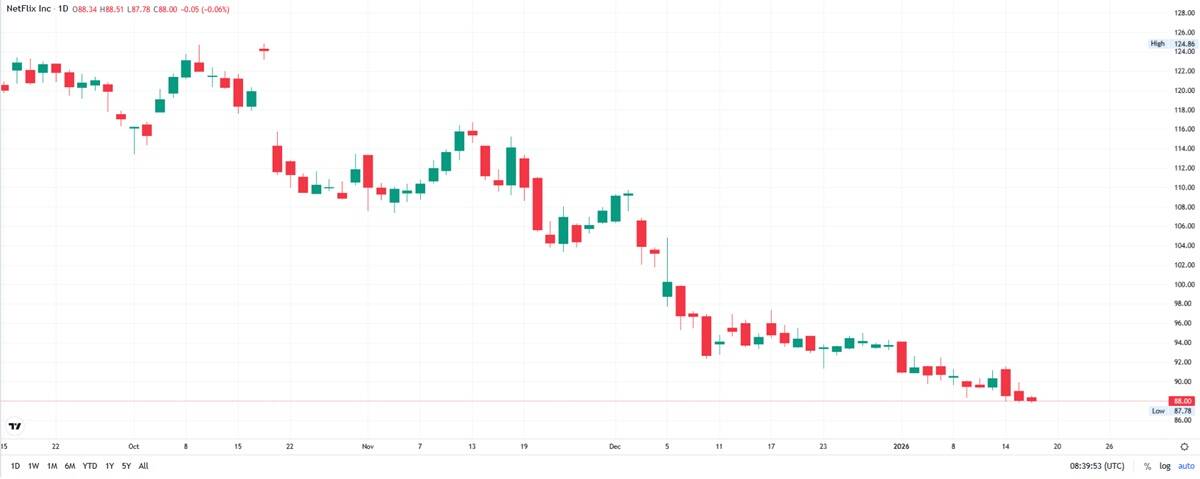
- Source: FX EmpireFor traders, the key questions are whether gaming shows early signs of traction, whether content strategy can sustain engagement beyond legacy franchises, and whether the Warner Bros. transaction can be executed without compromising profitability. The answers to these questions may not move earnings models immediately, but they will heavily influence how the market prices Netflix’s growth and risk profile heading into 2026 and beyond.
Sources: CNN, MorningStar, Reuters, NetflixAds, MarketingDive