



WTI Crude Slips for the Week as Oversupply Keeps the Pressure On
Light Crude Oil Futures (WTI) settled the week at $56.52, down $0.78 or 1.36%, wrapping up another heavy week for crude. The selloff pushed futures to a weekly low of $54.84, the weakest level since early 2021, before a geopolitical bounce helped stabilize prices. But the rebound never stuck. The market’s telling you it still cares far more about oversupply than headlines.
Geopolitical Risk Triggered a Bounce — But Not a Trend
Traders came into the week already leaning bearish, with OPEC+ adding barrels back and U.S. output still grinding higher. Then the tone flipped midweek after President Trump announced a “total and complete” blockade on sanctioned Venezuelan tankers. Shorts covered, and crude caught a bid.
Thursday’s EIA report added support, showing a 1.27 million-barrel draw and the biggest Cushing decline in nearly two months. New U.S. and UK sanctions targeting Russian energy interests helped extend the bounce. But by the weekly close, most of that strength had faded. Good headline pop — weak follow-through.
Oversupply Still Defines Crude Oil News Today
The broader story didn’t change: the market believes supply is winning. The IEA expects inventories to climb into 2026, and product builds in gasoline and distillates reinforced the idea that refiners remain well-supplied and end-user demand is still patchy. WTI’s roughly 20% year-to-date drop is doing the talking. Every rally gets sold.
Oil Prices Forecast: Key Resistance Stands Tall Into the Holiday Week
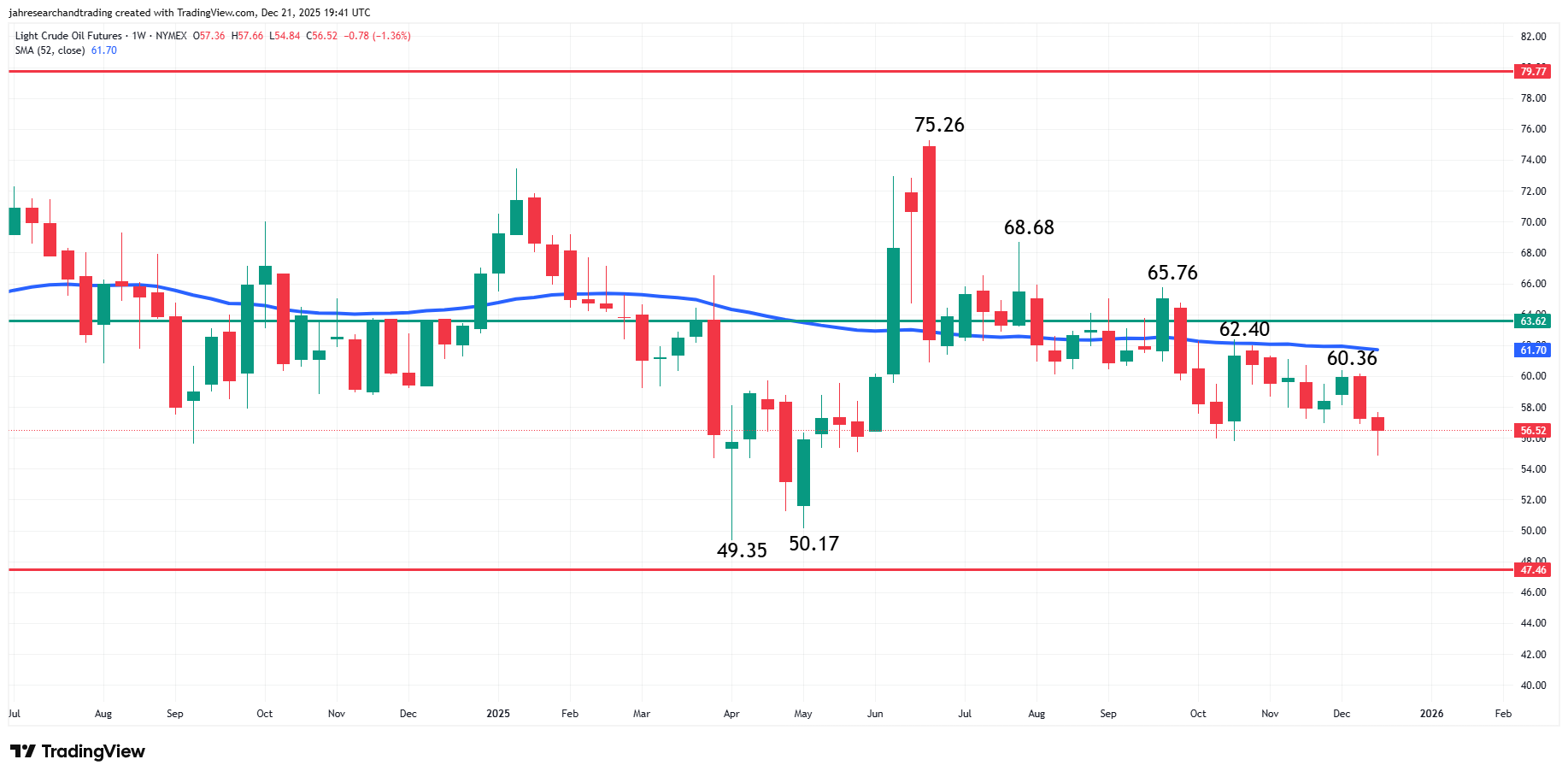
Technically, the picture stays bearish. WTI closed the week below the 52-week moving average at $61.70, a major trend indicator and firm resistance that crude hasn’t come close to challenging. Finishing more than $5 under that level reinforces the bearish structure.
Brent Oil Price Forecast
Every new Brent Oil analysis as it publishes, today's technical signal and key levels, live price — on one page.
See all Brent Oil forecastsLast week’s sharp break also put a wider downside band on trader radar: $50.17 to $49.35. Those levels matter because they represent the next meaningful support zone if sellers regain control. With a holiday-shortened week ahead — and liquidity thinning out — a move toward that lower band can’t be dismissed if sellers press their advantage.
Oil Prices Projections Lean Lower Into Early 2026
OPEC+ may pause further increases in early 2026, but no one is talking cuts. The IEA still sees a major surplus forming, and the EIA expects Brent — and by extension WTI — to average near $55 early next year. Russia-Ukraine negotiations add headline risk but don’t change core fundamentals: too many barrels on the market.
Bottom line: With WTI closing the week at $56.52 and firmly below the 52-week moving average, the bearish trend stays intact. The market is still treating every bounce as a chance to sell, and unless a real supply disruption hits, crude remains biased toward the $50.17–$49.35 support zone.
More Information in our Economic Calendar.