



Range-Bound Crude Eyes Upside Breakout on Geopolitical Tensions
March WTI crude oil futures are edging lower on Wednesday as traders test the upper end of its one-week range. The longer the market sits in this range, the greater the expected breakout. We’re leaning toward an upside breakout because there is a “war premium” providing support. Given the turmoil in Iran and tensions building with Europe over Greenland and fresh tariffs, we feel that any bullish spark will send shorts scrambling to aggressively cover positions, feeding the breakout rally.
At 10:14 GMT, March WTI crude oil futures are trading $59.91, down $0.45 or -0.75%.
Patience Required in This News-Driven Market
Buying ahead of the expected breakout is not necessarily a bad idea, but you have to be patient since we’re in a news-driven market and of course, you have to know your exit first. This is not a “set it and forget it” situation with two-sided, whipsaw action the norm lately. Concerns about the oversupply situation continue to cap gains so it’s going to take a bullish headline to trigger any acceleration to the upside.
Supply Concerns Battle Geopolitical Risk Premium
While the potential escalation of tensions in Iran and a subsequent supply disruption may be keeping prices afloat, Reuters is telling us today that supply concerns are pressuring prices. They cite an expected build-up of U.S. crude inventories as one reason gains are being limited just one day after yesterday’s price surge was fueled by a temporary halt in output at two large fields in Kazakhstan and geopolitical pressure from U.S. threats of tariffs over its bid to gain control of Greenland.
Key Inventory Data on the Horizon
U.S. crude oil and gasoline stockpiles were expected to have risen last week, while distillate inventories likely fell in the week to January 16. The American Petroleum Institute (API) will release its latest data later today with the Energy Information Administration (EIA) on tap for Thursday.
Technical Outlook: Caught Between Key Moving Averages
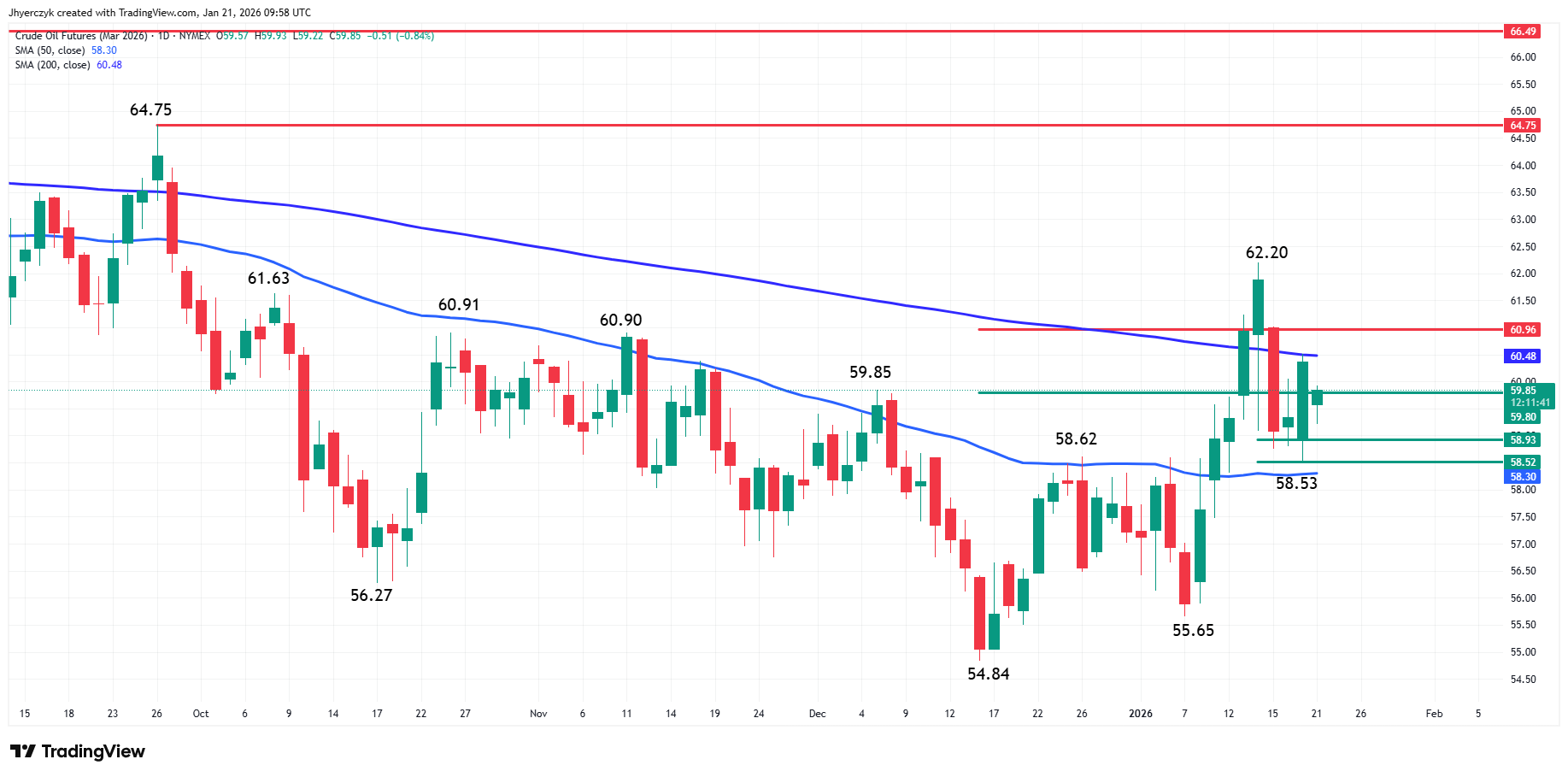
Technically, gains are being capped by a wide retracement zone at $59.80 to $60.96, but we believe the 200-day moving average inside this zone at $60.48 is likely the key to a longer-term rally. Last week, prices spiked to $62.20 after President Trump threatened military action against Iran.
Brent Oil Price Forecast
Every new Brent Oil analysis as it publishes, today's technical signal and key levels, live price — on one page.
See all Brent Oil forecastsOn the downside, support is a pair of 50% levels at $58.93 and $58.52, followed by the 50-day moving average at $58.30. This area was successfully tested three times over the last four days.
The Bottom Line: Bullish Bias Amid Dual Triggers
Looking ahead, keeping it simple, the market is being held rangebound by the 200-day moving average at $60.48 and the 50-day moving average at $58.30. Both prices are also potential trigger points for price surges. Our bias is to the upside at this time.
While inventory growth would be a negative for prices at this time, the potential for U.S.-Iran tensions would offset this growth and would help elevate oil prices. From a technical perspective, bearish news would likely lead prices to trend lower, while bullish news would spike prices higher.
More Information in our Economic Calendar.