Crude Oil Prices Edge Higher in Thin Holiday Trading
Light crude oil futures settled slightly higher last week at $56.74, up $0.22 or +0.39%. The price action was subdued because of feeble holiday volume and the lack of any major news events to drive the trade.

Oil Prices Forecast: Downtrend Dominates Weekly Chart
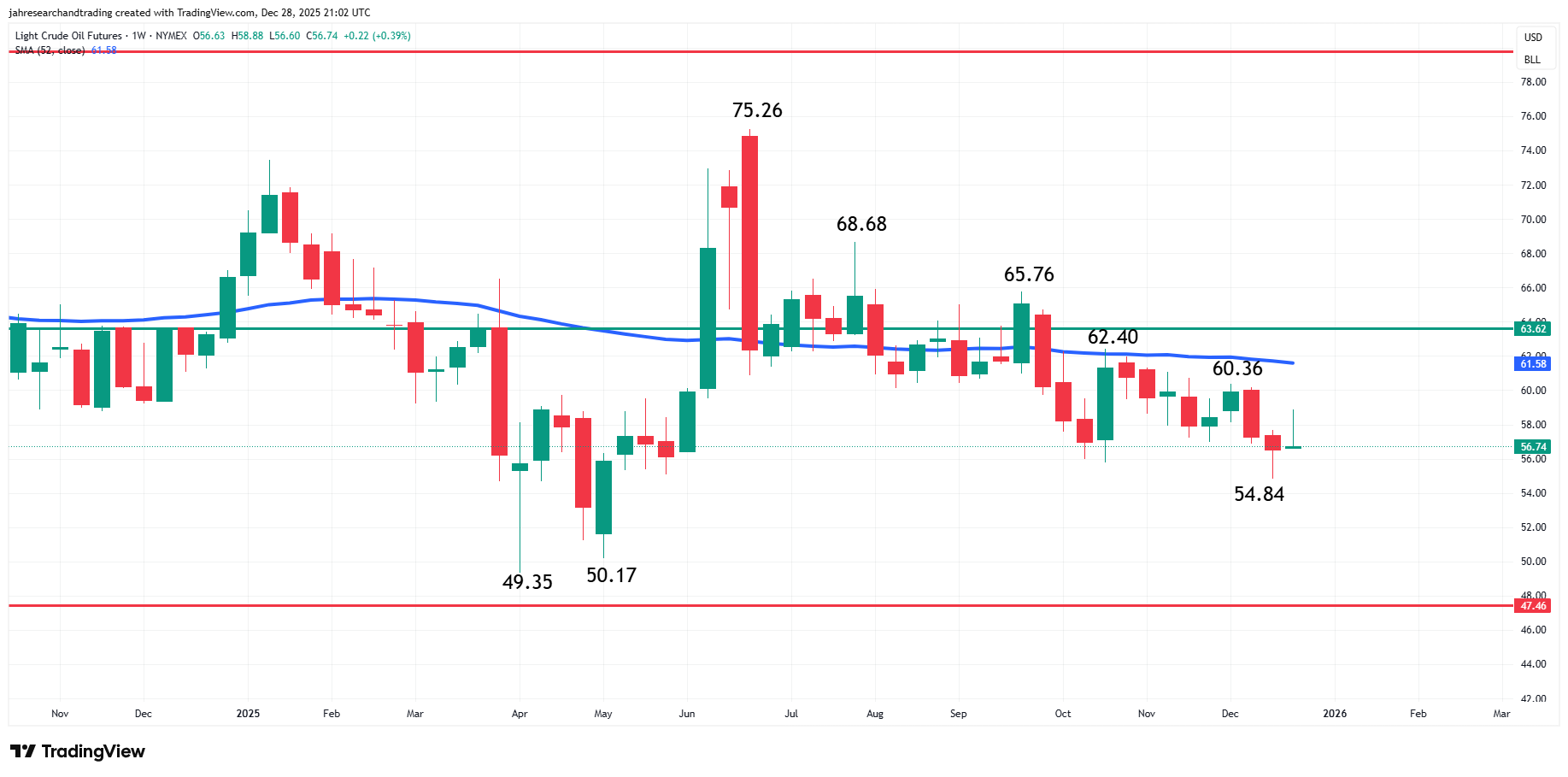
Technically, whatever trend indicator you choose to follow—moving average or swing chart—the main trend is down on the weekly chart.
For those following the moving average, the 52-week indicator at $61.58 is applying the pressure. It has been leaning on buyers and capping rallies since late October. Until this level is overcome with conviction, solid buying volume and a change in the fundamental narrative to bullish, traders will be more inclined to sell rallies into it.
Swing Chart Points to Lower Tops and Lower Bottoms
The swing chart is also pointing down as evidenced by the series of lower tops and lower bottoms. The last swing top at $60.36 is under the 52-week moving average. This means that even if the market changes the trend on the swing chart, it will still face headwinds at the 52-week moving average. So let’s just call the moving average the most important trend indicator.
Chart-watchers are also eyeing a long-term pivot at $63.62. This is another potential headwind.
Brent Oil Price Forecast
Every new Brent Oil analysis as it publishes, today's technical signal and key levels, live price — on one page.
See all Brent Oil forecastsAggressive Traders Eye Breakout Above $60.36
Aggressive traders looking for a bigger payoff may enter on the breakout over $60.36 and hope for strong enough buying to overtake both the 52-week moving average and the long-term pivot.
On the downside, a trade through $54.84 will signal a resumption of the downtrend, opening up the possibility of an acceleration into $50.17 to $49.35.
Crude Oil News: Bears Hold Real Numbers, Bulls Bank on Speculation
The fundamentals are stacked for both the bulls and the bears. However, for the bears, the sentiment is backed up by real numbers. Bullish traders are banking on speculative issues that may or may not take place.
Oil Prices Projections: Oversupply Remains Central for 2026
For the bears, oversupply is still central to oil price projections for 2026. Despite a stable week, the long-term expectations are still bearish. The U.S. Energy Information Administration’s (EIA) latest Short-Term Energy Outlook projects Brent oil averaging $55 in the first quarter of 2026. This reflects anticipated inventory builds exceeding 2 million barrels per day next year.
The International Energy Agency’s (IEA) supply assessment reinforces the view of the EIA, highlighting global supply growth to rise by 3 million barrels per day in 2025 and another 2.4 million barrels per day in 2026. Meanwhile, it projects demand growth to remain under 1 million barrels per day in both years.
Headlines Drive Price Action in Thin Holiday Trading
Even with these bearish assessments, the market has stopped going down, at least temporarily, because the bullish traders have been reading and reacting to the headlines. These headlines involve Venezuelan and Russian supply. During a holiday week when volume is light, these headlines could lead to exaggerated reactions.
Week Ahead: EIA Storage Report and Geopolitical Tensions in Focus
During the upcoming holiday-shortened week, bearish supply-side traders will be focused on the delayed EIA weekly storage report since there are no other major events scheduled. Bullish traders will be reading the headlines, hoping to react to geopolitical stress including U.S. seizures of Venezuelan crude and Ukraine’s escalating strikes on Russian infrastructure—both of which could introduce uncertainty around short-term supply flows.
Technically, traders are likely to sell rallies, using the 52-week moving average and the long-term 50% level as a cushion until they are overcome with fundamentally-backed buying conviction.
More Information in our Economic Calendar.