



WTI Crude Oil Stalls at 200-Day MA as Oversupply Battles Geopolitical Risk
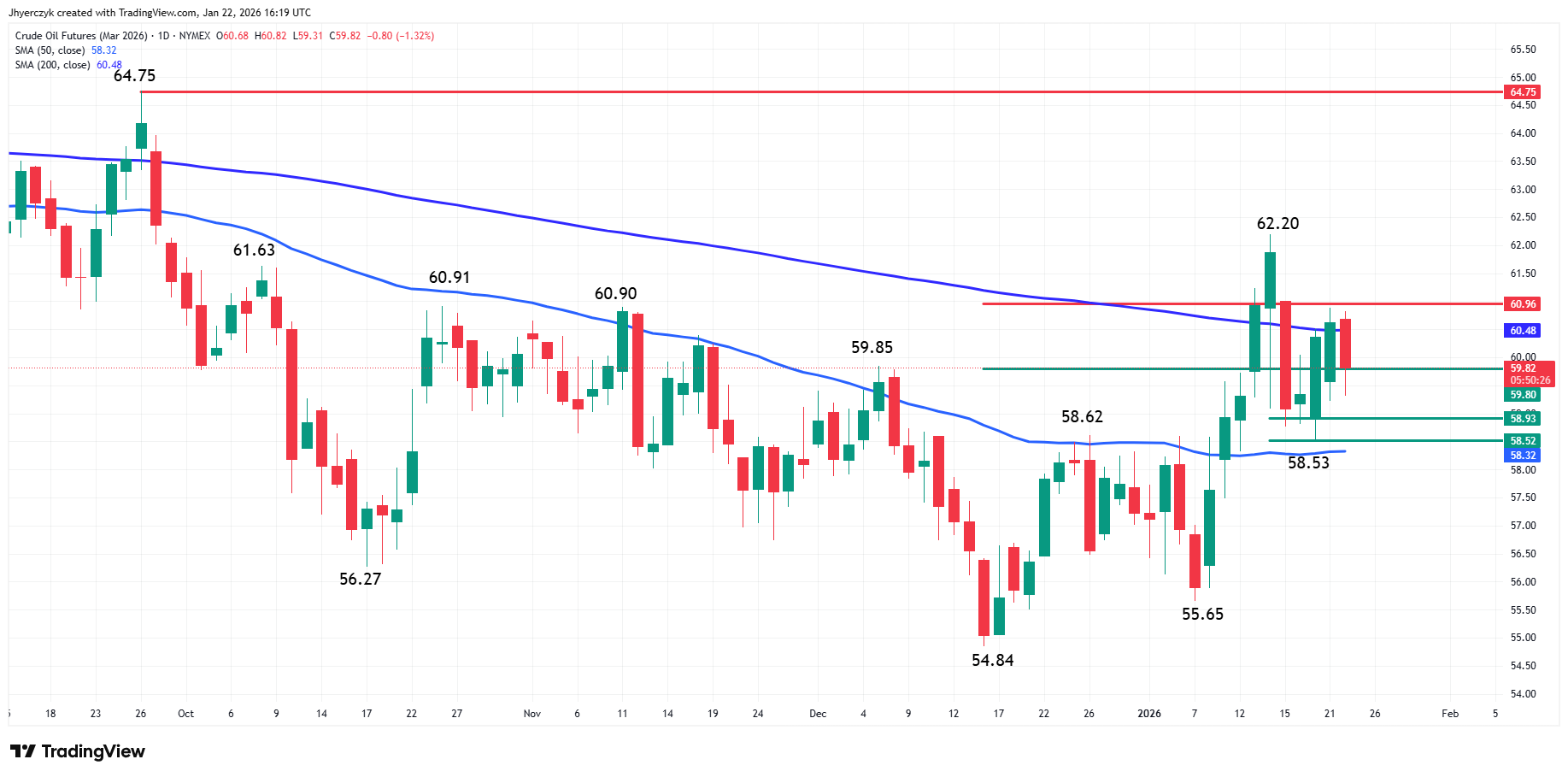
March WTI crude oil futures are edging lower on Thursday after running into the 200-day moving average at $60.48. The market is also testing the intermediate retracement zone at $59.80 to $60.96. On the downside, support is a pair of 50% levels at $58.93 and $58.52. This is followed by the 50-day moving average at $58.32.
At 16:17 GMT, March WTI crude oil futures are trading $59.88, down $0.74 or -1.22%.
Swing Chart Analysis: $62.20 Breakout Needed to Resume Uptrend
Looking at the swing chart, a trade through $62.20 will signal a resumption of the uptrend, while a sustained trade under $58.53 will change the main trend to down.
Oversupply Concerns Clash with Iran Supply Disruption Premium
Keeping prices rangebound is the battle between oversupply and the bullish premium driven by supply fears surrounding Iran.
EIA Report Due Today: Expected 1.1 Million Barrel Inventory Build
On the supply side, the U.S. Energy Information Administration (EIA)is expected to show an average increase of about 1.1 million barrels in today’s weekly inventories report, due to be released at 17:00 GMT. “High crude inventories are limiting further gains in oil prices in an oversupplied market,” said Yang An, an analyst at Haitong Futures.
Late Wednesday, the American Petroleum Institute (API) said U.S. crude and gasoline stocks rose, while distillate inventories fell last week, Reuters reported. Crude stocks rose by 3.04 million barrels in the week-ended on January 16 and Gasoline inventories rose by 6.21 million barrels, while distillate inventories fell by 33,000 barrels.
Brent Oil Price Forecast
Every new Brent Oil analysis as it publishes, today's technical signal and key levels, live price — on one page.
See all Brent Oil forecastsIEA Revises 2026 Global Oil Demand Growth Higher, Narrowing Surplus
Reuters also reported that the International Energy Agency (IEA) revised its 2026 global oil demand growth forecasts higher on Wednesday in its latest monthly oil market report. This was actually a little bullish since it suggested a slightly narrower surplus this year.
Geopolitical Risk Premium Deflates on Trump’s Greenland Pivot and Iran Signals
Diminishing geopolitical concerns are also capping gains today with the deflation of risk premium related to the Greenland pivot by Trump and Iran supply disruption risk. Late Wednesday, President Trump ruled out military force in his quest for Greenland, lifted his tariff threat on Europe and announced that a “framework” was in place to take control of Greenland.
Trump also said on Thursday that he hoped there would be no further U.S. military action in Iran, but added the United States would act if Tehran resumed its nuclear program, Reuters wrote.
Range-Bound Trade Expected: $60.48 Ceiling, $58.32 Floor, $59.40 Sweet Spot
Technical analysis points towards a range bound trade with prices capped by the 200-day moving average and supported by the 50-day moving average. Fundamentally, increasing supply and a slight easing of tensions over Iran are enough to curtail upside movement, but there is still a threat of a supply disruption in the Middle East so it looks as if the floor will remain in place over the near-term. The upside limit is currently at $60.48 and the lower limit at $58.32, making the sweet spot about $59.40.
More Information in our Economic Calendar.