



Positioning-Driven Buying Lifts Crude From Depressed Levels
Light crude oil futures edged higher during Tuesday’s mid-session, extending gains driven largely by short-covering rather than a change in underlying fundamentals. Prices rebounded from relatively depressed levels even as the broader market remains well supplied. Heightened geopolitical tension around shipping and sanctions enforcement encouraged traders to reduce bearish exposure.
At 19:01 GMT, Light crude oil futures are trading $58.36, up $0.35 or +0.60%.
Monday’s advance marked a sharp move higher, with both Brent and WTI posting their strongest daily gains in weeks. The rally occurred despite persistent surplus concerns, underscoring how quickly positioning can adjust when supply risk headlines resurface. Traders are now assessing whether the move represents corrective buying or the start of a broader reset in sentiment.
WTI Technical Structure Improves as Key Retracement Levels Give Way
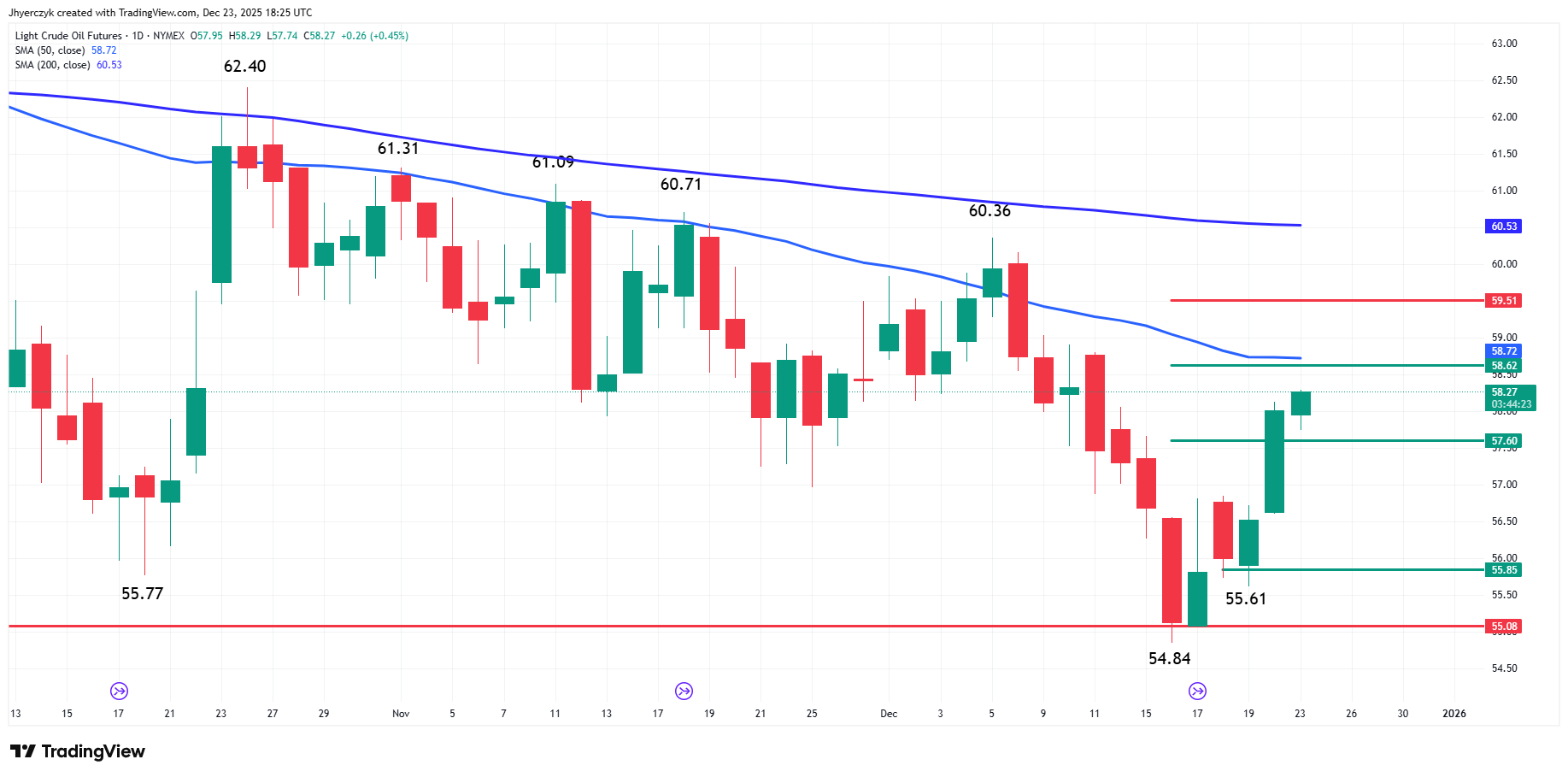
Light crude oil futures launched the current rally from $54.84, triggering short-covering as prices advanced through key retracement levels. The move cleared the 50% retracement at $55.85 and extended through the next 50% level at $57.60, reinforcing near-term upside momentum.
With those levels removed as resistance, prices are now testing a three-month retracement zone between $58.62 and $59.51. This area also contains the 50-day moving average at $58.72, increasing its importance as a near-term decision point for continuation versus renewed selling pressure.
Venezuela Sanctions Enforcement Raises Near-Term Supply Uncertainty
Oil prices steadied Tuesday as markets weighed the possibility of U.S. sales of Venezuelan crude seized under sanctions enforcement. Comments from U.S. President Donald Trump suggesting Washington could retain or sell confiscated cargoes injected uncertainty around near-term supply availability.
Tanker loading activity in Venezuela slowed, with most vessels restricted to domestic movements following U.S. action against additional ships. These developments raised concerns that exports could be constrained further if enforcement intensifies, tightening prompt availability for refiners reliant on sanctioned flows.
Brent Oil Price Forecast
Every new Brent Oil analysis as it publishes, today's technical signal and key levels, live price — on one page.
See all Brent Oil forecastsStrong U.S. Growth Complicates the Oil Prices Forecast
On the demand side, traders balanced supply concerns against firmer U.S. consumption signals. The Commerce Department’s Bureau of Economic Analysis reported faster-than-expected third-quarter GDP growth, driven by resilient consumer spending, reinforcing confidence in near-term fuel demand.
At the same time, stronger growth revived concerns that the Federal Reserve may need to maintain restrictive policy longer to control inflation. Market participants remain divided between demand optimism and policy caution that could temper forward consumption expectations.
Maritime Attacks Increase Risk Across Key Export Corridors
Geopolitical risk extended beyond Latin America as Russian strikes damaged port facilities and a vessel at Ukraine’s Black Sea port of Odesa. Ukrainian drone attacks also targeted maritime assets in Russia’s Krasnodar region, increasing risk around critical shipping routes.
Ukraine has intensified pressure on Russia’s maritime logistics, including shadow-fleet tankers moving sanctioned crude. Rystad Energy noted that markets remain caught between surplus-driven bearish fundamentals and growing supply risk tied to shipping disruptions.
Crude Oil Market Forecast: Near-Term Bias Remains Firm
In the near term, crude prices remain supported by positioning adjustments, geopolitical risk, and solid U.S. economic data. While surplus conditions continue to limit upside conviction, traders appear reluctant to re-establish aggressive bearish exposure with multiple supply risks unresolved. The short-term oil prices forecast carries a modestly bullish bias as long as demand resilience holds and supply disruptions remain a credible threat.
More Information in our Economic Calendar.