



Highlights
- U.S. crude inventory unexpectedly rises, oil prices fall
- Middle East tensions affect global oil demand outlook
- Short-term oil market forecast remains bearish
Oil Prices Fall
Oil prices are trading lower on Thursday, snapping a three-day winning streak. Brent crude oil is currently at $79.57, down $0.13 or -0.16%, while U.S. West Texas Intermediate (WTI) crude oil trades at $74.09, a decrease of $0.13 or -0.18%.

Inventory Surplus
A surprising increase in U.S. crude inventories is driving the decline. The EIA reported a 2.9 million barrel rise in crude stockpiles, contradicting analysts’ expectations of a 2.3 million barrel drop. Adding to the pressure, U.S. crude production reached a record 13.3 million barrels per day.
Middle East Tensions and Trade Impact
Earlier concerns about trade disruptions due to Middle East tensions have taken a backseat. The focus has shifted to the global demand outlook, with the Red Sea’s impact on oil seen as limited unless it escalates to the Strait of Hormuz.
Energy Sector Outlook
The oil and gas sector, according to a Dallas Federal Reserve Bank survey, remains unchanged in activity. The sector faces uncertainties around oil prices and OPEC’s influence. Large E&P firms are leaning towards asset acquisition or debt reduction, while smaller firms focus on production growth.
Short-Term Forecast
Given the current market conditions, including inventory levels and production rates, and the stable but cautious sentiment in the energy sector, oil prices are likely to remain bearish in the short term. WTI is expected to trade between $70 and $75 in the coming month, influenced by economic indicators and the U.S. dollar’s performance.
Technical Analysis
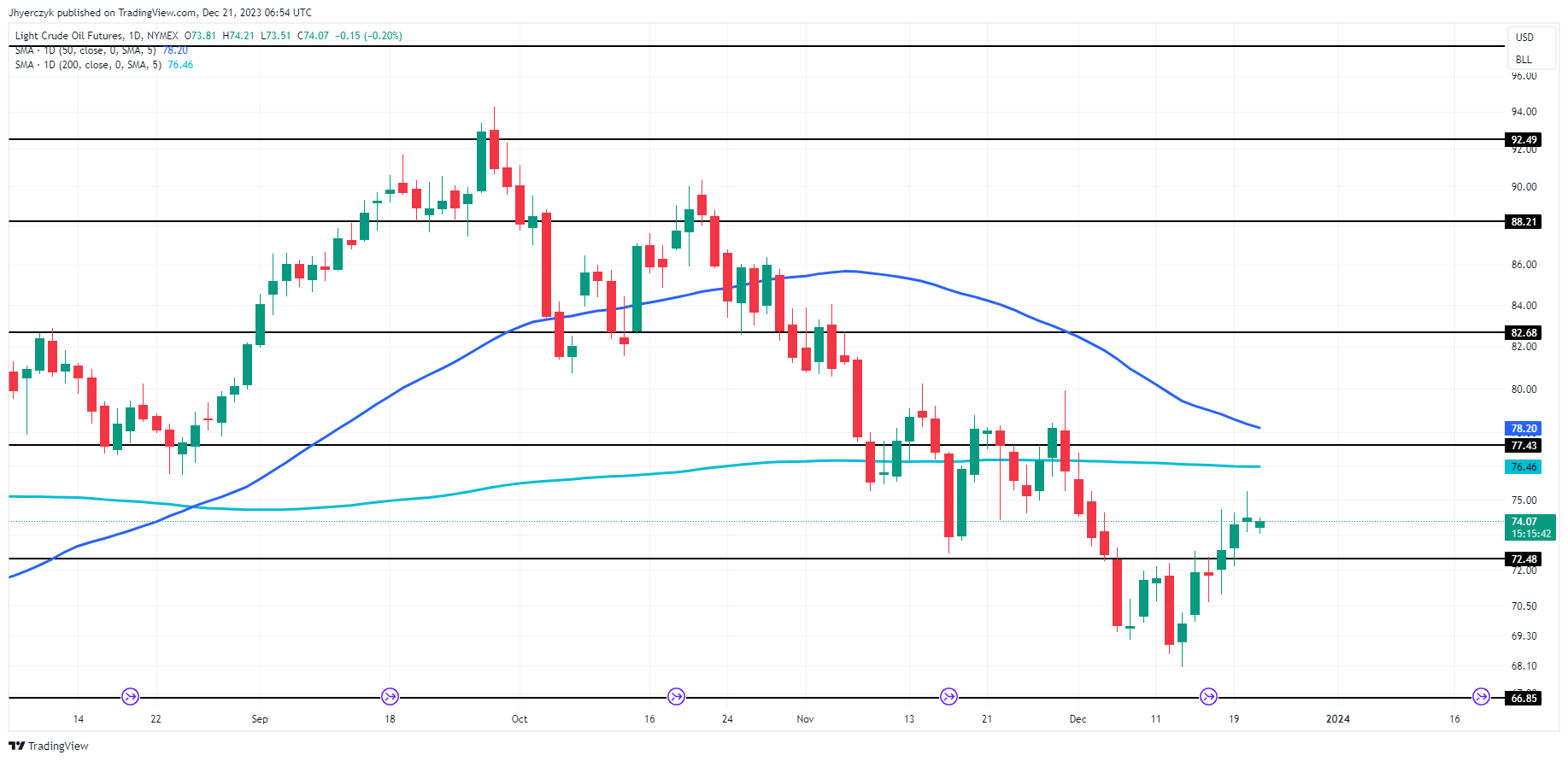
The current daily price of Light Crude Oil Futures at $74.11 is indicative of a slight bearish tilt, falling below both the 50-day and 200-day moving averages, which stand at $78.21 and $76.46, respectively. This positioning suggests prevailing bearish sentiment, as the market underperforms against these key averages, signaling a dominance of selling pressure both in the short and long term.
In terms of support and resistance levels, the current price finds itself comfortably above the minor support of $72.48, offering a degree of immediate stability. However, it remains notably below the minor resistance at $77.43, indicating that any upward trend may encounter resistance. The broader trading range is set between the main support at $66.85 and main resistance at $82.68, marking the zones where significant price shifts could be more pronounced.
Overall, the convergence of these technical indicators – the relative position to the moving averages and the proximity to support and resistance levels – points to a market leaning towards bearishness. The analysis reflects a scenario where the market could be in a consolidation phase or on the cusp of a more definitive downward trend, subject to changes in market dynamics and investor sentiment.


