


SpaceX is moving deeper into AI technology just days after its highly successful IPO. Elon Musk’s company is acquiring Anysphere for $60 billion in an all-stock deal. With the acquisition, SpaceX gains more favourable foothold in enterprise AI where coding tools are one of the first key revenue streams to materialise. This deal also alters investor perceptions of SpaceX. It is not just about a rocket, a satellite and Starlink. It is now a space, AI, cloud infrastructure and software growth story. That’s why SpaceX stock has surged since the announcement, and it is attracting the attention of technology and growth investors.

SpaceX Cursor Deal Strengthens Elon Musk’s AI Expansion
The deal with the Cursor will give SpaceX direct exposure to one of the hottest areas in AI. Cursor is an AI-powered tool for developers to write, edit and automate code. This market has been expanding rapidly as businesses can readily reap tangible productivity benefits from coding tools. That is a distinction from other AI offerings that don’t have the same revenue model as AI coding. For SpaceX, this is important because the company pitched a huge addressable market during its IPO. A greater stake in enterprise AI can contribute to that long-term growth narrative.
The acquisition also strengthens SpaceX’s previous acquisition, xAI. With Cursor, xAI will have access to the developer workflow, coding requests and design decisions. This data can be used to enhance AI models like Grok and new coding tools like Grok Build. SpaceX announced it will publish an AI model on Cursor, which will subsequently be followed by further training of its coding AI agent. This is an indication that the company is eager to compete on a level playing field with OpenAI, Anthropic and other giants in the AI space.
The deal structure is also important. SpaceX is paying in stocks, not the cash raised during the IPO. That enables the company to leverage its high valuation as a currency. The benefit of a high valued company is that it can buy assets with less dilution than a low valued company. This is how investors are responding positively. To acquire a rapidly expanding artificial intelligence company without hurting its own cash flow, SpaceX is leveraging the power of the stock market.
SpaceX Stock Price Surges After IPO and Cursor Deal
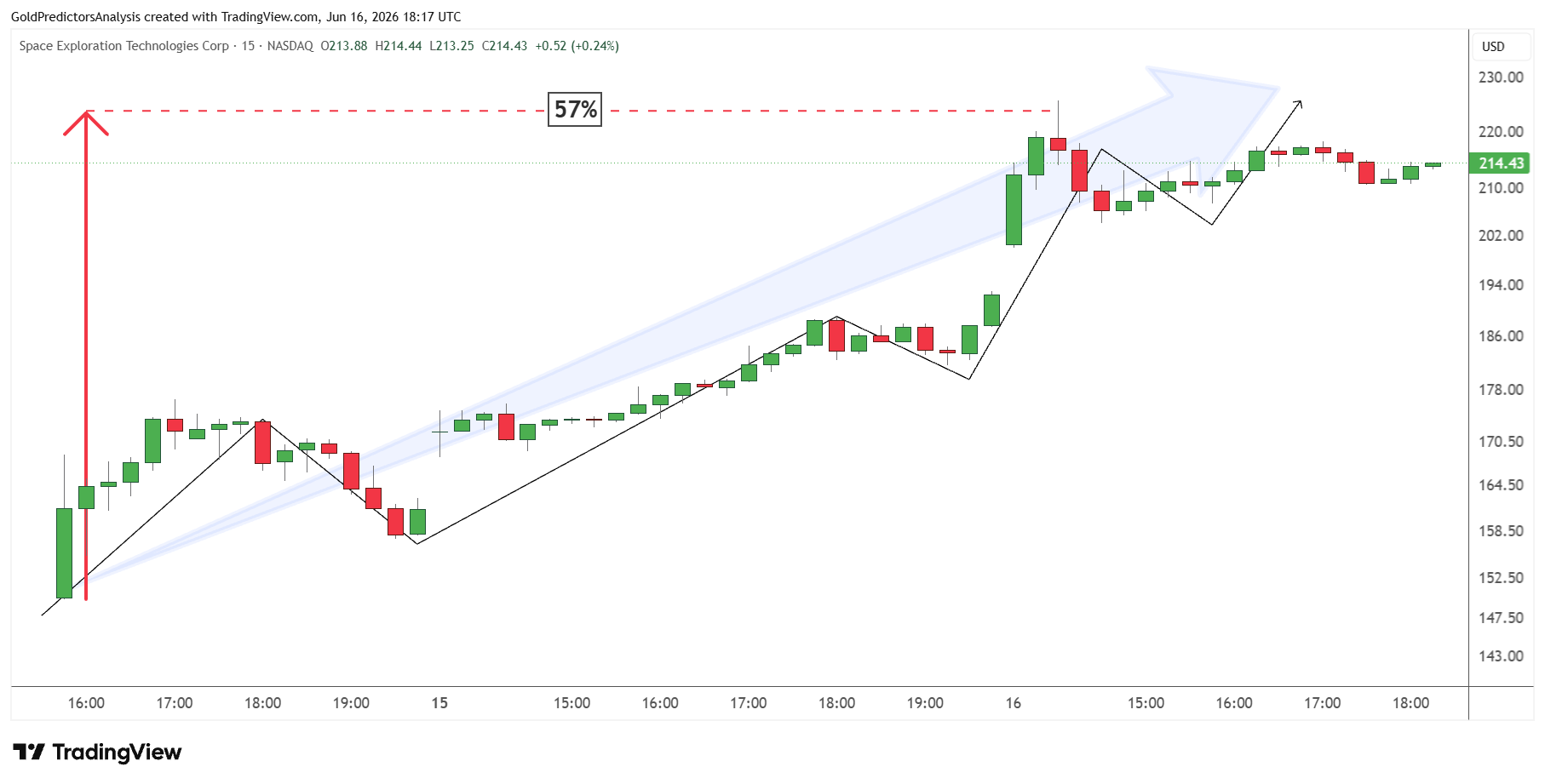
The share price of SpaceX has surged to $200 in just few hours of its IPO. The stock gained further traction on the news of Cursor and was trading around $212 on Wednesday. The stock has gained the 57% from the IPO price of $135.
This rally reflects strong demand for growth stocks that are linked to Musk. This also validates that investors are taking a long-term view on SpaceX and treat it as more than a typical aerospace firm. The market is already factoring in future growth of the company’s Starlink, AI and cloud computing businesses.
The chart below shows strong bullish momentum following the IPO breakout. The sharp rally after the public listing attracts more short-term buyers if the news is still positive. But this also introduces valuation risk. However, if the stock rises too high, any hesitation in the Cursor deal, antitrust issue or a decline in other technology stocks could lead to a downturn. The trend remains strong as long as buyers defend the post-IPO breakout zone.
What is Next?
SpaceX has emerged as one of the biggest market stories of the year after its IPO. The $60 billion Cursor deal is the proof that the company wants to expand its AI platform with xAI, Grok and enterprise coding tools. This provides an additional basis for investors to hold SpaceX in high regard beyond its rockets and satellite internet. That excitement is impacting the stock’s rally.
The rally could keep going if SpaceX is successful in making Cursor and Grok into big business tools. But if growth projections are raised too high, the stock may be headed for a massive pullback following the post-IPO rally. The short-term price action for SpaceX suggests further gains in the coming session as the rally is unstoppable.


