
Uranium prices jumped above $80/lb and reached a two month high in January 2026. In my view, this marks the start of a new bullish phase which is driven by tightening supply and rising strategic demand. This article presents the macro drivers, institutional positioning, technical structure and risk levels that shape the uranium outlook for 2026.
Macro Drivers – Strategic Demand Meets Supply Fragility
The spike in uranium price in January 2026 reflects its position as one of strongest performing commodities within the current cycle in the market. It is observed that the price of uranium has increased by more than 145% in the last ten years.
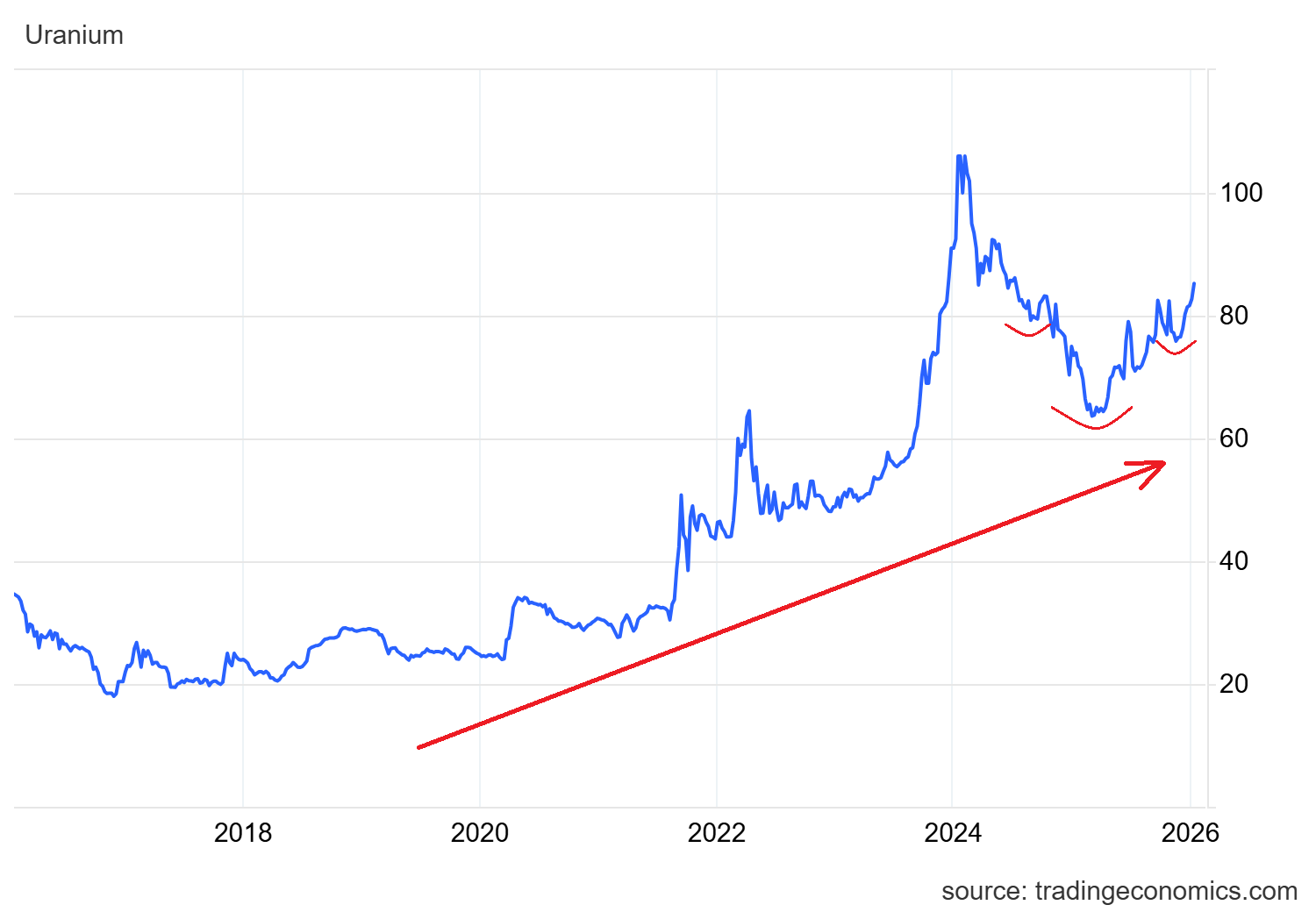
The latest rally was formed after reaching a low of $64.25/lb in 2025. This rally is based on institutional interest, energy policy changes and visibility of demand over long term. This latest strength reflects resilience towards short term volatility and growing confidence in a strategic role for uranium in the energy transition.
Financial Demand – Institutional Buyers Redefine the Market
One of the main catalysts for the uranium price rally is that institutional funds are still building up in holding physical uranium. This build-up creates constant demand above traditional utility buyers. These financial participants consider uranium strategic asset and not a cyclical commodity. Their positioning is consistent with projections for a long energy transformation, which anchors in nuclear capacity expansion.
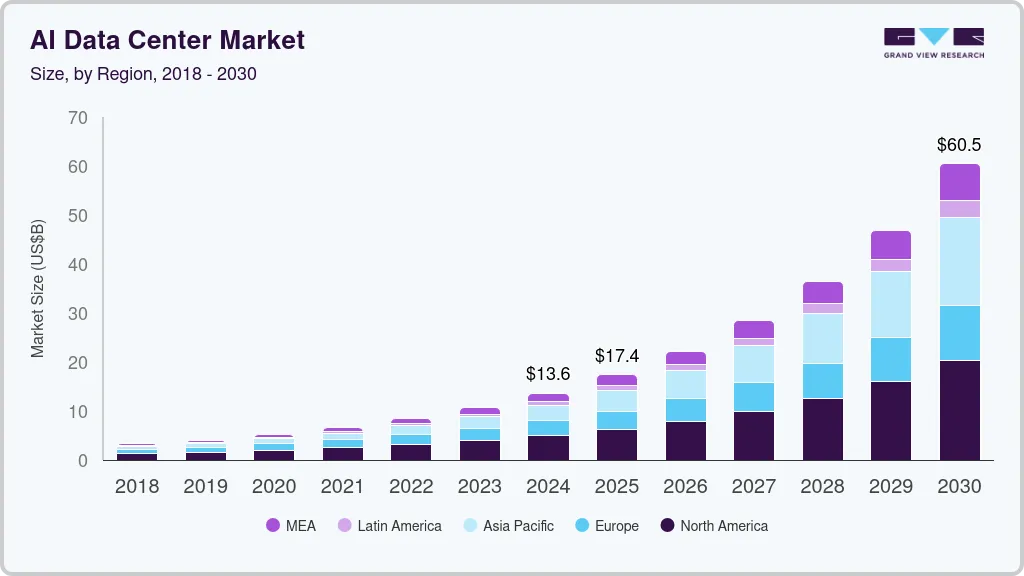
Moreover the behavior of the market echoes forward-thinking in positioning around AI-driven electricity demand. Data centers and AI infrastructure demand base load power and only nuclear plants are designed to supply it. This shift in demand in structure supports the thesis for uranium in the long run. The chart below shows that the uranium market is expected to grow exponentially over the next five years reaching $60.5 billion by 2030. This exponential growth is likely to accelerate demand for uranium.
Supply Crisis – U.S. Output Collapse Amplifies the Rally
According to the data from the EIA U.S. uranium production has declined by 44% in Q3 2025 and fell to 329,623 pounds. This is a sharp decrease from 477,501 pounds in Q2 2025 which shows a growing supply imbalance. This imbalance gives a greater urgency for restocking by utilities and funds. Since the output is concentrated in only six plants, the risk in terms of operational and geographical spread is high for the U.S.
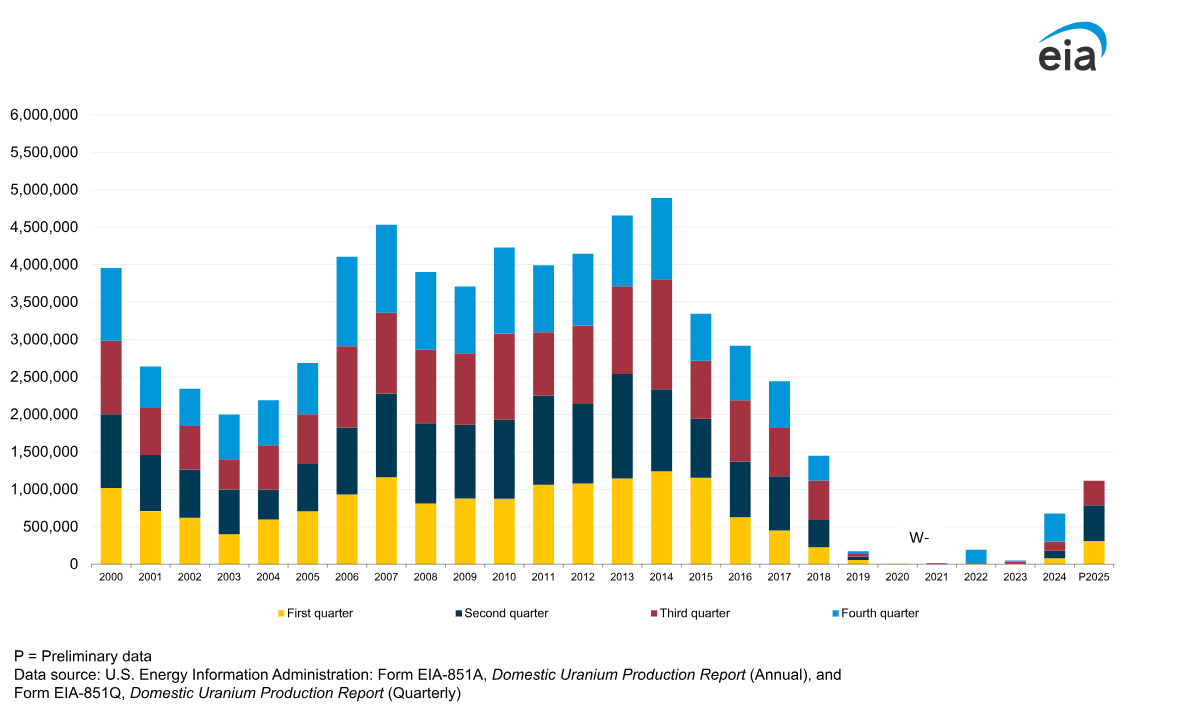
This shock shows a more profound trend on long-term basis. The U.S. output has dropped sharply and continually to the lowest in decades. The long-term lack of investment has undercut domestic potential. This has resulted in the reliance on the foreign suppliers like Kazakhstan and Russia whose exports face a growing level of geopolitical uncertainty. These structural constraints charge a price at strategic risk of uranium and are pointing to an increased revaluation.
Government Support – Multi-Decade Tailwinds from U.S. Policy
The latest funding by the U.S. government and strategic alliances enhances the prospects of uranium in the long run. The U.S. Department of Energy proclaimed that it would allocate $2.7 billion to target the production of high-assay low-enriched uranium. This is headed by American Centrifuge Operating, General Atomics and Orano Federal Services. This confirms the significance of a domestic fuel cycle.
Other major undertakings involve:
- Westinghouse, Cameco Corporation (CCJ) and Brookfield had a $80 billion contract to supply reactors.
- 10 additional reactors are planned to be rolled out in the U.S.
- U.S.–Kazakhstan cooperation for small modular reactors.
These initiatives project the demand for uranium up to 2086 since each plant has a 60-year lifespan. Advanced reactor designs and fuel demands in the Haleu present new categories of demands in addition to the traditional applications.
The uranium market is experiencing a re-rating based on these catalysts which are production restrictions, policy support and an increased long-cycle demand. The 44% decrease in production in the U.S. is just an addition of near term bullish pressure, but the decades long flows of investments are a pointer to long term imbalance in supply/demand. These drivers indicate additional upswing in uranium prices in 2026.
Technical Structure – Uranium Equities Confirm the Breakout
The chart below presents the custom uranium equity index which is made up of CCJ, Denison Mines Corp (DNN), NexGen Energy Ltd (NXE) and Sprott Uranium Miners ETF (URNM). This index surged by 30% in January 2026 and indicates further upside potential in the next few months. This index serves good proxy for market sentiment and the flow of capital into uranium assets.
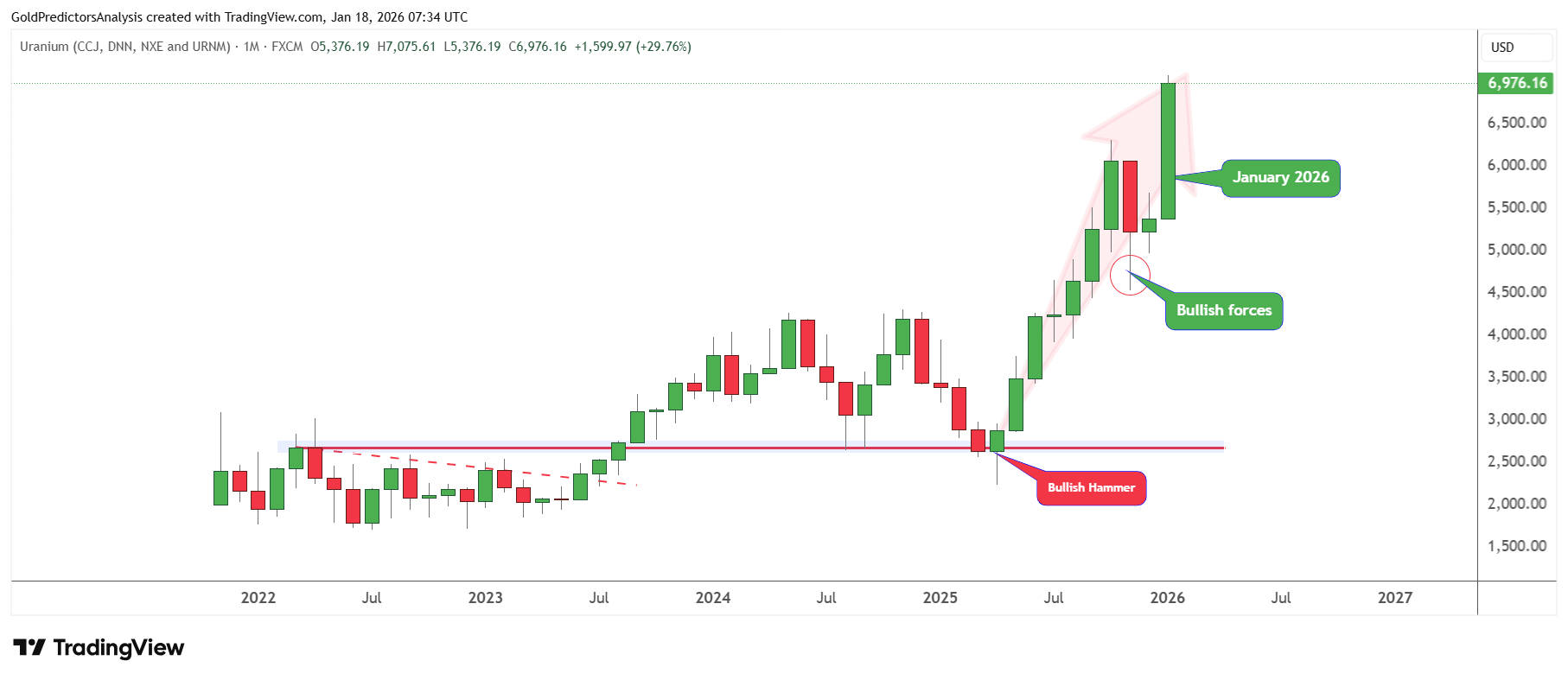
This massive uptrend in uranium was followed by a number of bullish monthly candles that developed after a key bullish hammer in early 2025. This bullish hammer candle formed above the support zone of $2,500 – $2,700.
This structure shows a strong bullish price action. The trend line breakout in 2023 resulted in bullish trend. Therefore every dip in 2025 was a strong buy.
This setup supports a continued push to 8,000 level over the next several weeks which means a strong rally in uranium prices is in place. Any correction towards 6,000 would be a constructive development and signal further upside potential in 2026.
Miners’ Momentum – ETF and Equity Surge Validates Price Strength
Miners are also backing bullish views in physical uranium. The chart below illustrates that the Global X Uranium ETF (URA) spiked by 27.31% in January and reached its greatest level since 2011. Furthermore the key Uranium Equities URNM, U.UN, and SRUUF have also surged by +26.74%, +12.03%, and +10.80% respectively in January 2026. These are strong gains that show fresh continuation patterns on the long-term charts.
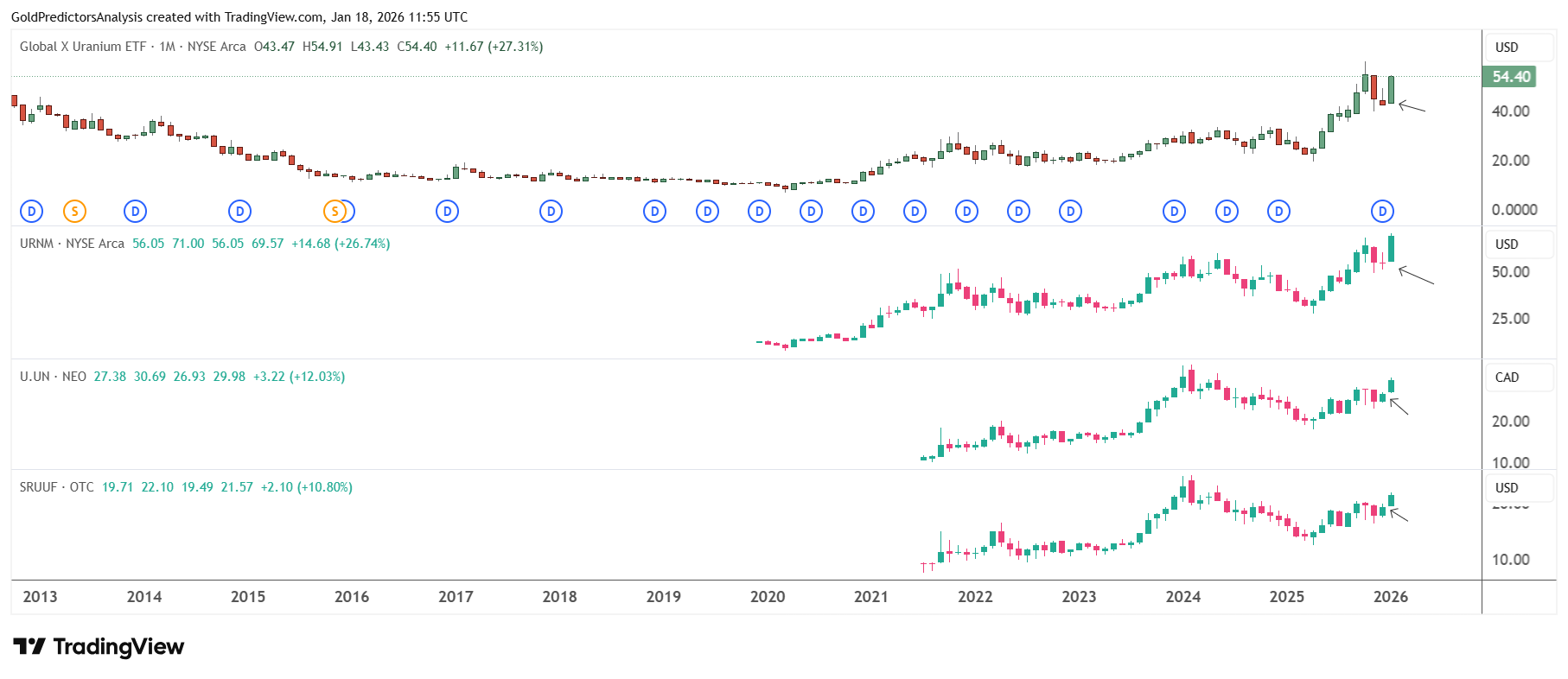
The fact that this lineup is consistent across miners and ETFs speaks volumes to the durability of the uranium rally. Historically, uranium equities have been the leaders in moving the spot price but this time they are moving together. This implies strong institutional participation and belief in the trend. These price gains also mark a sign of rotation into uranium assets in wider commodity sphere.
Energy Sector Comparison – Uranium Outshines Oil and Gas
Uranium is fuelled by the expansion of nuclear infrastructure and limitation of the fuel cycle, while WTI oil (CL) and natural gas (NG) prices reveal a lack of direction. Crude oil continues with its responsiveness to geopolitical headlines in the short term. On the other hand uranium has supply security with long cyclical certainty based on reactor construction and government backing.
Natural gas and coal face policy headwinds and ESG constraints. On the other hand uranium itself is gaining tailwinds in the form of regulation as countries look toward nuclear as a low-emission source of base load power. This breakaway in the larger energy complex leaves the uranium center to the theme of energy transition.
Market Risk – What Could Slow the Uranium Rally?
Despite the strong bullish momentum, uranium is susceptible to policy changes and geopolitical changes. Government support of nuclear energy may be suddenly cut off (as a result of environmental pressure, electoral politics, or budgetary reasons) causing short-term demand expectations to be lower.
Furthermore, developments in other base load technologies like battery storage or fusion could undermine the panic over uranium stockpiling. Conversely, a change in institutional capital to a faster moving asset may also be a constraint to short term upside.
A rebound in world output may help relieve crunchiness on the supply side. This can limit prices when giant producers such as Kazakhstan or Canada step up aggressively in 2026 or the U.S. reactivates idle capacity, which is likely to limit prices below the bullish forecasts. Uranium trades less actively than many other commodities which makes it more vulnerable to ETF outflows or physical fund liquidations. Although the long term view is good, the investors need to monitor macro shocks, production shocks and sentiment reversals, which may cause short-lived reverses.
Conclusion – Why the Uranium Bull Market Has More Room to Run
Uranium prices are entering 2026 with strong momentum. The market has rallied over 28% from last year’s low and now trades above $80/lb. This surge is backed by deep structural drivers that include rising institutional interest, physical accumulation and long-cycle demand from nuclear expansion.
In my view, these drivers will likely support prices of uranium in 2026. Moreover, the government investment, supply constraints and AI-driven electricity demand are reshaping role of uranium in the global energy mix. Therefore, the uranium price may continue to rally towards the $92/lb level in 2026.
If you’d like to know more about trend following in commodities, please visit our educational area.