
Market Overview
During early European trading, the US Dollar Index (DXY) slipped to around 98.60, easing after three consecutive sessions of gains. Markets are now focused on Tuesday’s release of US Q3 GDP (annualised), expected at 3.8%, up from the earlier 3.2% estimate. The data will be closely watched for confirmation of economic resilience.

Fed Policy Outlook Keeps Dollar Capped
The US dollar remains constrained as investors assess the Federal Reserve’s policy path. Cleveland Fed President Beth Hammack said rates are likely to remain on hold while policymakers evaluate the impact of 75 basis points of rate cuts delivered earlier this year.
According to the CME FedWatch Tool, markets now assign a 79% probability that rates will remain unchanged at the January meeting, up from 75.6% last week. Expectations for a 25-basis-point cut have declined to 21%.
Meanwhile, comments from potential future Fed leadership added nuance. Fed Governor Christopher Waller noted inflation remains elevated and suggested any easing would proceed cautiously.
Consumer Sentiment Adds to Economic Uncertainty
Weaker consumer data has also weighed on the dollar. The University of Michigan Consumer Sentiment Index fell to 52.9 in December, while inflation expectations edged higher to 4.2%, signaling persistent cost concerns alongside fragile confidence.
GBP/USD Price Forecast
Every new GBP/USD analysis as it publishes, today's technical signal and key levels, live price — on one page.
See all GBP/USD forecastsKey Data Ahead
Attention now turns to upcoming GDP and inflation readings, which will help shape expectations for Fed policy and near-term USD direction.
US Dollar Index (DXY) – Technical Analysis

The US Dollar Index remains under pressure, trading near 98.60 after failing to sustain a rebound above its descending channel. Price action continues to respect the broader downtrend, with rallies capped near the 50-EMA and the upper channel boundary around 99.20–99.30.
Recent candles show limited follow-through buying, suggesting the rebound from 97.85 was corrective rather than the start of a trend reversal. The 100-EMA above 99.40 remains a key ceiling, reinforcing the bearish medium-term structure.
Momentum indicators offer little relief for dollar bulls. RSI is hovering near 50–55, signaling neutral momentum but lacking the strength typically seen ahead of sustained upside moves. As long as DXY holds below 99.30, downside risks remain dominant.
A break below 98.20 would expose 97.85, followed by 97.50, keeping pressure on dollar-sensitive assets. Only a sustained close above the descending channel would challenge the bearish bias.
GBP/USD Technical Analysis
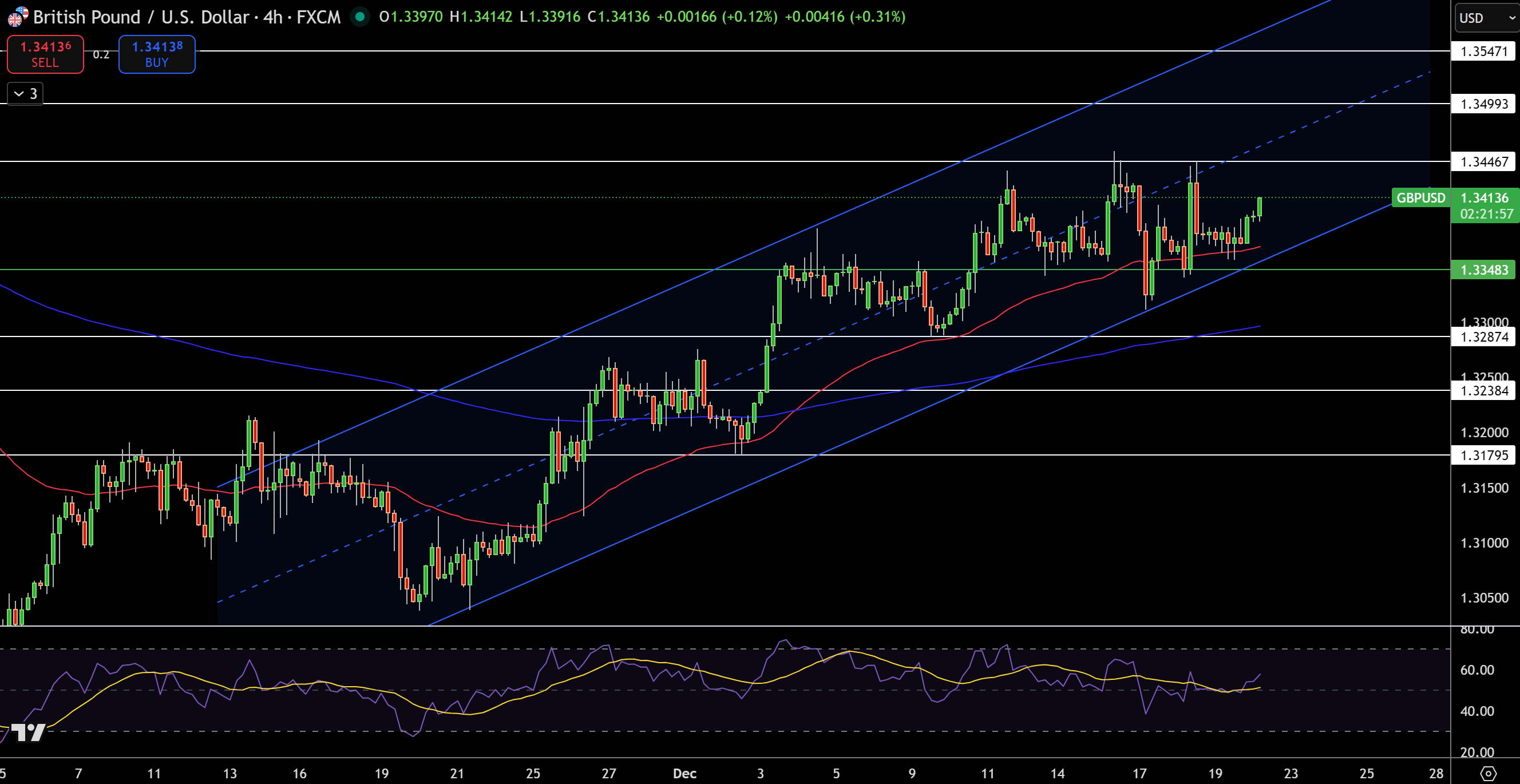
GBP/USD is trading near $1.3415, consolidating within a well-defined rising channel on the 4-hour chart. The broader trend remains constructive, supported by consistent higher highs and higher lows since late November.
Price is holding above the former support zone at $1.3350–$1.3370, with the rising 50-EMA providing near-term dynamic support. The 100-EMA near $1.3285 continues to underpin the medium-term bullish structure. Recent candles show reduced volatility, pointing to consolidation rather than trend exhaustion.
Momentum indicators remain balanced, with RSI stabilising around the 55–58 range, suggesting steady buying interest without overheating. A sustained break above $1.3450 would open the path toward $1.3500, while a move below $1.3330 would weaken the bullish setup.
EUR/USD Technical Forecast
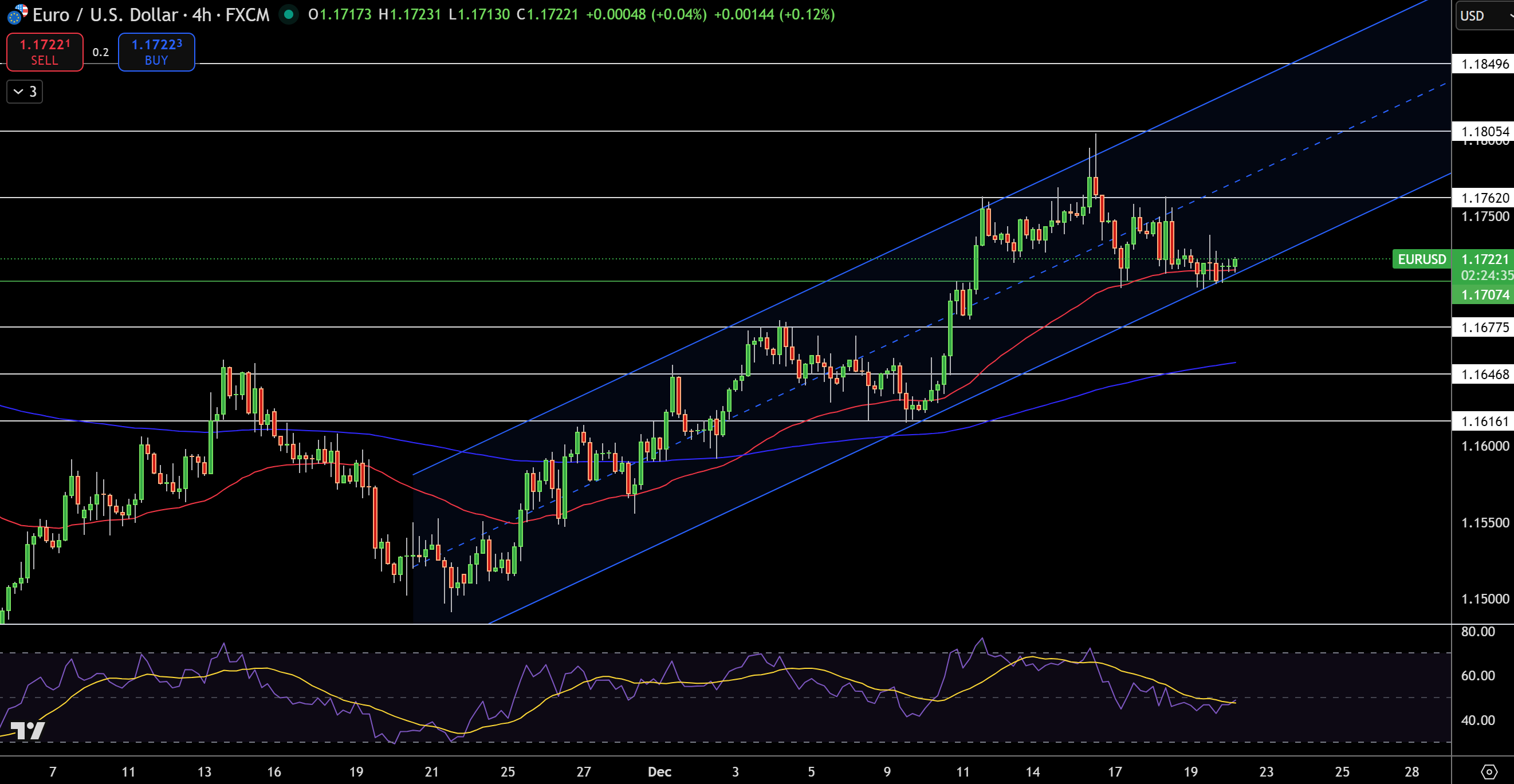
EUR/USD is consolidating near $1.1720 after easing from recent highs, while holding firmly within an ascending channel on the 4-hour chart. The broader structure remains constructive, supported by a series of higher highs and higher lows.
Price is holding above the former breakout zone at $1.1705, now acting as near-term support. The rising 50-EMA continues to underpin price action, while the 100-EMA near $1.1645 reinforces the medium-term bullish bias. Recent candles suggest consolidation rather than distribution, indicating a pause after the move toward $1.1800.
Momentum has moderated, with RSI drifting toward the 50–55 range without signaling trend reversal. A break above $1.1760 would refocus attention on $1.1805, while a sustained move below $1.1675 would weaken the bullish outlook.