Profit-taking left XRP in the red for a third consecutive day on Friday, December 12. News of Ripple receiving a conditional approval from the OCC to charter Ripple National Trust failed to trigger a breakout.
The pullback also came despite the US XRP-spot ETF market extending its inflow streak to nineteen days. Despite three-days in the red, XRP closed the session above $2.0, supporting a bullish price outlook.
Below, I will explore the key drivers behind recent price trends, the medium-term (4-8 weeks) outlook, and the key technical levels traders should watch.

OCC Grants Conditional Approval to Ripple Trust Charter
On Friday, December 12, the US Office of the Comptroller of the Currency (OCC) announced the conditional approval of five US-chartered banking license applications, including Ripple’s, stating:
“The Office of the Comptroller of the Currency (OCC) today announced its conditional approval of five national trust bank charter applications. Subject to meeting the OCC’s conditions, these institutions will join approximately 60 other national trust banks currently supervised by the OCC.”
Entry into the federal banking system is a significant step onto Main Street for Ripple, bridging TradFi and DeFi. According to the OCC, the institutions that make up the federal banking system conduct around 67% of US banking activity.
Comptroller of the Currency Jonathan V. Gould stated:
“New entrants into the federal banking sector are good for customers, the banking industry, and the economy. They provide access to new products, services, and sources of credit to customers, and ensure a dynamic, competitive, and diverse banking system.”
Ripple CEO Garlinghouse Targets Banking Lobbyists
Ripple CEO Brad Garlinghouse reacted to the announcement, stating:
Ripple Price Forecast
Every new Ripple analysis as it publishes, today's technical signal and key levels, live price — on one page.
See all Ripple forecasts“This is a massive step forward – first for RLUSD, setting the highest standard for stablecoin compliance with both federal (OCC) & state (NYDFS) oversight.”
The Ripple CEO also targeted the banking lobbyists, stating:
“Your anti-competitive tactics are transparent. You’ve complained that crypto isn’t playing by the same rules, but here’s the crypto industry – directly under the OCC’s supervision and standards – prioritizing compliance, trust, and innovation to the benefit of consumers. What are you so afraid of?”
For context, the Independent Community of Bankers of America (ICBA) filed a letter of opposition in August. The ICBA argued that Ripple could attempt to bypass banking regulations and warned of the potential threat of deposit outflows to the banking system.
Notably, the ICBA also cited the SEC v. Ripple case and Judge Analisa Torres’ ruling, permanently enjoining Ripple from violating section 5 of the Securities Act of 1933.
While Brad Garlinghouse referenced RLUSD, XRP utility will likely get a boost. Institutions using RLUSD may convert to XRP for liquidity operations, cross-border payments, or FX bridging.
Brad Garlinghouse previously commented on XRP’s central role, stating:
“I’m reminding you all that XRP sits at the center of everything Ripple does. Lock in.”
XRP-Spot ETFs Extend Inflow Streak
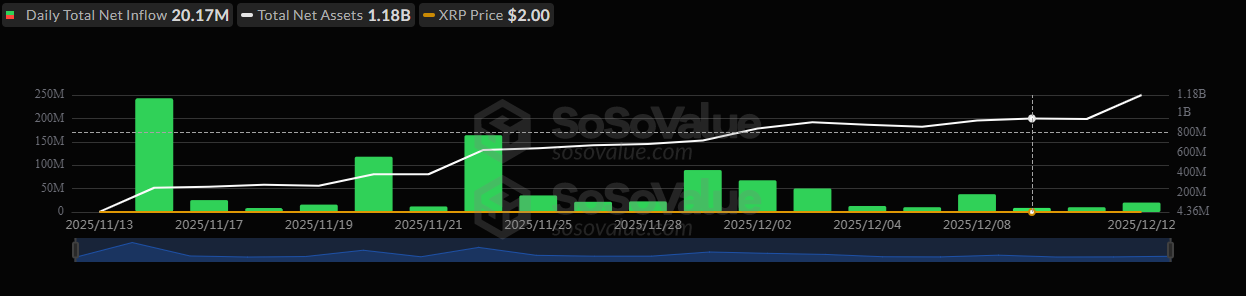
Analysts expect rising XRP utility to boost institutional demand for XRP-spot ETFs. On Thursday, December 11, the US XRP-spot ETF market reported $20.17 million in net inflows, up from $10.2 million on Wednesday, December 10. Crucially, XRP-spot ETF issuers extended their inflow streak to nineteen consecutive days, with total net inflows since launch to $974.5 million.
XRP-spot ETF inflows have cushioned the token’s downside, as XRP grips the $2.0 handle.
Bullish Medium-Term Outlook Hinges on ETFs and Legislation
XRP-spot ETF flows, and legislative developments on Capitol Hill are among several events that could trigger the next breakout. These include:
- XRP-spot ETFs experience an inflow surge.
- The Market Structure Bill receives bipartisan support.
- US inflation cools, supporting a more dovish Fed rate path.
In my view, these scenarios would support a near-term (1-4 weeks) climb to $2.35 and a medium-term (4-8 weeks) rise to $2.5.
Downside Risks to Bullish Outlook
While the short- to medium-term outlook remains bullish, several scenarios could weigh on sentiment. These include:
- The Bank of Japan raises interest rates and signals multiple 2026 rate hikes, leading to a yen carry trade unwind.
- The MSCI delists digital asset treasury companies (DATs). Delistings would likely reduce interest in XRP as a treasury reserve asset.
- US Senate opposes the Market Structure Bill.
- XRP-spot ETFs report heavy outflows.
These events would likely push XRP below $2, exposing the November low of $1.82.
However, in my opinion, sustained XRP-spot ETF inflows, a larger investor base, and progress toward crypto-friendly legislation support a longer-term move toward $3.
In summary, the short-term outlook remains cautiously bullish as fundamentals outweigh the technicals. Meanwhile, the medium- to longer-term outlook is constructive.
Financial Analysis
Technical Outlook: EMAs Signal Caution
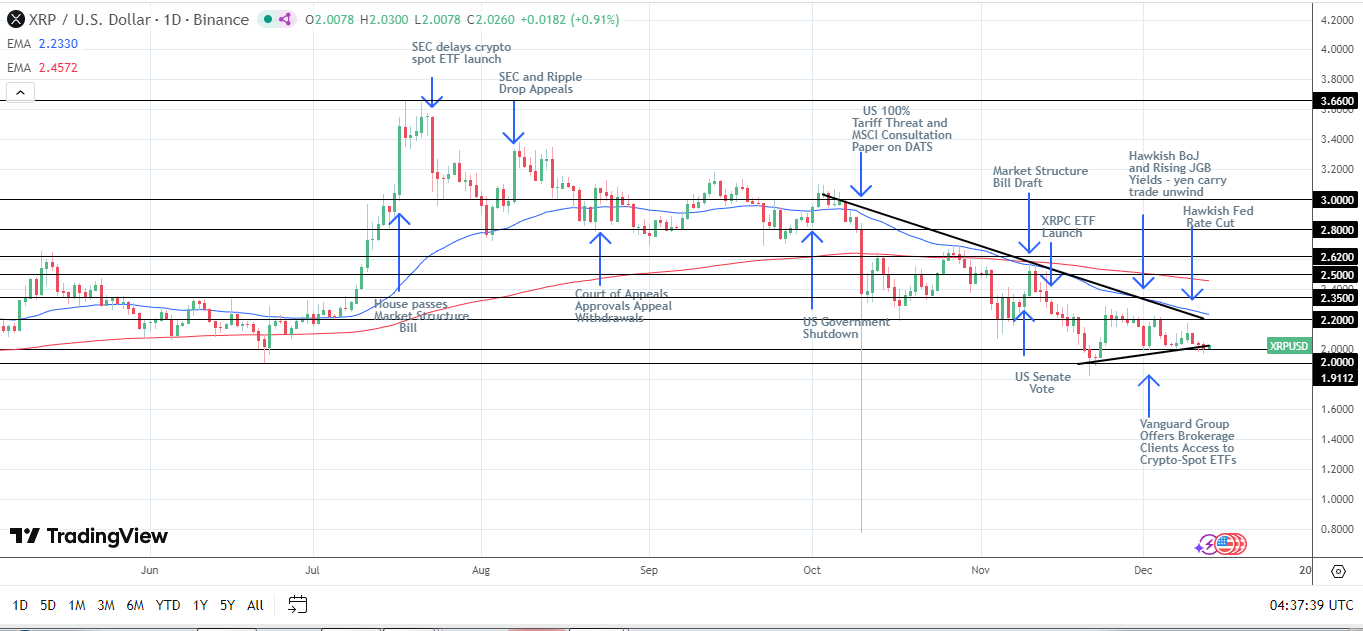
XRP fell 1.30% on Friday, December 12, following the previous day’s 0.34% loss, closing at $2.0078. The token saw a more modest loss than the broader crypto market, which dropped 2.34%.
The third consecutive day in the red left the token below the 50-day and 200-day Exponential Moving Averages (EMAs), signaling a bearish bias. While the technicals remain bearish, fundamentals are increasingly outweighing the technical structure.
Key technical levels to watch include:
- Support levels: $2, $1.9112, and $1.8239
- 50-day EMA resistance: $2.2330.
- 200-day EMA resistance: $2.4572.
- Resistance levels: $2.2, $2.35, $2.5, $2.62, $2.8, $3.0, and $3.66.
Avoiding a sustained fall below the $2.0 psychological support level would support a move to the 50-day EMA. A break above the 50-day EMA would pave the way toward $2.35. Importantly, a breakout from the 50-day EMA would signal a near-term bullish trend reversal. A bullish trend reversal would support a medium-term (4-8 weeks) climb toward the 200-day EMA and the $2.5 level.
Fundamental Indicators: Corporate Interest, ETF Demand, and Legislation
Near-term price drivers include:
- XRP-spot ETF flows.
- Blue-chip companies’ positions on XRP as a treasury reserve asset.
- The progress of the Market Structure Bill on Capitol Hill.
- MSCI’s decision on DAT listings.
- The BoJ’s interest rate decisions and forward guidance.
Bullish Structure: What Happens if $2.0 Holds?
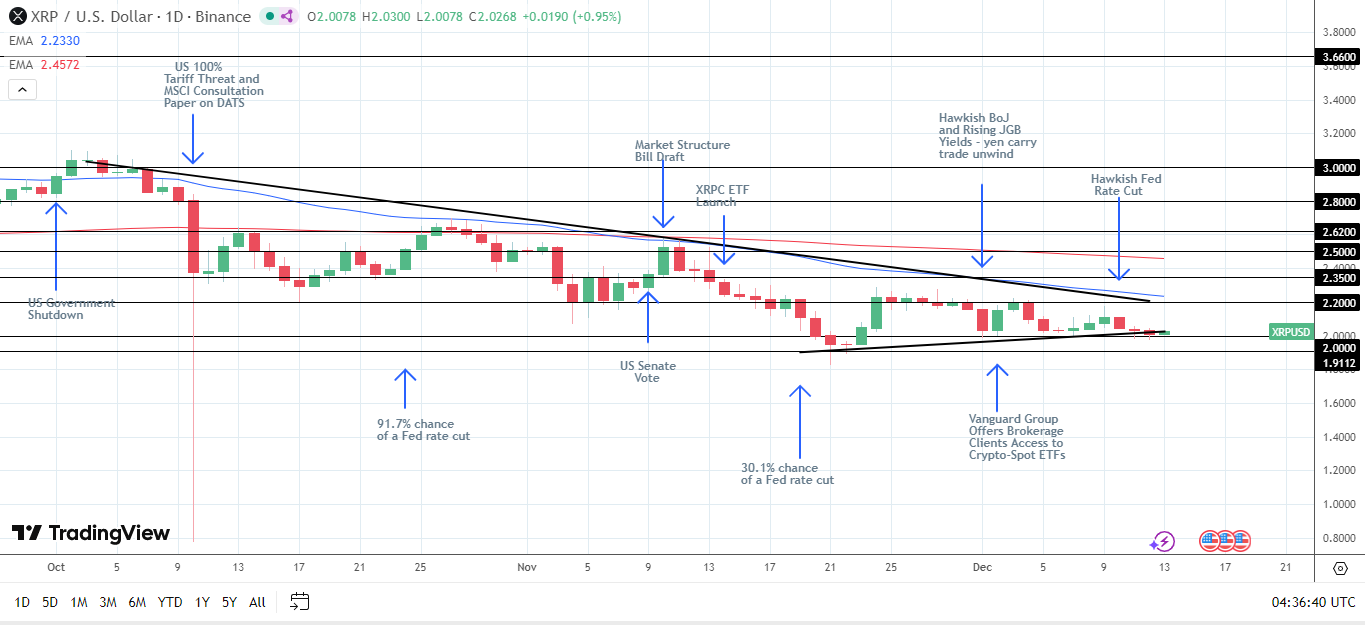
Avoiding a sustained drop below the trendline and $2.0 would enable the bulls to retest the $2.2 level and the upper trendline. A move through the upper trendline would support the bullish medium-term (4–8 weeks) target of $2.5 and longer-term (8–12 weeks) target of $3.0.
However, a drop below $1.8239 would invalidate the medium-term bullish structure.
Outlook: Breaking Clear of $2.0 Support Key to Short-Term Outlook
XRP-spot ETF flow trends for Friday, December 12, will set the tone for the Saturday, December 13, session. Another upswing in net inflows would likely boost XRP demand.
However, legislative developments on Capitol Hill will also influence sentiment, as traders track the Market Structure Bill’s progress in the Senate. The passing of the Market Structure Bill would legitimize the crypto market and open the door to a wider investor base.
To summarize, strong XRP-spot ETF inflows and bipartisan support for the Market Structure Bill support a short-term move to $2.35. Increasing XRP utility and a Senate vote passing the Market Structure Bill would reinforce the medium-term (4–8 weeks) target of $2.5 and the longer-term (8–12 weeks) target of $3.0.