
XRP extended its losing streak to four consecutive sessions on Wednesday, December 24, as technicals continued to overshadow fundamentals
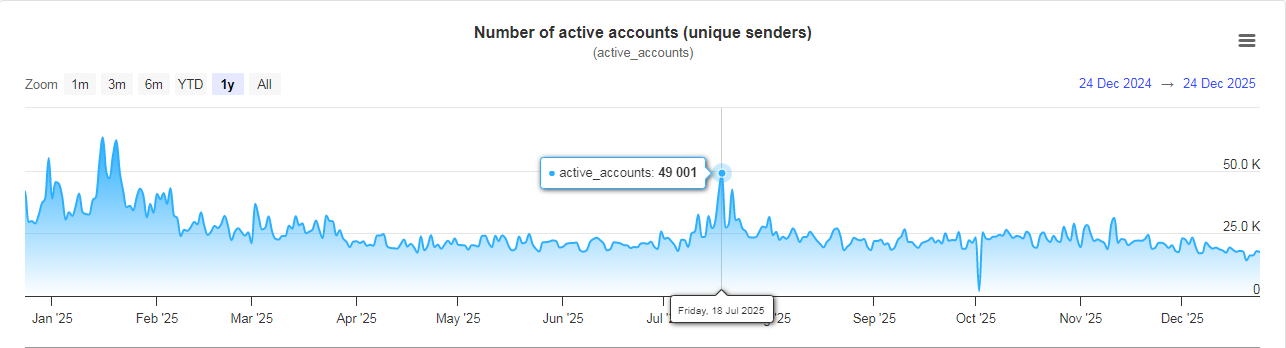
The number of active users has trended lower in 2025 after briefly peaking in January and mid-year, aligning with the sharp reversal through H2 2025. Profit taking and whale offloads have left the token down 17% in the second half of the year, despite the July rally to an all-time high of $3.66.
While selling pressure continues to counter resilient institutional demand, the stage is set for a 2026 reboot. Crypto-friendly regulations, XRP-spot ETF launches, increased XRP utility, and easing banking regulations support a bullish medium- to longer-term price outlook. However, several events would derail the constructive bias and positive price forecasts.
Below, I will explore the key drivers behind recent price trends, the medium-term (4-8 weeks) outlook, and the key technical levels traders should watch.

Active Accounts Wane as US Economic Indicators and Legislative Delays Hit Sentiment
This week, US GDP data impressed as the economy expanded by 4.3% quarter-on-quarter (QoQ) in Q3, up from 3.8% in the previous quarter. While the headline data would typically be a boon for risk assets, inflation and labor market jitters left the Fed and sentiment divided.
PCE prices increased 2.8% QoQ in Q3, up from 2.1% in the second quarter. Meanwhile, unemployment rose from 4.4% in September to 4.6% in November, its highest level since 2021. The gloomy labor market and inflation data clashed with growing concerns about a decoupling of the labor market from the economy. Analysts consider these events to be bad for crypto but good for stocks.
Ripple Price Forecast
Every new Ripple analysis as it publishes, today's technical signal and key levels, live price — on one page.
See all Ripple forecastsData Quality Concerns and Fed Uncertainty
Companies are likely to benefit from lower staffing levels through AI adoption, with higher profits and share prices. However, alternative assets may suffer from the combination of sticky inflation and rising unemployment, given the potential AI-linked tailwinds for corporations.
The Kobeissi Letter recently commented on deteriorating US labor market conditions, stating:
“The US economy lost 983,000 full-time jobs in October and November, bringing the total down to 134.2 million, the lowest since December 2021. As a result, just 78.2% of the labor force is now employed full-time, the lowest since June 2021. This percentage has now declined 2.5 points since the June 2023 peak. In the past, such a trend has usually been seen during recessions.”
Inflation Data Reliability Clouds Fed Outlook
Typically, a deteriorating labor market and cooling inflation would support a more dovish Fed rate path, boosting demand for crypto. The annual inflation rate dropped from 3% to 2.7% in November. However, the PCE price trends for Q3 painted a different picture, suggesting a sticky inflation backdrop, which curbed bets on a March Fed rate cut.
According to the CME FedWatch Tool, the chances of a March Fed rate cut fell from 53.9% on December 17 to 48.7% on December 24.
Growing concerns over the quality of inflation and labor market data have added to the negative narrative. The Kobeissi Letter commented on recent inflation data, stating:
“CPI inflation data quality has rarely been worse. In October, a record 40% of core CPI items were estimated, with 22 percentage points coming from rents and 18 points from other commodities and services. Under normal conditions, the BLS measures CPI inflation using ~90,000 monthly price observations spanning across 200 product and service categories.
The Kobeissi Letter explained further:
“When price data is unavailable, the BLS fills the gaps with estimated values, which typically account for ~10% of all entries. Overall, 34% of all inflation components were estimated using other items or geographies. This marks the 5th consecutive reading above 30% and more than triple the average seen from 2022 to 2024. Confidence in economic data is eroding.”
Unreliable data and a divided Fed appear to have vexed XRP holders and the broader cryptomarket.
XRP Network Activity Reflects Shifting Sentiment
According to XRPScan, the number of active XRP accounts (unique senders) surged to a 2025 high of 63,233 in January before falling below 20,000. Trump’s presidential election victory, his pro-crypto policies, and SEC Chair Gensler’s step down lifted sentiment.
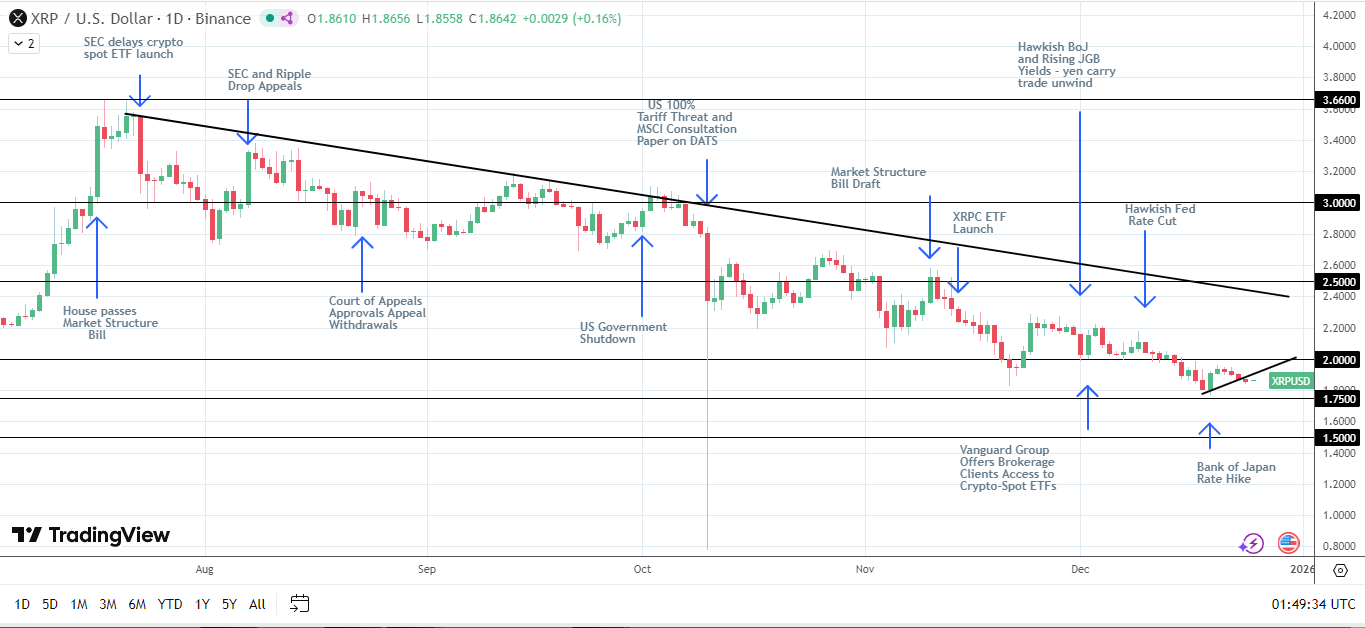
Meanwhile, active accounts rebounded in July, rising 19,560 on July 8 to 49,001 on July 18, coinciding with XRP’s all-time high. The US House of Representatives passed the Market Structure Bill to the Senate on July 17, triggering a 14.69% rally and delivering a new ATH.
Since then, delays to XRP-spot ETF launches (July 23), the US government shutdown (October 1), and MSCI’s consultation paper on digital asset treasuries (DATs) have sent XRP crashing through key support levels. Crucially, these events invalidated bullish price outlooks, impacting investor confidence.
Headwinds Turn to Tailwinds Looking Into 2026
However, the headwinds through H1 2025 are likely to become tailwinds for XRP in 2026, supporting the bullish medium- to longer-term price outlook. These include:
- Robust demand for XRP-spot ETFs. The XRP-spot ETF market extended its net inflow streak to 26 days on Tuesday, December 23, taking total net inflows since launch to $1.13 billion.
- New XRP-spot ETF launches in 2026 are likely to boost demand.
- Legislative developments signal a permanent end to regulation through enforcement. A Market Structure Bill markup is expected in early January, paving the way to crypto-friendly regulation within the first quarter.
- Fed Chair Powell’s successor is likely to favor lower interest rates, adding to the upbeat narrative.
Medium- and Long-Term Outlook: Constructive Bias Intact
Shifting bets on a March Fed rate cut have weighed on sentiment. Nevertheless, developing tailwinds reinforce the positive price outlook.
Considering the current market dynamics, the short-term (1-4 weeks) outlook remains cautiously bullish, with a $2 price target. The medium-term (4-8 weeks) and longer-term (8-12 weeks) outlooks remain constructive, with price targets of $2.5 and $3.0, respectively.
Downside Risks to the Constructive Bias
Several events could unravel the bullish outlooks. These include:
- The Bank of Japan declares a neutral interest rate of between 1.5% and 2.5%, triggering a yen carry trade unwind.
- US data and the Fed sink expectations of a March rate cut.
- The MSCI delists digital asset treasury companies (DATs). Delistings would likely reduce interest in XRP as a treasury reserve asset.
- US Senate stalls the Market Structure Bill.
- XRP-spot ETFs report outflows.
These scenarios would likely push XRP toward $1.75, indicating a bearish trend reversal.
In summary, the short-term outlook remains cautiously bullish as fundamentals override the bearish technicals. Meanwhile, the medium- to longer-term outlooks are constructive.
Financial Analysis
Technical Outlook: EMAs Signal Caution
XRP fell 0.59% on Wednesday, December 24, following the previous day’s 1.62% loss, closing at $1.8613. The token underperformed the broader crypto market, which ended the session flat.
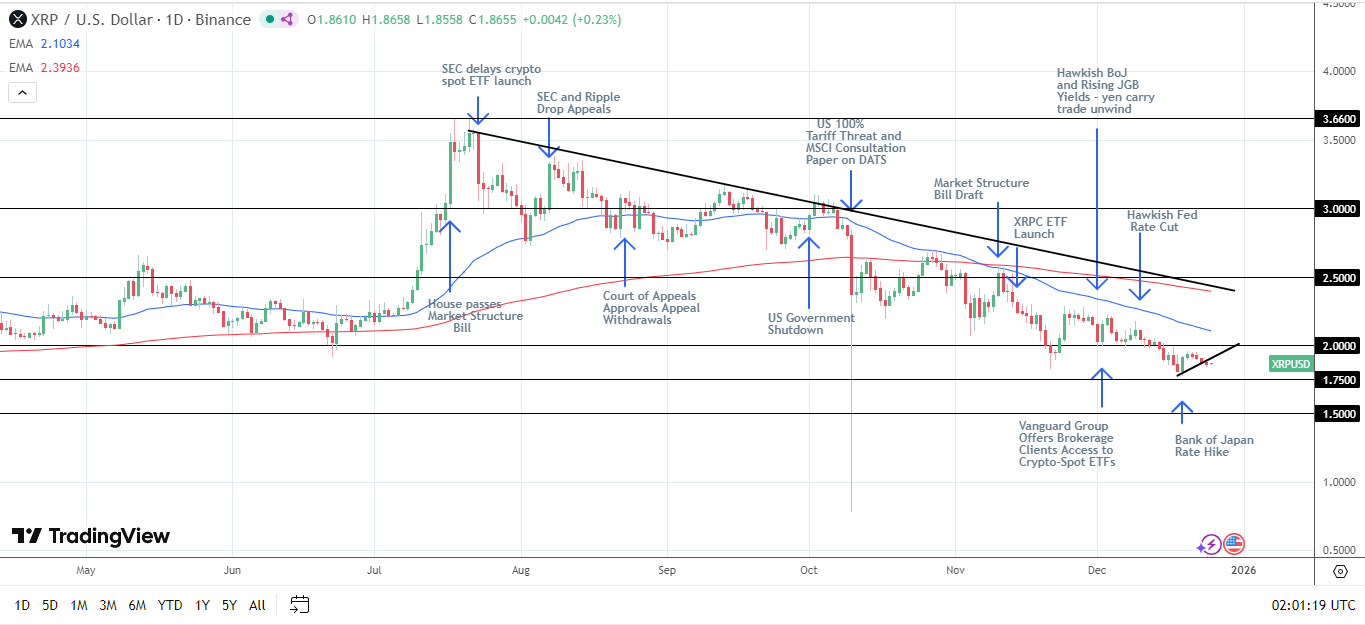
Wednesday’s pullback left XRP well below the 50-day and 200-day Exponential Moving Averages (EMAs), signaling a bearish bias. While technicals remain bearish, bullish fundamentals are developing, outweighing the technical structure.
Key technical levels to watch include:
- Support levels: $1.75, and then $1.50.
- 50-day EMA resistance: $2.1034.
- 200-day EMA resistance: $2.3936.
- Resistance levels: $2, $2.5, $3.0, and $3.66.
Looking at the daily chart, a breakout above the $2 psychological level would open the door to testing the 50-day EMA. A sustained move through the 50-day EMA would indicate a near-term bullish trend reversal, paving the way to the 200-day EMA and the $2.5 resistance level.
A break above the EMAs would support the constructive medium-term outlook and the longer-term (8-12 weeks) $3.0 price target.
Fundamental Indicators: ETF Demand, Central Bank Rate Paths, and Legislation
Near-term price drivers include:
- XRP-spot ETF flows.
- US economic data and March Fed rate cut expectations.
- US crypto-related regulatory developments.
- The BoJ’s neutral interest rate.
Bullish Structure Formation: What Happens if XRP Reclaims $2.0?
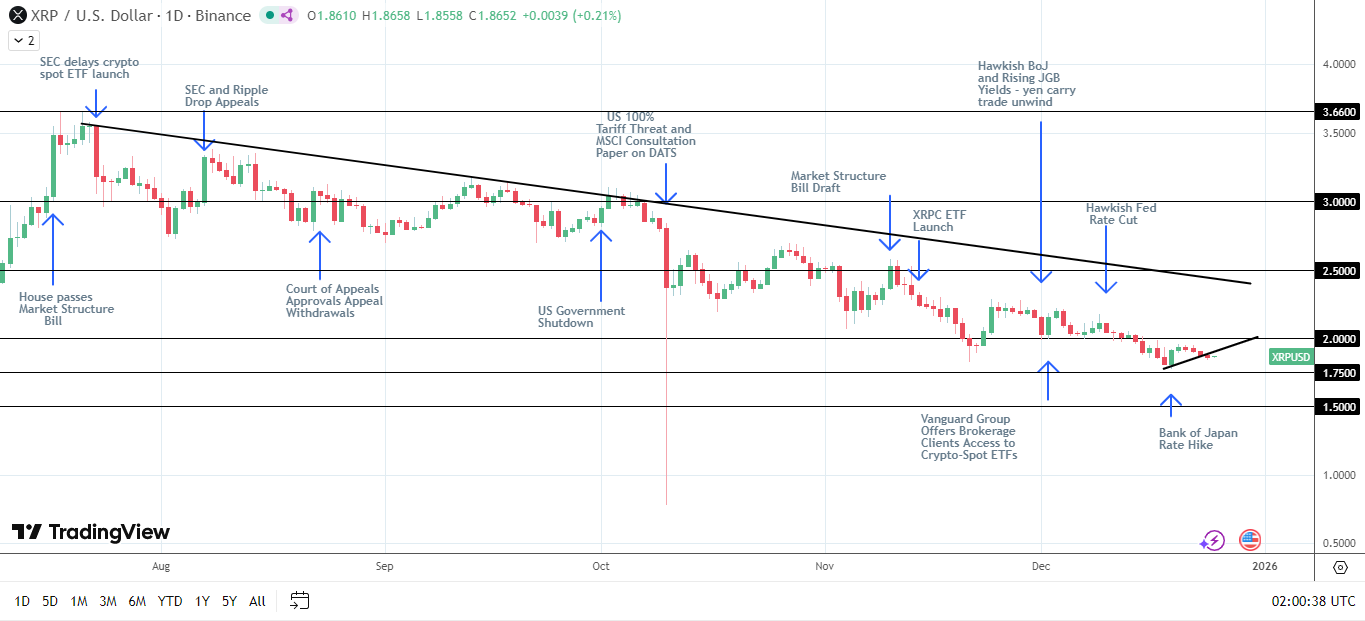
Despite a four-day losing streak, the bullish structure remained intact, reinforcing the positive short- to medium-term outlook.
Reclaiming $2.0 would bring the upper trendline and the $2.5 resistance level into play. A sustained move through the upper trendline would signal a bullish trend reversal, reinforcing the price targets.
- Medium-Term (4-8 weeks): $2.5.
- Longer-term (8–12 weeks): target of $3.0.
However, rejection at the $2.0 psychological level and a sustained break below the lower trendline would invalidate the bullish short- to medium-term outlook, and indicate a bearish trend reversal.
Outlook: $2.0 Remains the Pivot Level
Looking ahead, Fed and BoJ rhetoric, US economic data, XRP-spot ETF flows, and legislative developments will dictate near-term price trends.
Rising bets on a March Fed rate cut and a cautious Bank of Japan policy stance would likely raise demand for XRP. Robust demand for XRP-spot ETFs will also lift sentiment.
In summary, strong institutional demand for XRP-spot ETFs and legislative developments support a medium-term (4–8 weeks) move to $2.5. A March Fed rate cut and the Senate passing the Market Structure Bill would support the longer-term (8–12 weeks) price target of $3.0.
Meanwhile, a breakout above the all-time high $3.66 is likely if the bullish scenarios unfold over the 6-12 month time horizon.