
XRP eyes a four-day winning streak as speculation intensifies about the US Senate passing the Market Structure Bill.
Reports of US lawmakers setting a date for the Market Structure Bill boosted demand for XRP at the end of the year. Crypto-friendly legislation would likely open the door to a wider investor base and drive institutional interest.
The progress of the Market Structure Bill coincided with robust inflows into XRP-spot ETFs, tilting the supply-demand balance in XRP’s favor.
These two key price catalysts support a bullish short- to medium-term price outlook for XRP.
Below, I will explore the key drivers behind recent price trends, the medium-term (4-8 weeks) outlook, and the key technical levels traders should watch.
US Senate Banking Committee Market Structure Bill Markup Looms
On December 31, the US Senate Banking Committee announced a January 15 markup date for the Market Structure Bill. The US government shutdown dented hopes of crypto-friendly legislation being in place by year-end, weighing on sentiment.
Notably, XRP fell from an October 1 high of $2.9619 to a December 19 low of $1.7712. While the US government reopened on November 12, the shutdown delayed the progress of the Market Structure Bill, overshadowing the launch and robust inflows into XRP-spot ETFs.
The latest developments and prospects of the Senate passing the Market Structure Bill set the stage for a bullish price outlook for 2026.
Bitcoin Price Forecast
Every new Bitcoin analysis as it publishes, today's technical signal and key levels, live price — on one page.
See all Bitcoin forecasts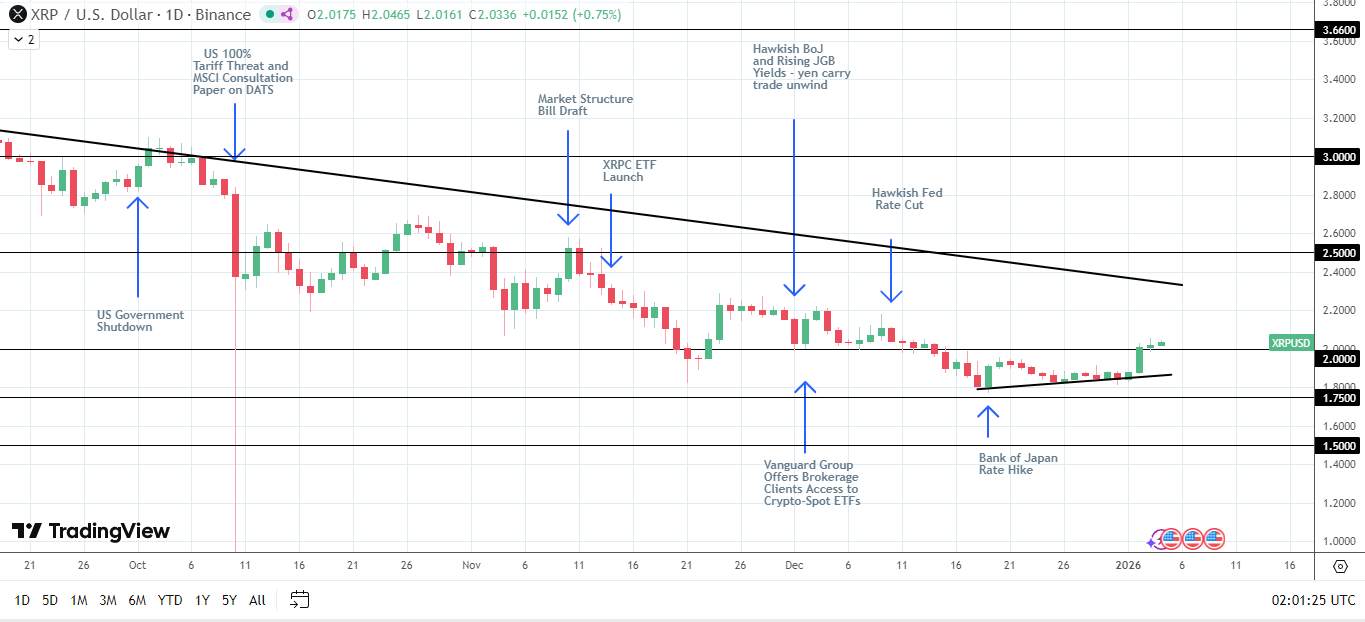
XRP-Spot ETF Issuers Signal Breakout Year
The US XRP-spot ETF market has seen total net inflows of $1.18 billion since launching, outperforming the BTC-spot and ETH-spot ETF markets. Significantly, there are only five XRP-spot ETFs compared with 11 BTC-spot ETFs and nine ETH-spot ETFs.
For context, XRP-spot ETFs saw net inflows of $499.91 million in December, while BTC-spot and ETH-spot ETFs reported net outflows of $1.09 billion and $616.82 million, respectively.
Crucially, diverging flow trends signal a potential decoupling of XRP from BTC and the broader crypto market. Canary Funds CEO Steven McClurg recently discussed a potential decoupling, stating:
“XRP, I believe, is going to be a divergent asset, actually. […] Altcoins typically follow Bitcoin, but there are a handful of assets that I do believe will diverge in this manner and just watching XRP perform as everything’s going straight down and we continue to get inflows everyday and continue to hold up, I believe that it could look like another peak in XRP in 2026, when most of other crypto assets are going to be down.”
McClurg’s outlook underscored the significance of inflows into XRP-spot ETFs and the divergence from BTC-spot and ETH-spot ETFs.
Increased inflows into XRP-spot ETFs and the progress toward crypto-friendly legislation reinforce the constructive short- to medium-term bias.
For context, XRP surged 14.69% on July 17 after the US House of Representatives passed the Market Structure Bill. By contrast, BTC and ETH gained 0.39% and 3.10%, respectively.
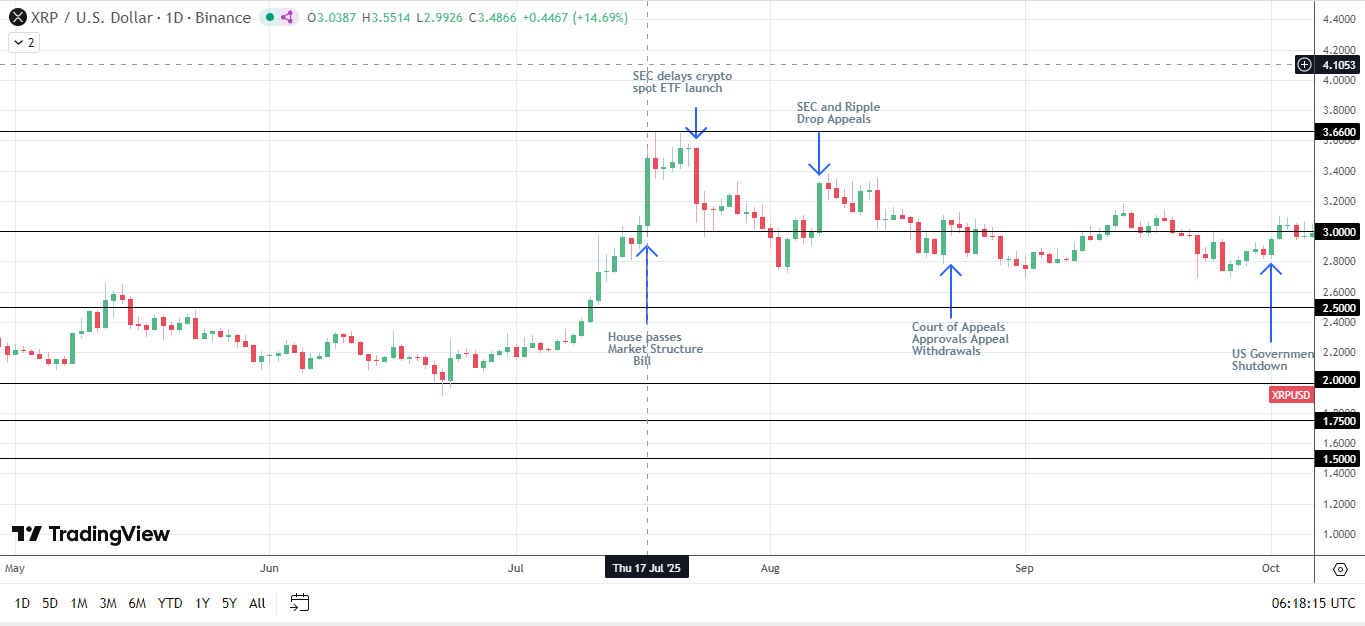
The price action underscored XRP’s sensitivity to crypto-related regulatory developments on Capitol Hill, driven by the resolution of the SEC vs. Ripple case.
The US Court of Appeals approved Ripple and the SEC’s appeal withdrawal motions on August 22. The court ruling legitimized XRP as a non-security, paving the way to the US XRP-spot ETF market.
XRP Bullish Outlook Intact
XRP-spot ETF flow trends and crypto-related legislative developments reaffirmed the bullish short-term (1-4 weeks) outlook, with a $2.5 price target. Meanwhile, increased utility, expectations of Fed rate cuts, and the Senate passing the Market Structure Bill reinforce the positive longer-term price trajectories:
- Medium-term (4-8 weeks): $3.0.
- Longer-term (8-12 weeks) $3.66.
Key Risks Challenge Bullish Outlook
Several scenarios could unravel the positive outlook. These include:
- The Bank of Japan declares a neutral interest rate of between 1.5% and 2.5%, signaling aggressive rate hikes. A higher neutral rate may trigger a yen carry trade unwind, which would weigh on risk assets.
- US economic data and the Fed are cooling expectations of a March rate cut.
- The MSCI delists digital asset treasury companies (DATs). Delistings are likely to temper interest in XRP as a treasury reserve asset.
- Partisan opposition to the Market Structure Bill.
- XRP-spot ETFs report outflows.
These scenarios would likely push the token toward $1.75, indicating a bearish trend reversal.
Technical Indicators Continue to Signal Caution
XRP gained 0.60% on Saturday, January 3, consolidating the previous day’s 6.76% rally, closing at $2.0184. The token mirrored the broader crypto market cap, which advanced 0.71%.
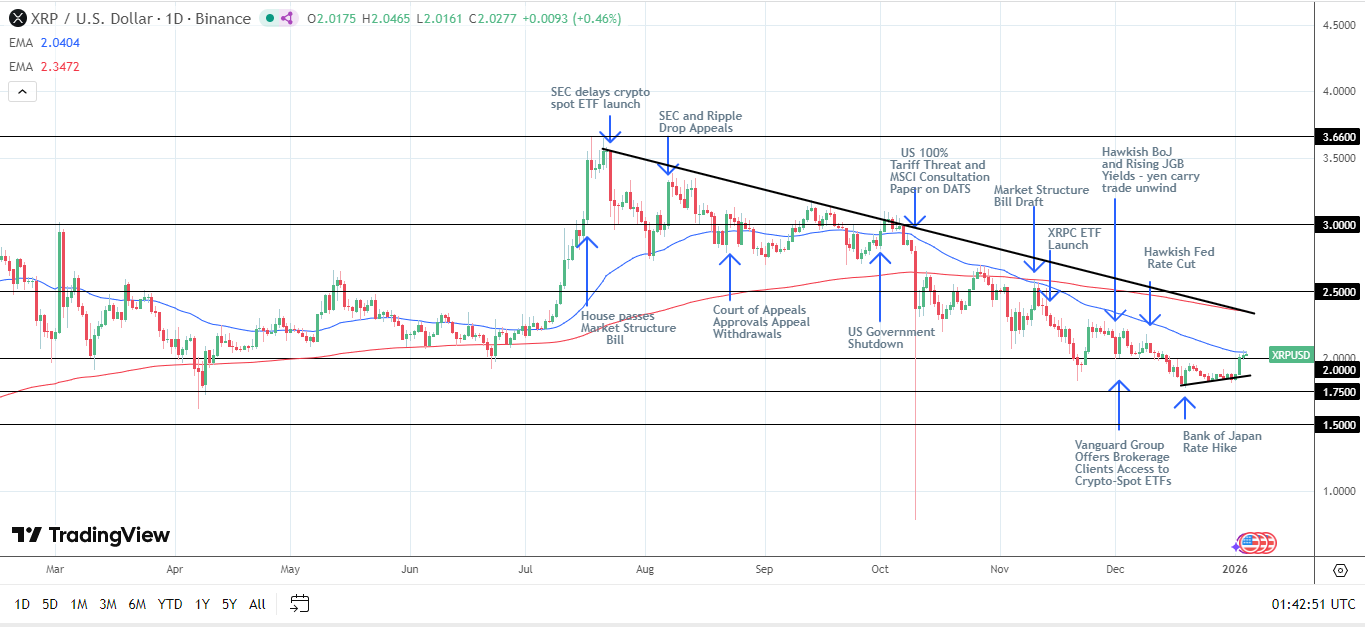
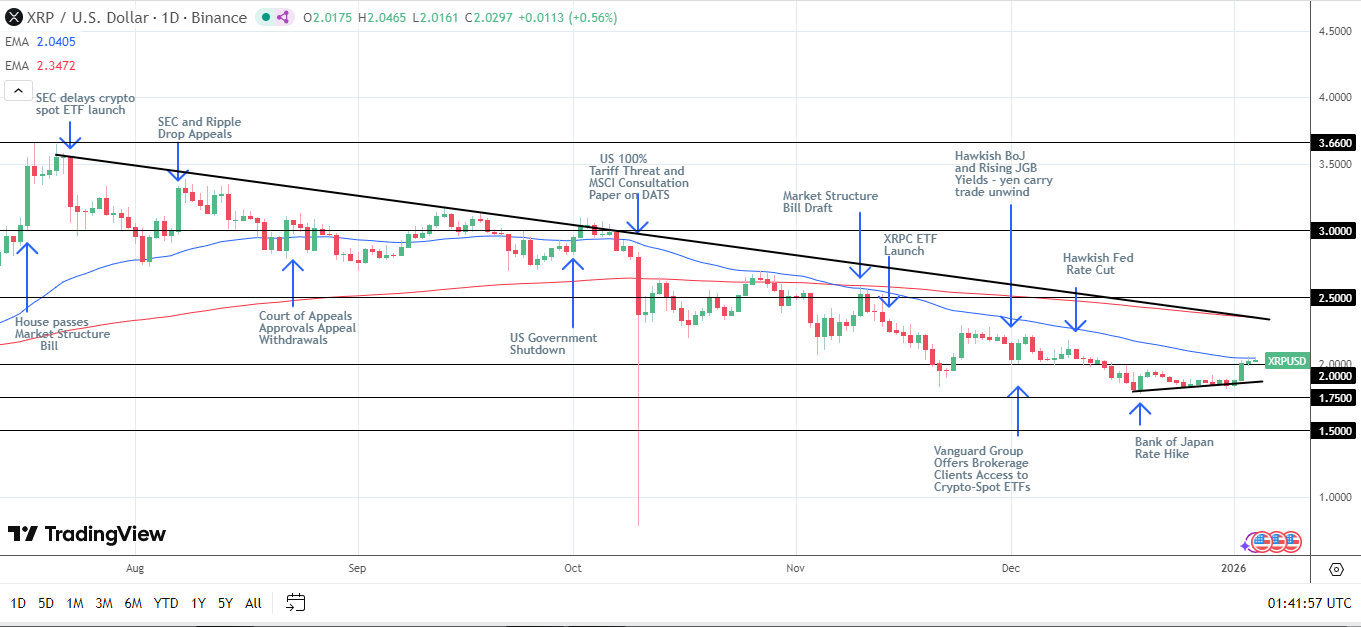
Despite heading for a four-day winning streak, XRP traded below the 50-day and 200-day Exponential Moving Averages (EMAs), suggesting a bearish bias. While technicals remained bearish, bullish fundamentals are building, countering the technical structure.
Key technical levels to watch include:
- Support levels: $2.0, $1.75, and then $1.50.
- 50-day EMA resistance: $2.0404.
- 200-day EMA resistance: $2.3472.
- Resistance levels: $2.5, $3.0, and $3.66.
Looking at the daily chart, a breakout above the 50-day EMA would indicate a near-term bullish trend reversal. A sustained move through the 50-day EMA would bring the 200-day EMA and the $2.5 resistance level into play.
A breakout above the EMAs would reinforce the bullish medium-term outlook and the longer-term (8-12 weeks) $3.66 price target.
Fundamental Indicators: Fed Rate Cuts, the Market Structure Bill, and Spot ETFs
Near-term price drivers include:
- XRP-spot ETF flow trends.
- US economic data and the Fed’s policy stance.
- US crypto-related legislative developments.
Break Above $2.2 Key for the Bullish Structure
Reclaiming $2.0 underscored a shift in investor sentiment after the extended period of tight price ranges in late December. The recent price trends reaffirmed the bullish structure and the positive price outlook.
A breakout above $2.2 would open the door to testing the upper trendline. A sustained move through the upper trendline would validate the bullish structure and affirm a bullish trend reversal, supporting the price targets:
- Medium-term (4-8 weeks): $3.0.
- Longer-term (8–12 weeks): target of $3.66.
However, rejection at the upper trendline and a drop below the lower trendline would invalidate the bullish structure, suggesting a bearish trend reversal.
Outlook:
Looking ahead, the Fed, the Bank of Japan, US economic data, crypto-related regulatory headlines, and XRP-spot ETF flows will influence near-term price trends.
Increased expectations of a March Fed rate cut, and a more dovish BoJ neutral rate, ranging between 1% and 1.25%, would likely lift sentiment. Strong inflows into XRP-spot ETFs and bipartisan support for the Market Structure Bill would reinforce the bullish outlook.
In summary, robust institutional demand for XRP-spot ETFs and crypto regulatory developments support a medium-term (4–8 weeks) move to $3.0. A March Fed rate cut and the Senate passing the Market Structure Bill would reaffirm the longer-term (8–12 weeks) price target of $3.66.
Looking beyond the 12-week timeline, these key price catalysts are likely to drive XRP above its all-time high $3.66, indicating a $5 price target over a 6-12 month time horizon.