
XRP gives up the $2.2 handle as spot ETF developments impact sentiment ahead of the Market Structure Bill markup.
This week, WisdomTree withdrew its S-1 for an XRP-spot ETF, while Morgan Stanley caught analysts by surprise, filing for BTC-spot and SOL-spot ETFs. BTC and SOL are likely to benefit from the firm’s sizeable investor base, leaving XRP out in the cold.
These two events clashed with investor caution ahead of the highly anticipated Market Structure Bill markup. XRP faced a second day of profit-taking, pushing the token below $2.2.
Despite the reversal, robust XRP-spot ETF inflows driven by the secondary market, XRP’s real-world utility, and the Market Structure Bill’s progress on Capitol Hill continue to support the bullish short- to medium-term outlook.
Below, I will explore the key drivers behind recent price trends, the medium-term (4-8 weeks) outlook, and the key technical levels traders should watch.

US XRP-Spot ETF Market: Issuers Give XRP the Cold Shoulder
Morgan Stanley entered the crypto-spot ETF race on Tuesday, January 6, filing S-1s for BTC-spot and SOL-spot ETFs. Notably, the US banking giant did not file for an XRP-spot ETF despite the US XRP-spot ETF market seeing stronger demand than the BTC-spot and SOL-spot ETFs since November.
For context, XRP-spot ETF issuers have seen $1.25 billion in inflows since the Canary XRP-spot ETF (XRPC) launched on November 14. In contrast, US SOL-spot ETFs have reported net inflows of $801.31 million since launching in October, while BTC-spot ETFs have experienced net outflows of $1.8 billion since November 14.
Bloomberg Intelligence ETF analyst Eric Balchunas commented on the filings, stating:
“I like this move by them. It’s smart. They have like $8T in advisory assets and they already OK’d those advisors to allocate so might as well be in their own branded fund vs paying BlackRock or someone else. Further, they could use kickstart to their mostly BYOA ETF biz. This could nudge a couple others to launch in house branded btc etfs as well, we’ll see…”
Balchunas underscored the significance of Morgan Stanley’s focus on BTC and SOL, with other Main Street players likely to follow suit. The lack of interest in filing for XRP-spot ETFs would limit access to the token for their investor bases.
Morgan Stanley’s filing coincided with WisdomTree withdrawing its S-1 for an XRP-spot ETF. While the ETF issuer did not provide a reason for the withdrawal, XRP-spot ETF flows have underscored the first-to-market advantage that Canary Capital, Bitwise, Franklin Templeton, and Grayscale have benefited from. The 21Shares XRP ETF has seen $39.07 million in net inflows since launch, modest relative to early demand for the four other XRP-spot ETFs.
Bitcoin Price Forecast
Every new Bitcoin analysis as it publishes, today's technical signal and key levels, live price — on one page.
See all Bitcoin forecasts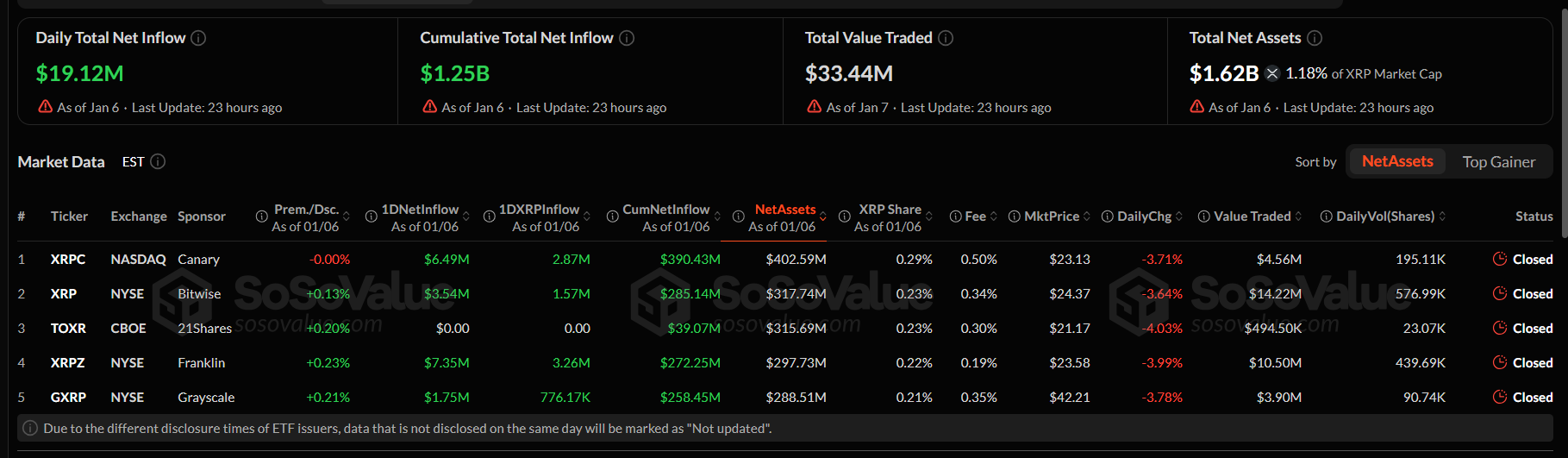
Market Structure Bill Markup Dates Fast Approaching
While US XRP-spot ETF developments influenced market sentiment, the upcoming Market Structure Bill markup will be key to near-term price trends.
The US Senate Banking Committee and US Senate Agricultural Committee have announced January 15 Market Structure Bill markups. January 15 could be a pivotal day for XRP, given its sensitivity to legislative developments.
Crypto in America host Eleanor Terrett shared the latest developments on Capitol Hill, stating:
“Next Thursday is set to be a BUSY day for crypto on Capitol Hill. A Senate Ag spokesperson tells me the committee will hold its own market structure markup on January 15, the same day as the Senate Banking Committee’s markup.”
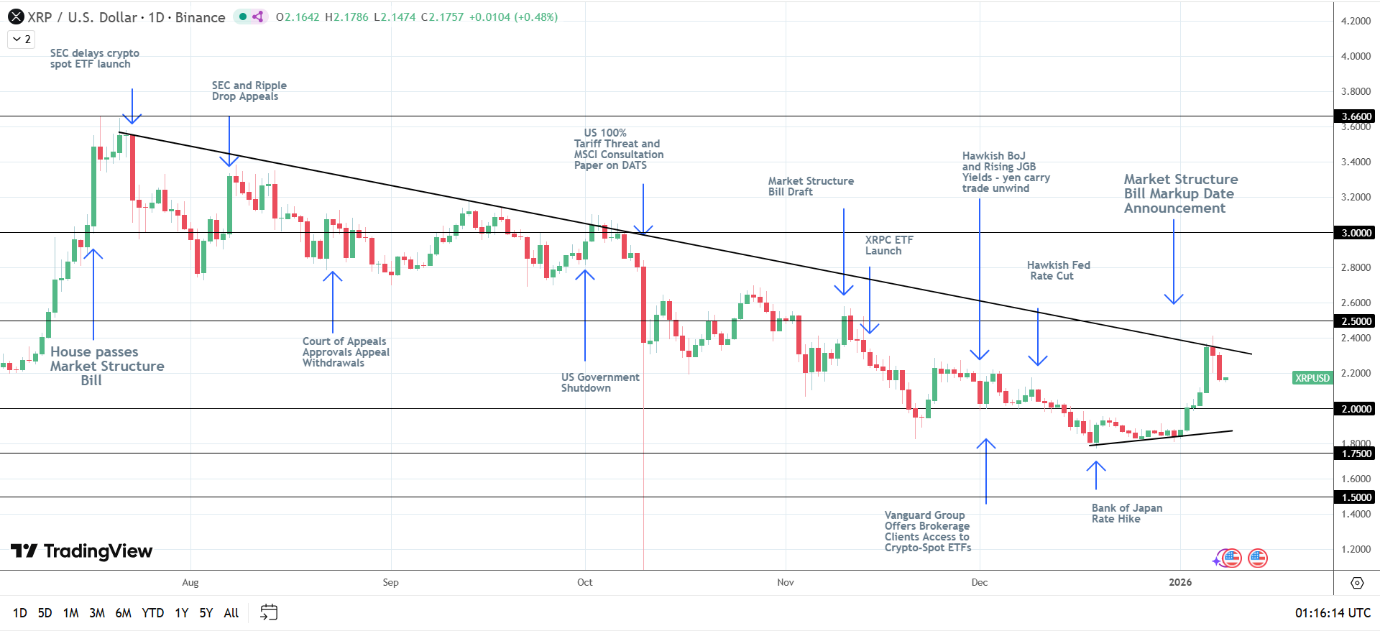
For context, XRP soared 14.69% on July 17 after the US House of Representatives passed the Market Structure Bill to the Senate. XRP rallied 33% to a January 6 high of $2.4151 after the US Banking Committee announced its January 15 Market Structure Bill markup on December 31.
XRP Bullish Outlook Intact
Robust demand for XRP-spot ETFs and the progress toward a crypto-friendly regulatory landscape in the US affirmed the bullish short-term (1-4 weeks) outlook, with a $2.5 price target. Meanwhile, increased utility, bets on Fed rate cuts, and optimism that the Senate will pass the Market Structure Bill reinforce the positive longer-term price targets:
- Medium-term (4-8 weeks): $3.0.
- Longer-term (8-12 weeks): $3.66.
Key Risks Challenge Bullish Outlook
Several events could derail the positive outlook. These include:
- The Bank of Japan announces a neutral interest rate of between 1.5% and 2.5%, indicating multiple rate hikes. A higher neutral rate could fuel a yen carry trade unwind, as traders exit their leveraged XRP position.
- US economic indicators and the Fed are cooling bets on a March rate cut.
- US lawmakers oppose the Market Structure Bill.
- XRP-spot ETFs report outflows.
These events would likely trigger a sell-off, pushing XRP below $2, which would signal a bearish trend reversal.
Technical Indicators Continue to Signal Caution
XRP slid 5.97% on Wednesday, January 7, following the previous day’s 1.88% loss, closing at $2.1653. The token came under heavier selling pressure than the broader crypto market cap, which declined 2.71%.
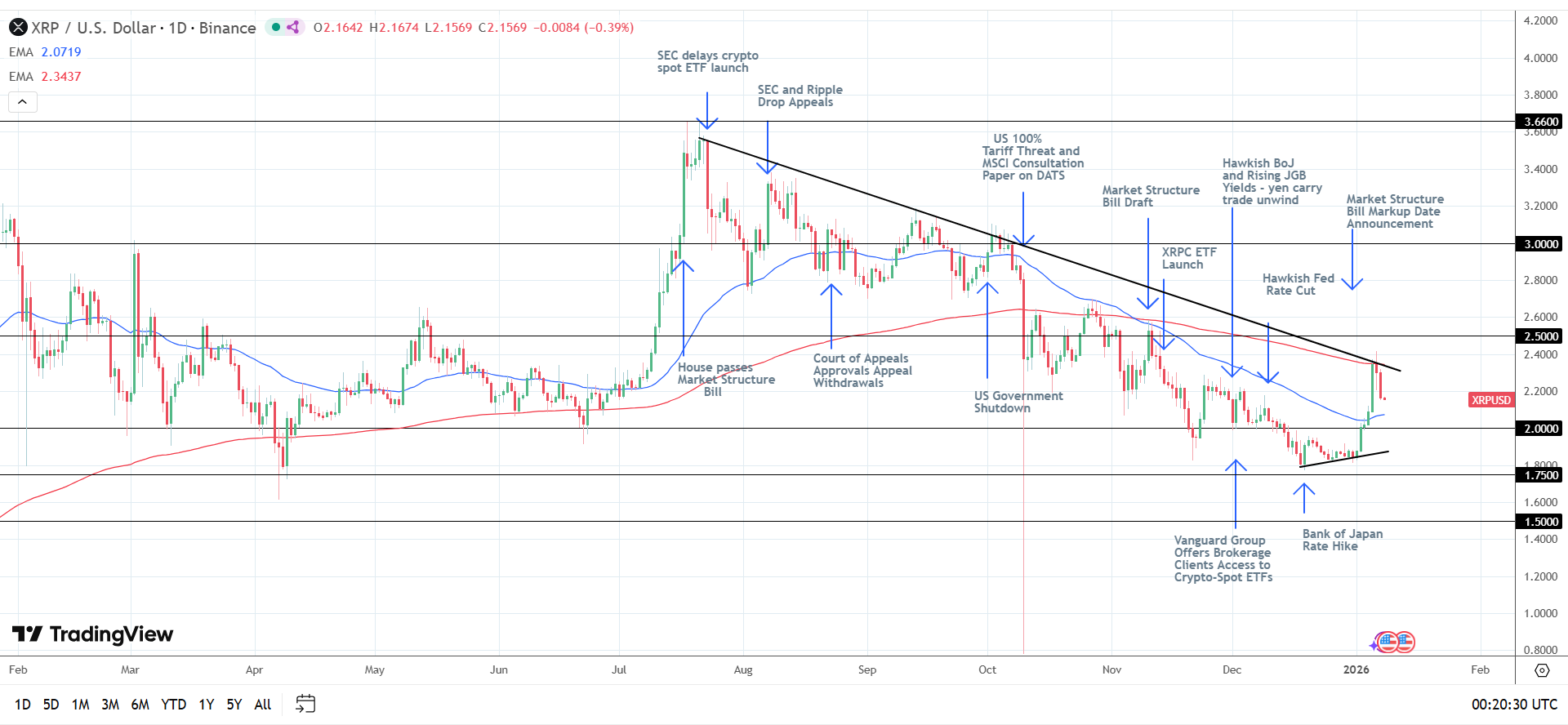
Two consecutive daily losses left XRP trading below the 200-day EMA, while holding above the 50-day EMA. While the EMAs suggest a bullish near-term but bearish longer-term bias, the fundamentals remain positive and dominate.
Key technical levels to watch include:
- Support levels: $2.0, $1.75, and then $1.50.
- 50-day EMA support: $2.0719.
- 200-day EMA resistance: $2.3437.
- Resistance levels: $2.5, $3.0, and $3.66.
Viewing the daily chart, a break above the 200-day EMA would signal a bullish trend reversal, bringing the $2.5 resistance level into play.
Crucially, a sustained move through the 200-day EMA would reaffirm the bullish medium-term outlook and the longer-term (8-12 weeks) $3.66 price target.
Fundamental Indicators: US Data, Crypto Legislation, and Spot ETF Flows
Near-term price drivers include:
- XRP-spot ETF flows.
- US economic indicators and the Fed’s policy stance.
- US crypto-related regulatory developments.
Holding Above $2.0 Crucial for the Bullish Outlook
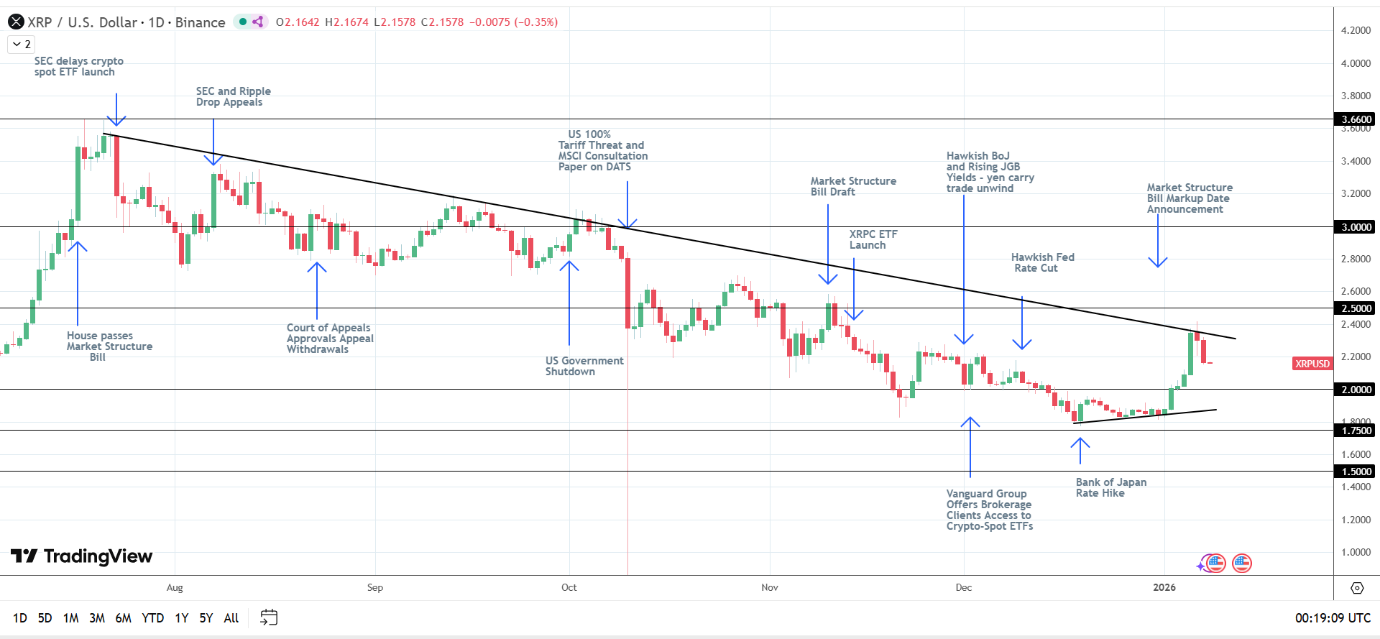
Avoiding a drop below the $2 psychological support level remains key for the constructive short- to medium-term bias. Improving fundamentals continue to counter bearish technicals, suggesting a breakout. The early January rally has reinforced the bullish structure and bullish short- to medium-term price outlook.
A break above the upper trendline would validate the bullish structure and reaffirm the bullish trend reversal, supporting the price targets:
- Medium-term (4-8 weeks): $3.0.
- Longer-term (8–12 weeks): target of $3.66.
However, a break below $2.0 would bring the lower trendline into play. A sustained fall through the lower trendline would invalidate the bullish structure, indicating a bearish trend reversal.
Outlook:
Looking ahead, US economic indicators, central bank rhetoric, crypto-related legislative developments, and XRP-spot ETF flow trends will dictate the near-term price outlook.
Rising bets on a March Fed rate cut and a dovish BoJ neutral rate (1%-1.25%) would likely boost sentiment. Robust demand for XRP-spot ETFs and bipartisan support for the Market Structure Bill would reaffirm the bullish outlook.
In summary, strong institutional demand for XRP-spot ETFs and crypto-related regulatory developments support a medium-term (4–8 weeks) move to $3.0. A March Fed rate cut and the Senate passing the Market Structure Bill would reinforce the longer-term (8–12 weeks) price target of $3.66.
Looking beyond the 12-week time horizon, these key scenarios are likely to send XRP above its all-time high $3.66. A breakout above $3.66 would affirm $5 as the next key price target over a 6- to 12-month timeline.