
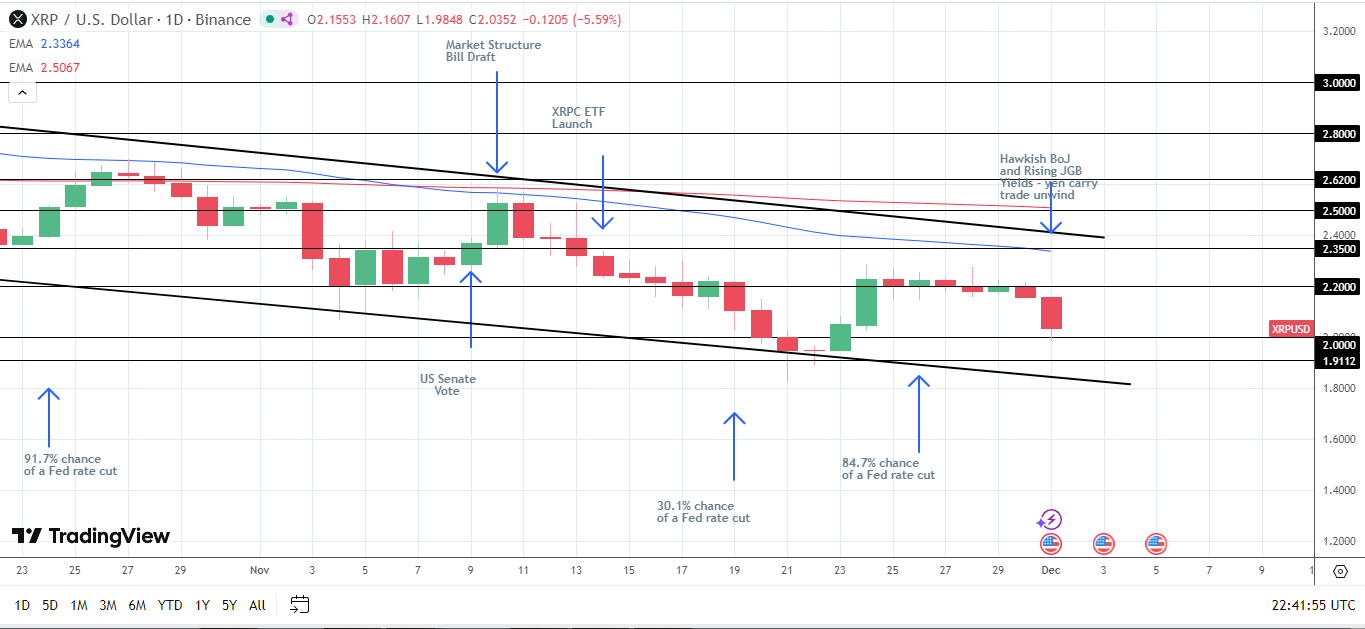
XRP tracked the broader crypto market into the deep red on Monday, December 1, erasing any hopes for an end to the October and November gloom. Another non-crypto market event sent XRP briefly below $2.0, highlighting the sensitivity to external market forces.
The Bank of Japan became the latest crypto antagonist, with Governor Kazuo Ueda signaling a December rate hike. The hawkish chatter sent Japanese Government Bond yields (JGBs) soaring, triggering a yen carry trade unwind.
Traders brushed aside reports that Vanguard will give client access to crypto ETFs.
In my view, the current market dynamics set the stage for a sharper consolidation toward $1.8 in the coming weeks. Below, I will explore the key drivers behind the pullback, the medium-term (4-8 week) outlook, and the key technical levels traders should watch.

Japanese Government Bond Yields Soar, Triggering Crypto Sell-Off
JGB yields hit 2008 levels, sending borrowing costs soaring and hitting levered-crypto positions. The Kobeissie Letter flagged concerns about rising JGB yields in early trading on Monday, December 1, noting that 10-year JGB yields jumped to 1.84%, the highest since April 2008.
Previously low JGB yields fueled yen carry trades into risk assets such as BTC and XRP. The Bank of Japan’s monetary policy decision on December 19 will be a key event. Policymakers will likely set the stage for a rate hike in the weeks ahead, potentially sending JGB yields higher. Higher borrowing costs would intensify the yen carry trade unwind and send BTC, XRP, and the broader market lower.
The Kobeissi Letter reported on the crypto market conditions, stating:
“Crypto liquidations surge to $900 million over the last 24 hours as Bitcoin falls toward $84,000. No headlines or market-moving news, yet Bitcoin has erased -$120 billion in market cap in 24 hours. Leverage is a dangerous game.”
For context, the BoJ cut purchases of Japanese Government Bonds (JGBs) and raised interest rates in July 2024, triggering a yen carry trade unwind. XRP slid from $0.6591 to $0.4320 following the decision. However, the pullback was short-lived, with the token reclaiming the $0.60 handle within eight sessions.
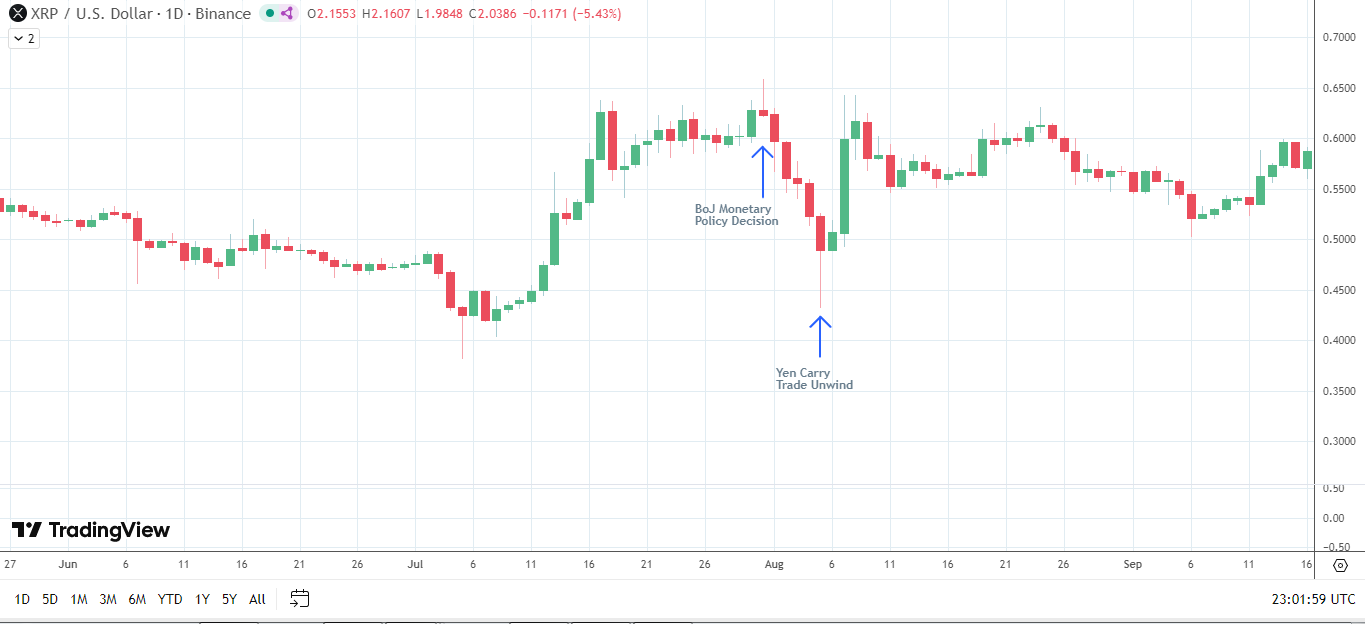
Fast forward to December 2025, and markets are also pricing in a Fed rate cut. A BoJ rate hike and Fed rate cut combination would narrow US-Japan rate differentials further, potentially extending the fourth-quarter sell-off.
These scenarios align with my bearish short-term (1-4 week) opinion on XRP’s price outlook.
Bitcoin Price Forecast
Every new Bitcoin analysis as it publishes, today's technical signal and key levels, live price — on one page.
See all Bitcoin forecastsBullish Medium-Term Outlook Intact
The December 1 losses and extending fourth-quarter losses will raise questions about the viability of BTC and XRP as treasury reserve assets for blue-chip firms. XRP has tumbled 28.41% in Q4, while BTC is down 24.11%. Meanwhile, gold has risen 9.69%.
However, the fourth quarter sell-off will likely reignite institutional demand through spot ETFs as market stress eases, supporting a bullish medium-term (4-8 week) outlook. BTC-spot ETFs saw net outflows of just $41.5 million in October and November. $3.47 billion in net outflows for November reversed October’s inflows, contributing to the broader market’s reversal.
The launch of XRP-spot ETFs and Vanguard offering access to crypto ETFs will change the narrative. Vanguard Group will reportedly give brokerage clients access to crypto ETFs on Tuesday, December 2, opening access to a $10 trillion client pool. Vanguard’s move comes just after the launch of XRP-spot ETFs, which may benefit from the asset manager’s entry into the digital asset space.
Crucially, the crypto investor base could broaden further in the new year as the Market Structure Bill progresses on Capitol Hill. A crypto-friendly framework and pro-crypto US administration would boost demand, potentially sending XRP to new highs.
Market intelligence platform Santiment offered an optimistic spin amid the market doom and gloom, stating:
“Looking for capitulation signs? Retail is showing less & less interest in most topics that had been dominant throughout 2025. With less and less cryptocurrency discourse, we continue moving closer to a potential bottom.”
Monday’s price action, coupled with bearish technical indicators, reaffirmed my bearish short-term (1-4 week) outlook. In my view, XRP remains exposed to the risk of a near-term drop to the November low of $1.82 before any sustained recovery.
XRP Medium-Term Downside Risk
The medium-term price outlook hinges on several key events that influence demand for XRP-spot ETFs and XRP. These scenarios include:
- A dovish December Fed rate cut.
- A one-and-done December BoJ rate hike.
- The Market Structure Bill passes the Senate hurdle.
- XRP-spot ETFs see robust inflows.
- BlackRock launches an iShares XRP Trust, indicating increasing institutional interest in XRP exposure.
These events would support a rebound to the July all-time high of $3.66 (on Binance).
However, several events would likely derail the bullish medium-term outlook. These events include:
- The MSCI delists digital asset treasury companies (DATs), reducing blue-chip companies’ interest in using XRP as a treasury reserve asset.
- The Senate opposes the Market Structure Bill.
- OCC rejects Bitcoin’s application for a US-chartered banking license.
- Weak inflows into XRP-spot ETFs and heavier BTC-spot ETF outflows.
- The Fed cuts interest rates in December but signals caution over further cuts.
- The BoJ hints at more rate hikes in 2026.
In my view, XRP is likely to test the November low of $1.8239 if these scenarios unfold. Given the downside risks, a $1.8239 stop-loss would be appropriate for traders holding long positions.
To summarize, the short-term outlook remains bearish while the medium- to longer-term outlook is constructive.
Financial Analysis
Technical Outlook: EMAs Signal Caution
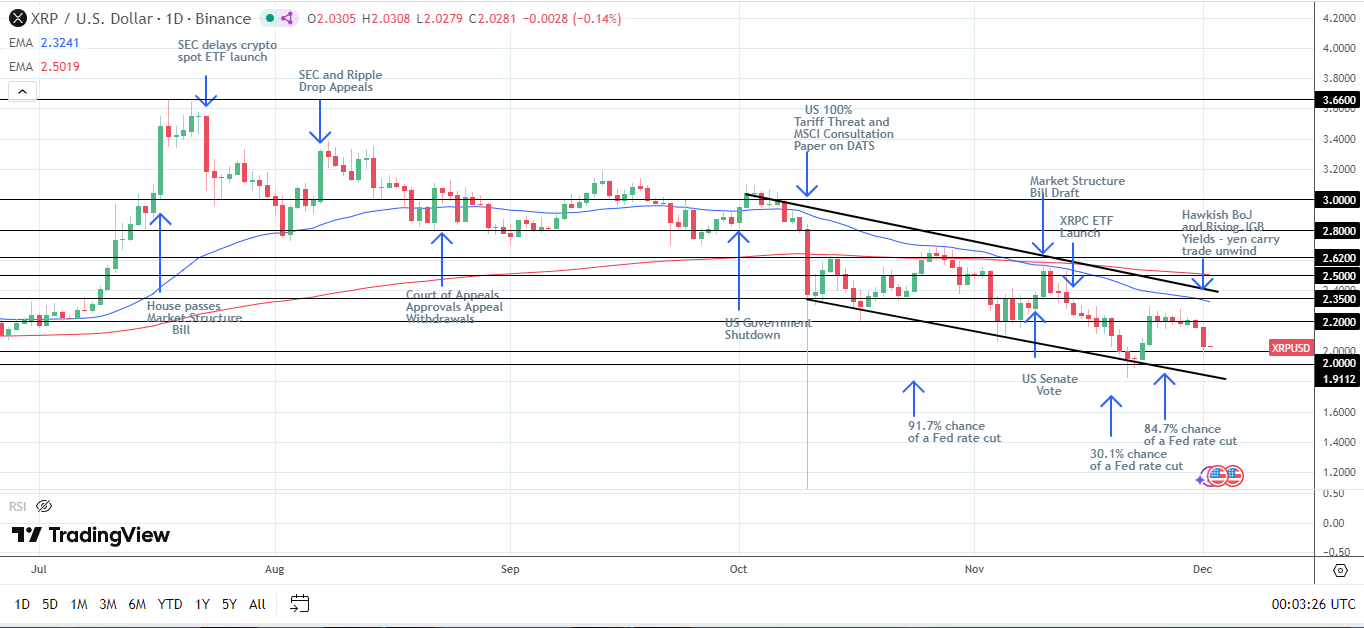
XRP slid 5.78% on Monday, December 1, following the previous day’s 2.08% loss, closing at $2.0311. The token saw heavier losses than the broader market, which dropped 4.50%.
Monday’s sell-off left XRP well below the 50-day and 200-day Exponential Moving Averages (EMAs), reaffirming a bearish bias.
Key technical levels to watch include:
- Support levels: $2, $1.9112, and $1.8239
- 50-day EMA resistance: $2.3241.
- 200-day EMA resistance: $2.5019.
- Resistance levels: $2.2, $2.35, $2.5, $2.62, $2.8, $3.0, and $3.66.
Fundamental Indicators: Corporate Signals, Policy Decisions
Near-term price drivers include:
- XRP-spot ETF daily inflows.
- Blue-chip companies’ views on XRP as a treasury reserve asset.
- Regulatory milestones: Ripple’s application for a US-chartered bank license, the progress of the Market Structure Bill on Capitol Hill.
- MSCI’s position on DATs.
- The Fed and the BoJ’s rate paths.
Bearish Scenario: What Happens if $2.0 Breaks?
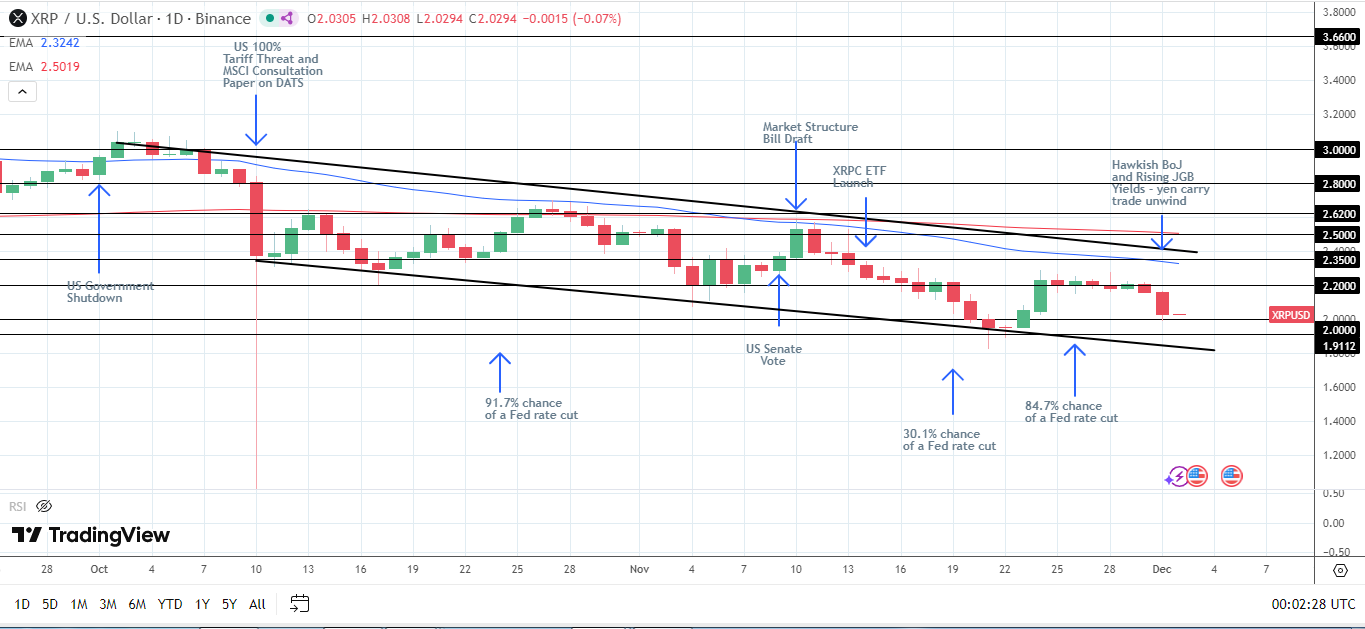
Bearish events would push XRP below the $2.0 psychological support level. A break below $2.0 would bring the $1.9112 support level into play. If breached, the November 21 low of $1.8239 and the lower trendline would be the next key support levels.
Outlook: $1.8239 Support Key for Bullish Medium-Term Path
XRP faces a crucial session on Tuesday, December 2, as softer spot ETF inflows and yen carry trade unwind risks clash. The progress of the Market Structure Bill, US economic indicators, the BoJ, and the Fed will influence risk sentiment.
Higher JGB yields and opposition to the Market Structure Bill will likely weaken demand for XRP, potentially pushing the token toward $1.9112.