



China Announces Major Stimulus Plan
On Wednesday, February 26, Beijing announced fresh stimulus plans to boost credit demand, domestic consumption, and economic growth.
CN Wire reported:
“China plans to inject fresh capital into several of its largest banks in the coming months as part of a broader stimulus package aimed at supporting the struggling economy. […]The capital infusion could be completed as soon as the end of June, although the final amount for each bank is still being finalized.”
The Ministry of Finance will reportedly fund the capital injections through the bond markets. By strengthening the banks’ balance sheets, Beijing aims to support lending activity and ensure financial stability amid economic uncertainties.
The recapitalization of the six banks should ease pressure on net interest margins following recent mortgage and key policy rate cuts.
CN Wire noted that a capital injection from Beijing would be the first since the 2008 global financial crisis, underscoring concerns about US policies and China’s commitment to transitioning toward a consumption-driven economy.
China’s Consumer Sentiment: A Key Economic Driver
Since Trump’s reelection, Beijing has intensified efforts to stimulate domestic consumption, offsetting the effect of US tariffs on the economy.
In February, Beijing targeted the auto, electronics, and home products sectors, announcing plans to boost demand. This followed January’s trade-in program for mobile devices and other electronics.
However, improving household incomes and labor market conditions remains critical for sustaining consumer confidence.
China’s consumer confidence index rose slightly from 86.2 in November to 86.4 in December, hovering just above the November 2022 record low of 85.5. Recent government pledges could support a shift in sentiment and spending appetite. On February 10, Beijing announced plans to:
- Increase residents’ income and promote reasonable wage growth.
- Better fulfill housing and consumer spending needs.
- Place greater emphasis on boosting consumption.
Beyond these measures, unemployment remains another challenge. The youth unemployment rate has fallen from 18.8% in August 2024 to 16.1% in November 2024. However, this remains excessively high compared to a national unemployment rate of 5%.
Beijing could address this issue by incentivizing firms to hire young people or introducing labor reforms aimed at creating more opportunities for school leavers.
Global AI Race Heats Up as Hong Kong Eyes AI Expansion
The global AI race could be a potential source for job creation. On February 21, Beijing reaffirmed its commitment to expanding the tech sector, prioritizing support for tech firms.
Days after, on February 26, the Hong Kong government reportedly announced plans to establish an AI institute, earmarking HK$1 billion for the initiative. This move aligns with Beijing’s broader AI ambitions, particularly as Chinese AI firms like DeepSeek continue making inroads into the global market.
Expert Views on China’s Economic Outlook
Financial analysts view Beijing’s latest measures favorably. Brian Tycangco, editor and analyst at Stansberry Research, commented on the recapitalization of Chinese banks:
“Very good move here by Chinese regulators and PBoC to keep the positive momentum on improving sentiment going. Recapitalizing banks to free up more of their balance sheet to lend out as the real estate market recovers. Expect more of this in the coming months as Beijing makes good on its 1 trillion yuan banking sector support pledge.”
Stock Market Trends: Hong Kong and Mainland China Gain Momentum
Investors have brushed aside concerns about the potential impact of US tariffs on China’s economy. Several factors have bolstered demand for Hong Kong and Mainland China-listed stocks, including:
- Government stimulus targeting domestic demand.
- Tech sector support.
- Expanding AI investments.
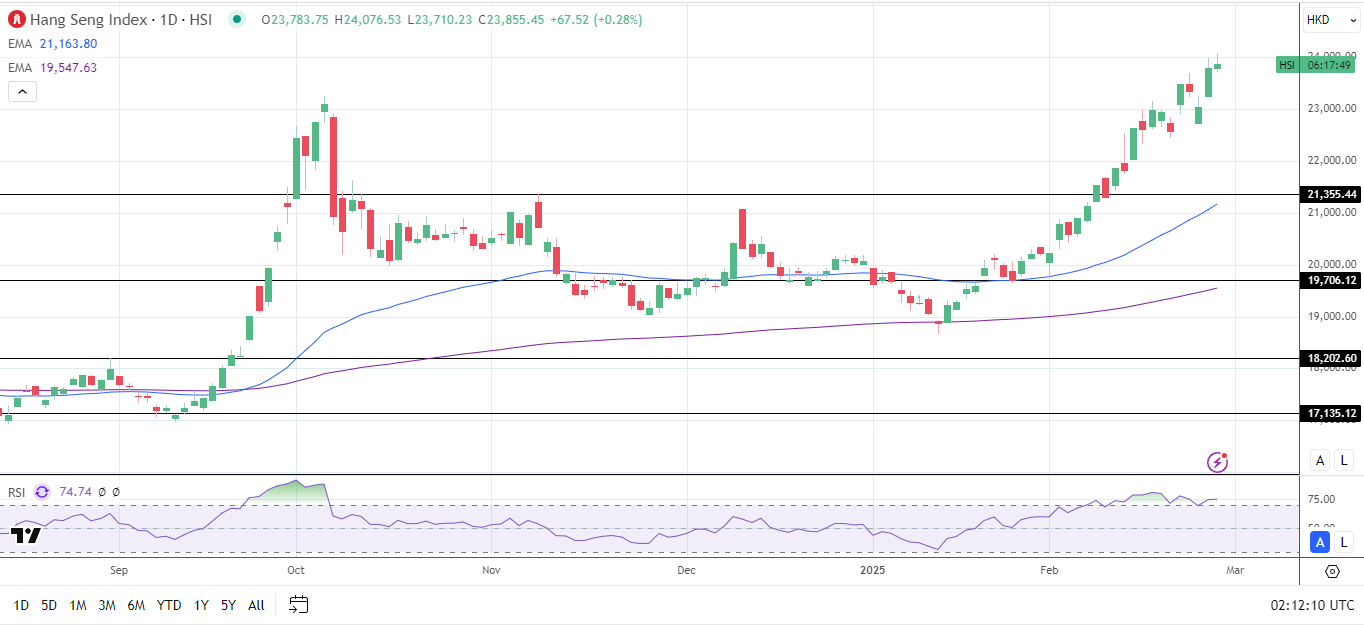
Notably, the Hong Kong and Mainland Markets are outperforming the Nasdaq Composite Index in early 2025.
- CSI 300: +0.93% year-to-date (YTD).
- Shanghai Composite Index: +0.98% YTD.
- Hang Seng Index +18.64% YTD.
- Nasdaq Composite Index: -1.22% YTD.
The Hang Seng Index continues to outpace its Mainland Chinese indices, fueled by tech and EV stocks. Alibaba Group Holding Ltd. (9988) leads the charge, surging 68% YTD, while Li Auto Inc. (2015) is up 45%. In contrast, Nvidia (NVDA) has fallen 2.24%.
Looking Ahead: US-China Trade Developments and Stimulus Plans
The focus will shift to the third session of the 14th NPC in March, where lawmakers are expected to discuss economic reforms, fiscal policies, and key government initiatives, including the Five-Year Plan.
Critical topics will likely include:
- Measures to address youth unemployment.
- Policies to boost domestic consumption.
- Developments in China’s AI sector.
- US-China trade relations and potential policy shifts.
Meanwhile, traders should closely monitor tariff developments and potential stimulus measures aimed at countering levies on Chinese exports.
For further insights into China’s economy and financial markets, check out our latest reports here.