Key Insights:
- Crypto liquidity is too low for Russia to use as a currency.
- Russia will likely build stronger trade ties with China than switch to Bitcoin.
- US Senator Elizabeth Warren is still calling for a massive crackdown on crypto.
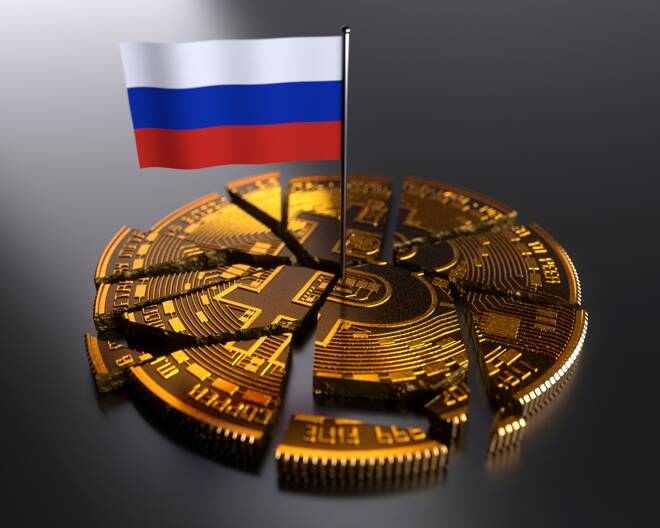
When the U.S. and E.U. imposed sanctions and banned several Russian banks from the SWIFT messaging system earlier this week, it was postulated that the country would turn to cryptocurrencies.
However, industry experts and analysts are now debunking this theory for several reasons. The Bitcoin Policy Institute has published a memo outlining the key reasons why Russia will not be pivoting to cryptocurrencies any time soon.
It does argue that Bitcoin and digital assets have become the monetary method of choice for raising funds for Ukrainian struggles during the conflict. So far, the Ukrainian government and NGOs providing support to the military have raised $33.8 million, through almost 30,000 crypto donations, as of Mar. 1, 23.55 UTC according to Elliptic.
No Russian Pivot to Crypto
The Institute argues that Bitcoin (BTC) is currently “too small” to replace the USD or Euro as a trade currency in Russia. Before the conflict, Russia exported around $400 billion worth per year, around half of the BTC market capitalization.
“Attempting to sell Russian goods in Bitcoin (to a constrained set of buyers) would exaggerate its already high volatility and consequently would make it hard for Russia to predict or manage its commodity revenues,”
It added that Russia’s “substantial gold and yuan reserves” would make those assets a more viable backup. There is also the question of volume. Bitcoin markets are currently transacting $27 billion in daily volume. Russia conducts nearly $50 billion in forex transactions a day according to RippleNet GM Asheesh Birla so it would need to encompass the entire BTC network and then some.
JUST IN – Bitcoin Policy Institute memo debunks claims that #Bitcoin will help Russia evade sanctions, argues that BTC helps individuals in Ukraine and Russia.🧵 pic.twitter.com/zkRGMdpm8G
— David Zell (@DavidZell_) March 1, 2022
Another reason is that most major crypto exchanges have to comply with U.S. and global regulations and KYC (know-your-customer) procedures. As reported by FXEmpire yesterday, many of them have already agreed to block sanctioned individuals and organizations.
Additionally, crypto transactions are now easily traced as several monitoring firms and blockchain tracking entities have emerged over the past few years.
Russia also has made increasing ties with China, a country that has yet to condemn the invasion, so more trade there is likely to be established before any pivot to crypto. Russia also has its version of SWIFT that it has already initialized.
Bitcoin Price Forecast
Every new Bitcoin analysis as it publishes, today's technical signal and key levels, live price — on one page.
See all Bitcoin forecastsAngry Senator Calls for Ban
With all of this evidence against Bitcoin being used to avoid sanctions, anti-crypto Senators in the United States are still waving angry fists and calling for more restrictions on the industry.
Commenting on a New York Times article on March 1 arguing that crypto will be adopted by Russia, Senator Elizabeth Warren called for tighter regulations:
“Cryptocurrencies risk undermining sanctions against Russia, allowing Putin and his cronies to evade economic pain. U.S. financial regulators need to take this threat seriously and increase their scrutiny of digital assets.”
It seems that some are looking for any reason to crush the crypto industry even when faced with overwhelming evidence debunking their flawed thinking.