Germany’s Consumer Confidence Plummets: Recession Fears Surge
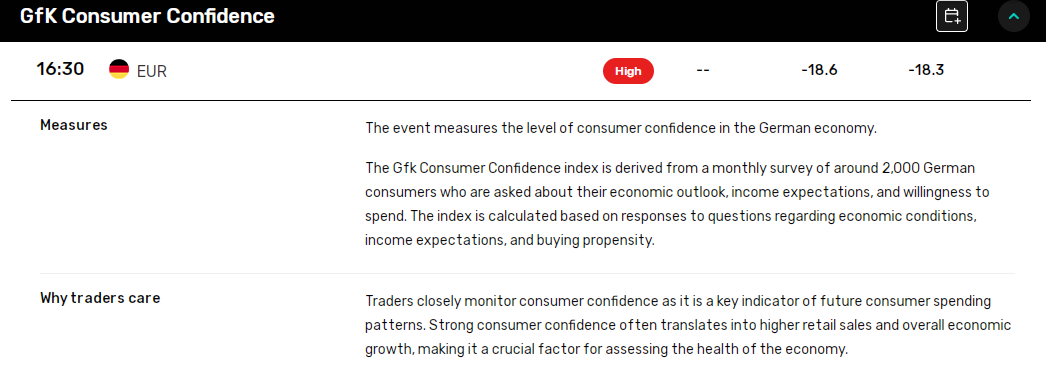
Consumer sentiment in Germany weakened significantly in late Q4 2024, signaling growing economic concerns for the ECB. The GfK Consumer Climate Indicator dropped from -18.3 for November to –23.3 for December. Economists had expected the Indicator to fall to -18.6.

The November survey revealed troubling trends:
- Income expectations declined sharply, sliding by 17.2 points to -3.5 points, the lowest level since February 2024.
- Rising unemployment and a weak wage growth outlook impacted income expectations.
- Concerns about the labor market weighed on the willingness to buy indicator, which declined by 1.3 to -6.
- The pullback in income expectations led to a rise in the willingness to save indicator, reflecting reduced consumer spending intentions.
- Notably, the economic indicator declined by 3.8 points to -3.6 points, also the lowest level since February 2024.
Nuremberg Institute for Market Decisions (NIM) consumer expert Rolf Buerkl remarked on the November survey-based data, saying,

“Consumer uncertainty has increased again recently, as evidenced by the rising willingness to save. There is also another uncertainty factor: concerns about job security in Germany are growing. The reasons for this are certainly the job cuts reported by industry and the relocation of production abroad.”
Implications for Inflation and Economic Growth
The survey underscores a softer inflation outlook, driven by falling consumer spending. Private consumption, which accounts for over half of Germany’s GDP, could see further declines, intensifying recession risks. The ECB must also grapple with deteriorating labor market conditions, now compounded by the potential for new US tariffs.
Pictet Wealth Management Head of Macroeconomic Research Fred Ducrozet commented on the potential impact of increased global protectionism, stating,
EUR/USD Price Forecast
Every new EUR/USD analysis as it publishes, today's technical signal and key levels, live price — on one page.
See all EUR/USD forecasts“If the global economy is more protectionist this will impair the growth rate of the European economy and that will be likely to reduce inflationary pressures.”
Economic Data Reflects Broader Eurozone Weakness
November’s private sector PMIs highlighted Germany and the Euro area’s economic challenges. The Eurozone HCOB Services PMI slid from 51.6 in October to 49.2 in November, while the manufacturing sector contracted at a sharper rate. Germany’s service sector suffered a similar fate, potentially supporting arguments for more aggressive ECB rate cuts to bolster the Euro area economy.
EUR/USD Reaction to German GfK Consumer Climate Survey
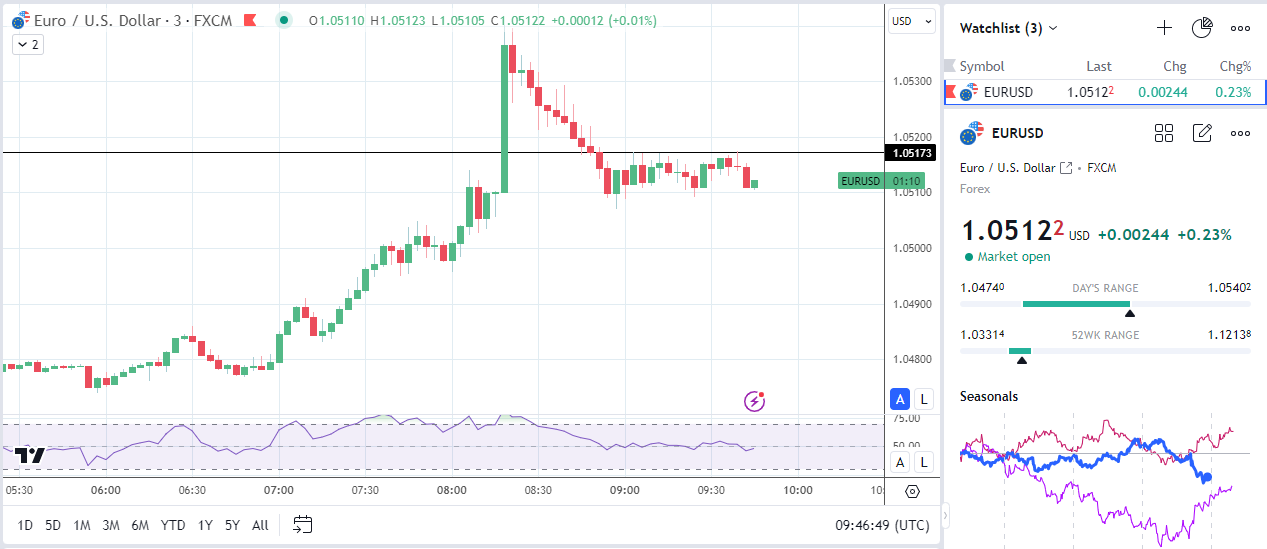
Ahead of the German GfK Consumer Climate report, the EUR/USD briefly fell to a low of $1.04740 before climbing to a high of $1.05402.
However, EUR/USD reacted to the GfK Consumer Confidence report, initially rising to a post-report high of $1.05175 before falling to a low of $1.05105.
On Wednesday, November 27, the EUR/USD was up 0.23% to $1.05122.