


Forex Pricing Explained: How Brokers Set Prices
Here's an insight into how we make money. While we strive to be comprehensive, the compensation we receive can influence the products, companies, or services we showcase and review. Not all available options may be featured on this page.
Intro
Key Points:
- Forex pricing happens in the OTC market, where traders deal in derivatives rather than owning underlying assets, relying on brokers as intermediaries.
- Brokers set prices using either the Market Maker or STP/ECN model, with market makers internalizing trades and STP/ECN brokers sourcing prices from liquidity providers.
- Spreads are the main trading cost, consisting of raw spreads from liquidity providers plus broker markups or commissions.
- Liquidity, volatility, and broker risk management directly affect spreads, causing them to widen during fast or uncertain market conditions.
- Best execution policies and fast execution speeds improve pricing transparency, while limit orders help traders reduce the risk of negative slippage.
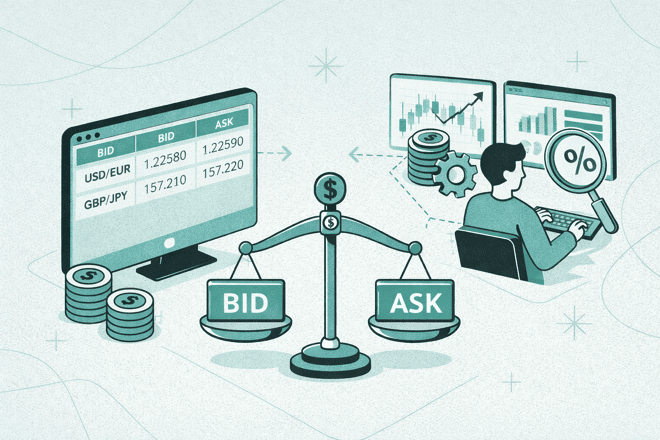
Forex and CFD brokers make trading with financial derivatives possible. They create and direct market liquidity, allowing buyers and sellers to open and close trading orders. Brokers charge their clients several types of trading fees for their services, the most popular of which is the bid/ask spread.
In this article, we will explain how different types of brokers determine their pricing mechanisms and set their trading costs.
How Forex and CFD Market Is Built
Have you ever wondered why, as a trader, you don’t receive gold bars when you buy gold, how you can sell crude oil without owning any barrels, or how you can execute trades that far exceed the funds in your trading account?
These questions relate to the Over-the-Counter (OTC) market, where retail traders execute trades using various financial derivatives.
A financial derivative is an instrument whose price reflects the price of an underlying asset or commodity (gold, crude oil, Apple shares, etc.). When you trade a derivative, you are trading with the price of the underlying asset, which allows instant execution without physical delivery.
Major financial institutions, such as market makers, investment banks, and hedge funds, facilitate derivatives trading on the OTC market. These institutions trade with each other on major exchanges, creating market liquidity that filters into the OTC market.
How Prices Are Formed
Factors Influencing Price Setting
- Liquidity: The more liquid a currency pair or an asset (meaning, the easier it is to buy or sell it), the narrower the spreads. In contrast, exotic pairs or less traded assets may have wider spreads due to lower trading volumes.
- Market Conditions: During periods of high volatility, spreads may widen due to increased risk and uncertainty.
- Broker’s Risk Management: Brokers might adjust prices to manage their risk, especially if they anticipate significant market movements or have a large exposure to one side of the market.
Forex and CFD brokers typically set their prices using one of the following models: Market Maker or ECN/STP.
Market Maker
- How it works: In this model, the broker acts as a counterparty to the trader’s positions. It creates an internal market and offers buy and sell prices to the client. The prices offered by market makers may differ from the interbank market prices.
- Price Setting: The broker sets the bid and ask prices, often adding a spread markup to the interbank prices. This spread is how market makers typically earn profits. They might also adjust prices based on their risk exposure or the expected behavior of the trader (e.g., increasing spreads in times of high volatility).
ECN/STP
- How it works: ECN brokers use electronic communication networks to match client orders (buyers to sellers and sellers to buyers). While STP brokers route client orders directly to their liquidity providers, such as banks or other financial institutions. The client order is then filled by one of the broker’s liquidity providers (acting as a counterparty to the trader).
- Price Setting: Prices in this model come from the liquidity providers. STP/ECN brokers with a Best Execution Policy aggregate the best bid and ask prices from a pool of liquidity providers. The broker might then add a small markup or commission to these prices to generate revenue.
Market Makers vs STP/ECN Brokers
While market makers tend to charge higher trading fees on average, they also tend to offer faster execution speeds because they fill their client orders in-house. And so, the general tradeoff between market makers and STP/ECN brokers can be summed up in the following manner:
| Broker Type | Advantages | Disadvantages |
| Market Makers | Faster execution | Higher costs |
| STP/ECN Brokers | Lower costs | Slower execution |
What is Spread Markup
The price of an asset can vary across different markets. For example, institutional traders—such as large corporations, funds, and trading companies—who have access to exchange trading typically receive different price quotes than retail traders engaged in over-the-counter (OTC) trading.
Retail traders do not have direct access to exchange trading and must work through intermediaries, such as market makers or STP/ECN brokers, who act as a bridge between the retail market and the exchange market. These intermediaries often add a markup to the raw prices for their services.
To understand the pricing process in OTC trading, consider the following image and text:

Two market makers, a hedge fund, and an investment bank, all members of the same exchange, trade among themselves. Each institution quotes its own bid and ask prices for buying or selling shares of company XYZ, which is listed on the exchange.
These institutions also serve as liquidity providers to STP and ECN brokers in the OTC market by forming a liquidity pool. Additionally, they can work directly with retail traders.
Liquidity Providers
Forex and CFD brokers that do not act as counterparties to their clients’ orders source liquidity from a pool of providers. By using price aggregation, they secure the tightest and most favorable bid/ask spreads available. For instance, in a pool, Market Maker 2 might offer the tightest spread at 0.02 points.
In contrast, retail traders dealing directly with market makers are limited to the bid/ask spread quoted by their broker. This is because market makers fill client orders by trading against them—selling to buyers and buying from sellers.
Raw Spreads, Spread Markup, and Commissions
The bid/ask spread that forex and CFD brokers receive from their liquidity providers is known as the raw spread. For example, an STP/ECN broker might obtain a 0.02-point raw spread, which it then passes on to clients, along with its own service fee.
It’s crucial to understand the different pricing mechanisms between STP and ECN brokers. STP brokers typically charge floating spreads, which include the raw spread plus a spread markup. In contrast, ECN brokers charge raw spreads along with volume-based commissions.
In the example above, the spread markup or volume-based commission equals 0.02 points. As a result, retail traders with the STP/ECN broker would pay a final spread of 0.04 points.
It’s important to note that the spread markup is added to the broker’s asking price in this example, but this doesn’t mean only the retail buyer is disadvantaged. In margin trading, the spread is paid when opening buy orders. Sell orders aren’t charged until they are closed, meaning the trader pays the spread when buying back the position.
Transparency in Price Formulation
Price aggregation ensures fair and competitive prices for retail traders only when their broker has a ‘best execution policy.’ This policy, applicable to STP and ECN brokers (and not market makers), is a legal requirement mandating brokers to take all necessary steps to offer the best possible prices under current market conditions.
STP/ECN brokers without such a policy might still have a pool of liquidity providers, but without the legal obligation, they could potentially offer less favorable spreads to their clients.
In the example below, the STP/ECN broker operates without a ‘best execution policy.’ It obtains the 0.05-point raw spread from the investment bank and adds its operating costs of 0.2 points. Accordingly, the retail traders pay a final spread of 0.07 points.

Adverse Market Volatility and Negative Slippage
Sometimes, even a deep pool of liquidity providers and a ‘best execution policy’ do not guarantee precise order filling. At times of heightened market volatility (when there is increased buying and/or selling, causing rapid changes in price quotes), significant discrepancies may occur between a trader’s requested price and the price at which their order is filled by the broker. And when such a discrepancy is to the detriment of the trader, that is called negative slippage.
Market volatility may increase drastically when heightened trading activity affects the underlying buying and selling pressures. The most clear example of this is right before or during major economic releases, such as the US Non-Farm Payrolls.
Traders place their orders before the release (in anticipation of some probable outcome) or immediately after the release (hoping to catch the market reaction afterward). This typically results in heightened trading activity within a relatively narrow period of time, which may also cause the bid/ask spread to widen.
Negative Slippage in Practice
The risk of negative slippage is highest when traders use market orders during periods of heightened volatility. This is because while a market order guarantees that the order will be filled, it does not guarantee the exact price at which it will be filled. But what does this mean in practice?
Pro Tip: Market orders are best suited for high-volume trading when filling the order, which is more critical than the exact price at which it is executed.
For example, let’s say you’re using an STP broker and place a long market order on the EUR/USD pair at the current spot price of 1.0870. The broker routes your order to one of its liquidity providers, offering the best available price. However, by the time the order is processed, the price has risen to 1.0875 – a 5-pip increase – resulting in your market order being filled at this higher price.
If the trade size is 1 lot (100,000 units), this 5-pip difference equates to a $50 loss in potential profit. This is because the pip value for a standard lot is $10 (100,000 x 0.0001). In this scenario, the negative slippage is 5 pips.
If the order gets filled at the initially requested price of 1.0870, the subsequent 5-pip movement will represent a running profit for the trader. However, due to the delayed entry, the same price movement represents a missed opportunity (and, therefore, a loss) for the trader.
How to Mitigate the Risk
One way to mitigate the risk of negative slippage is to use limit orders instead of market orders. A limit order guarantees that your order will be filled at your specified price or better, rather than prioritizing the volume filled.
For example, if the EUR/USD spot price is 1.0870 and you anticipate a price increase, you might place a long-limit order at 1.0875. Once the price reaches 1.0875, your order will be triggered and filled at that price. However, if the price never reaches 1.0875, no position will be opened, ensuring that you only enter the market at your desired price.
Pro Tip: Limit orders are a better choice than market orders in highly volatile trading environments.
How You Can Verify a Broker’s Fee Transparency
There are several things you can do to verify a broker’s trading fee transparency:
- Check if the broker is licensed and regulated.
- Look for a ‘best execution policy’ in its legal documents.
- Check for a live spread feed on the website.
- Open a demo account and compare the price quotes there to the live spread feed.
Why Broker’s Order Execution Speed Matters
Price quotes are directly tied to a broker’s execution speed. Delays between a trader’s order placement and its execution can lead to negative slippage, as discussed earlier. This can also result in requotes, where the broker offers a new, potentially less favorable, price for the trade.
To assess the risk of negative slippage and requotes, it’s essential to check the broker’s average execution speed. Platforms like MetaTrader 4 and 5 display this crucial information in the bottom-right corner of the screen.

When you click the green bars as shown above, a pop-up screen will appear showing the current execution speeds of each of the available servers.
Pro Tip: The risk of negative slippage is lowest with brokers that average execution speeds below 60 milliseconds.

When comparing broker fees and pricing mechanisms, you can use our extensive broker reviews, which evaluate brokers’ spreads, swaps, commissions, and non-trading fees.
Conclusion
Brokers calibrate their prices based on their execution models, depending on whether they operate as market makers or obtain their liquidity from third-party providers. They may charge a combination of raw spreads, spread markups, and volume-based commissions.
When it comes to fee transparency, it is crucial to choose a broker with a ‘best execution policy’ in place, which also achieves fast order execution speeds. Additionally, you can use limit orders instead of market orders to lessen the risk of negative slippage, especially during times of heightened market volatility.
About the Author
Finance writer, analyst, and author of a book for beginner traders "Bulls, Bears and Sharks" with an experience of over 8 years in retail trading and more than 3 years in the finance area.


