
Bitcoin (BTC) has lost nearly a quarter of its value in the past 30 days, as the market was not at all happy with Kevin Warsh’s nomination as future head of the Federal Reserve.
Long liquidations spiked to over $8 billion in just a day, triggering a cascade of selling that depressed market sentiment to record lows.
As a result, 43% of BTC holders are currently sitting at unrealized losses – the lowest level seen in the past three years.

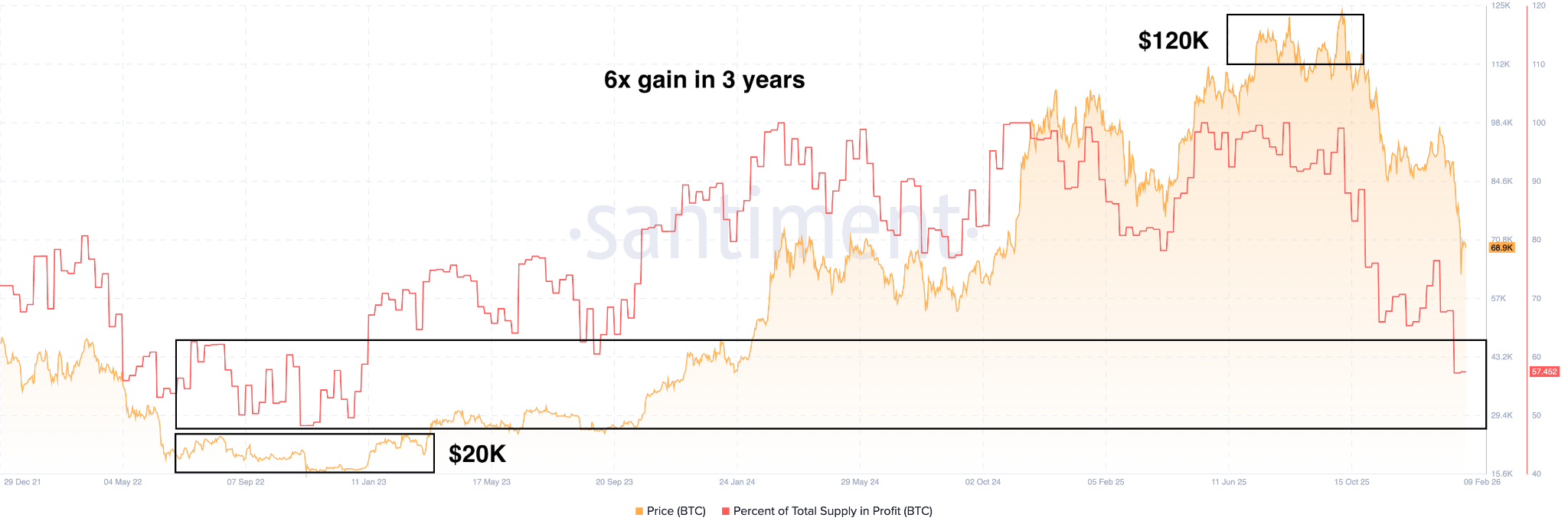
Percentage of BTC Supply in Profit – Source: Santiment
Guess what happened afterward? The top crypto rose to $120,000 in 36 months, delivering a 6x gain to those who bought at this very moment.
Now, BTC could still drop by another 25% if historical patterns repeat. This would mean that we could see it trading for nearly $50,000 over the next few weeks.
So, how to potentially benefit from this early signal? The easiest way would be to adopt dollar-cost averaging (DCA) and buy every dip until BTC stops dipping.
This on-chain metric shows that the bottom might not be that far. Back then, the lowest this metric got was 48%.
Bitcoin Price Forecast
Every new Bitcoin analysis as it publishes, today's technical signal and key levels, live price — on one page.
See all Bitcoin forecastsHow to Cash In If Bitcoin Bounces Back?
Since it is almost impossible to predict how low BTC will go during this cycle, DCA offers a time-tested approach to smooth out the cost basis of an investment.
The risk-reward ratio of this potential trade is quite advantageous. A 6x gain compared to a 25% loss. A DCA system that spreads $1,000 across 5 different purchases could look a bit like this:
| Entry Price | Amount |
|---|---|
| $70,00 | $200 |
| $65,000 | $200 |
| $60,000 | $200 |
| $55,000 | $200 |
| $50,000 | $200 |
Resulting Cost Basis: $60,000
Now, for the upside potential. If BTC were to drop to $50,000, as it could, and deliver a 3x to 6x gain over the next three years, as it did, that would mean a price target ranging from $150,000 to $300,000.
Based on this hypothetical cost basis of $60,000, the upside potential would range from 2.5x to 5x.
Key Levels to Watch as BTC Struggles to Stay Above $70,000
In the near term, we continue to see the $75,000 area as the most likely area of resistance that BTC will retest over the next few weeks.
Depending on what happens once the token reaches that level, we could either get a confirmed rejection or a trend reversal.
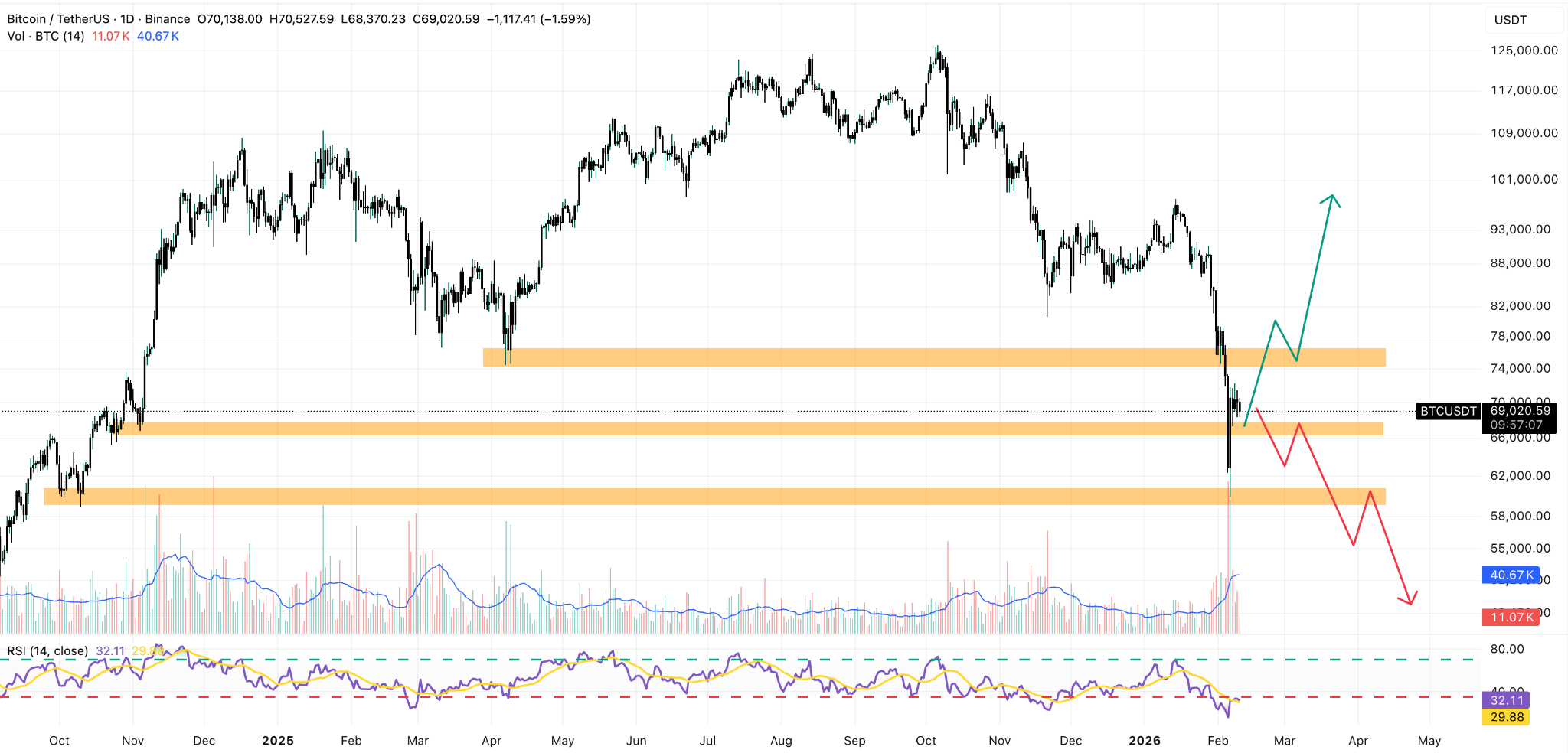
BTC/USDT Daily Chart (Binance) – Source: TradingView
Failing to recapture the $80,000 level could send BTC back to $60,000, pushing it even closer to our expected bottom of $50K for this cycle.
In contrast, if we get a move to $80,000, that could mean a bottom might be in. Considering that short positioning has accelerated lately, a move to $90,000 could prompt a massive squeeze that could mark the beginning of BTC’s recovery.