



Beijing responded to waning domestic demand, announcing fresh stimulus plans on Monday, December 8, setting the stage for a Santa Rally across Mainland China equity markets.
Chinese President Xi Jinping led the Politburo meeting, focused on addressing economic imbalances. These imbalances continue to challenge Beijing’s GDP growth targets.
The announcement followed trade data for November, which signaled a pickup in external demand.
This week’s developments support a short- to medium-term outlook, bolstered by expectations of rotation into Chinese stocks. The CSI 300 and the Shanghai Composite Index will be eyeing their 2025 highs and a four-week winning streak.
Below, I will explore the key drivers behind recent gains, the medium-term (3-6 months) outlook, and the key technical levels traders should watch.
Chinese Exports Rebound as US-China Trade Truce Boosts Demand
Chinese economic data came under intense scrutiny on Monday, December 8, following US President Trump’s October trade talks with President Xi.
Exports rose 5.9% year-on-year (YoY) in November, recovering from October’s 1.1% drop. Meanwhile, imports increased 1.9% YoY, up from 1% in October. According to CN Wire, key YoY import and export trends included:
- Iron ore imports increased 8.5%.
- Soybean imports rose 13%.
- Vehicle imports fell 28%.
- Rare earth mineral exports increased 24.4%.
- Vehicle exports soared 48%.
Notably, President Xi’s agreement to ease restrictions on rare earth mineral exports and increase soybean imports influenced November’s trends.
The rebound in exports aligned with November’s manufacturing PMI survey, which signaled an upswing in external demand. The RatingDog China General Manufacturing PMI fell from 50.6 in October to 49.9 in November, dropping below the neutral 50 level for the first time since July.
Despite production stalling, new export orders rose at the fastest pace in eight months. However, input prices increased, while export charges fell, despite the demand pickup, suggesting intensifying margin squeezes.
November’s trade data and the Manufacturing PMI survey underscore goods producers’ cost-cutting strategies aimed at pricing out the competition. These pricing strategies and margin squeezes led to further job cuts midway through Q4, potentially weakening consumer sentiment.
November’s PMI data and modest rise in imports underscored the need for further policy measures from Beijing to bolster economic momentum.
Hong Kong Hang Seng Price Forecast
Every new Hong Kong Hang Seng analysis as it publishes, today's technical signal and key levels, live price — on one page.
See all Hong Kong Hang Seng forecastsBeijing Announces Fresh Policy Goals to Boost GDP Growth
Weakening domestic consumption and a teetering labor market put Beijing in the spotlight early this week. President Xi Jinping reportedly chaired a Politburo meeting to discuss fresh policy measures to support the economy. CN Wire reported:
“China’s Politburo convened a meeting chaired by Xi Jinping, saying the economy remains “generally stable” and outlining plans for more proactive and effective macro policies in 2026, including more active fiscal measures and moderately loose monetary policy.”
Notably, lawmakers reportedly pledged to boost domestic demand and stabilize employment. The US-China trade war, tariffs, and margin squeezes weighed on consumer sentiment and consumption. Retail sales increased by just 2.9% YoY in October. While falling back modestly from 3.1% in September, retail sales were down sharply from May’s 6.4% rise.
Lower wages and job cuts stemming from margin squeezes and high youth unemployment likely contributed to the pullback in domestic demand. Youth unemployment fell from 17.7% in September to 17.3% in October, but remained well above the 16.6% long-run average (2021-2025). Stabilizing the labor market will likely be key for lawmakers looking to boost domestic demand.
The pledge for moderately loose monetary policy aligned with China Galaxy and Morgan Stanley’s predictions on the People’s Bank of China outlook, which included:
- Reserve Requirement Ratio (RRR): 25-50 bps reduction (Morgan Stanley); 50 bps (China Galaxy).
- PBoC rate cuts: 10-20 basis points (Morgan Stanley, China Galaxy).
The level of monetary policy support may hinge on the effectiveness of lawmakers’ efforts to stabilize the labor market. Further job cuts and softer wage growth would likely weigh on consumer sentiment and water down the effectiveness of measures aimed at boosting consumption.
USD/CNY Weakens as Margin Squeezes Intensify
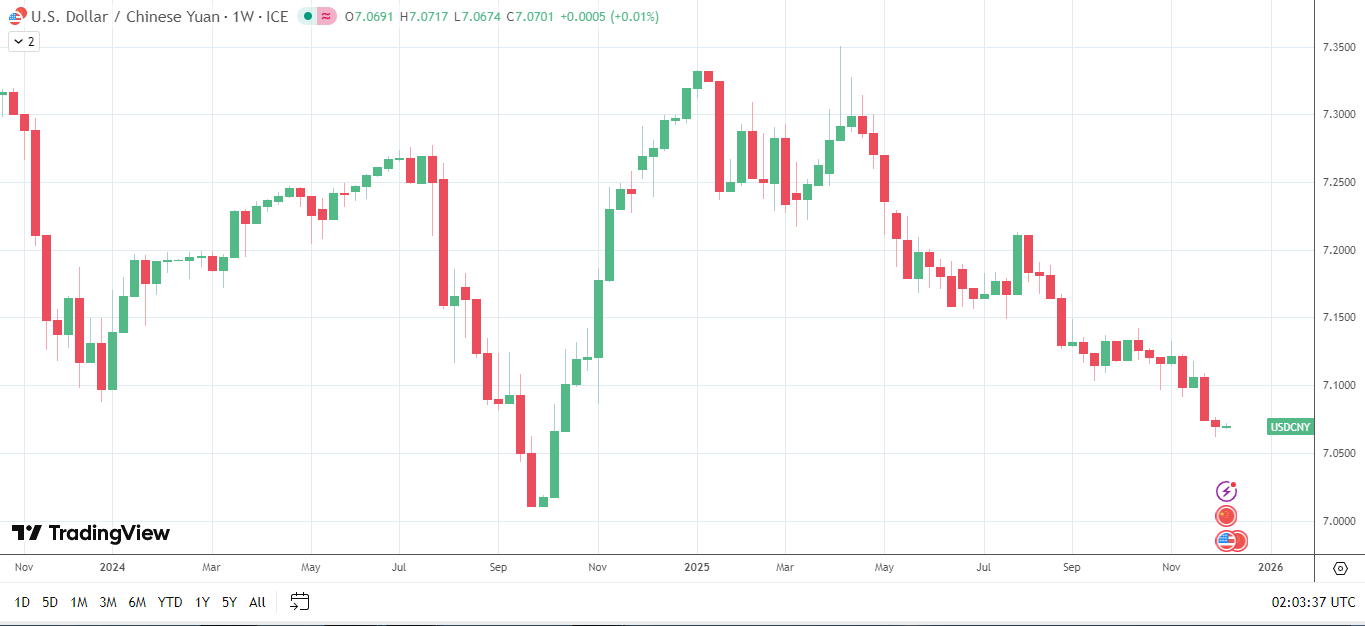
Meanwhile, a stronger Yuan may also affect external demand, margins, the labor market, and domestic consumption. USD/CNY was flat at $7.0701 on Tuesday, December 9, but down 0.68% in the fourth quarter and, more significantly, down 1.3% in H2 2025, following a 1.86% drop through H1 2025.
The stronger Yuan has eased concerns about a breach of the US-China trade war truce. Nevertheless, a weaker USD/CNY increases the cost of Chinese goods, magnifying the effect of tariffs on external demand.
Medium-Term Outlook Bullish
Beijing’s pledge to deliver fresh stimulus and monetary policy support has overshadowed concerns about margin squeezes, lifting demand for Mainland China-listed stocks. Effective stimulus measures and lower borrowing rates would likely fuel demand for risk assets on expectations of a pickup in economic momentum.
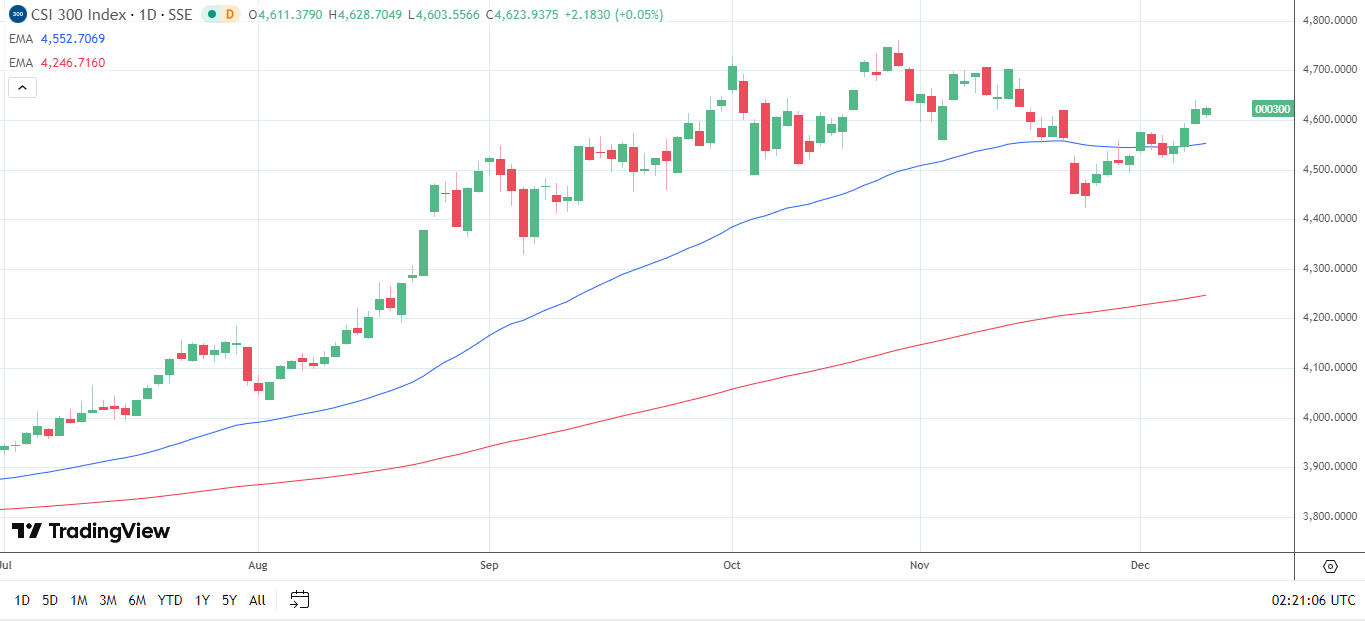
Given these dynamics, coupled with easing US-China trade tensions, the short- to medium-term outlook remains bullish for the CSI 300. The CSI 300 has gained 17.56% year-to-date in 2025 despite a pullback from its current-year high of 4,762.
Technical Signals Favor Higher CSI 300 Levels
Bullish fundamentals align with technical indicators as the year-end approaches. Looking at the daily chart, the CSI 300 broke above its 50-day EMA on Friday, December 5, signaling a bullish trend reversal. A break above the November 11 high of 4,707 would bring the October 30 high of 4,762 into play.
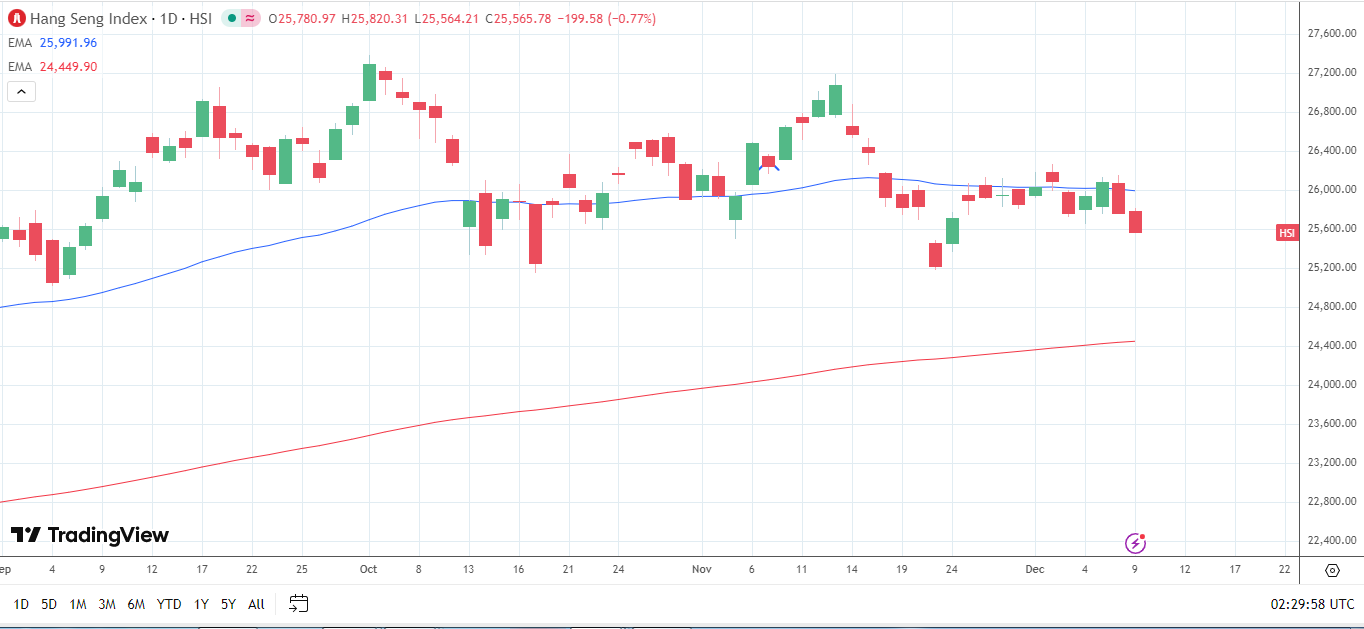
Notably, anticipation and pledges of policy measures led to a decoupling between the CSI 300 and the Hang Seng Index. The Hang Seng Index has soared 27.51% YTD, likely triggering profit-taking and a rotation into Mainland-listed stocks.
The Hang Seng Index dropped below its 50-day EMA on Monday, December 8, indicating a bearish near-term bias.
Key Downside Risks to Monitor
Despite increased investor appetite for Mainland-listed stocks, several downside risks to the bullish outlook remain, including:
- Beijing delays fresh stimulus and monetary policy support.
- A re-escalation in the US-China trade war.
- Increasing margin squeezes, higher unemployment, and waning demand
- China Vanke debt crisis spreads.
Considering these downside risks, the medium-term bullish structure would be invalidated if the CSI 300 and the Hang Seng Index were to breach their June closing prices of 3,936 and 24,072.
Conclusion: Cautiously Bullish Heading into 2026
In summary, the short-term outlook remains cautiously bullish, while the medium-term outlook remains constructive.
Policy support from Beijing and improving US-China trade developments will continue to lift sentiment. However, stimulus and monetary policy measures will need to address deflationary pressures, weak domestic demand, the housing market crisis, and labor market stress for the CSI 300 and the Hang Seng Index to target their all-time highs of 5,931 (2021) and 33,484 (2018), respectively.
Discover strategies to navigate this week’s market trends here.