
The metal has reached fresh record highs above $13,000 per ton in London and $6 per pound in New York today. Geopolitical tensions, robust demand from data centres and renewable energy, and a weaker US dollar have supported the rise. Let’s take a closer look:

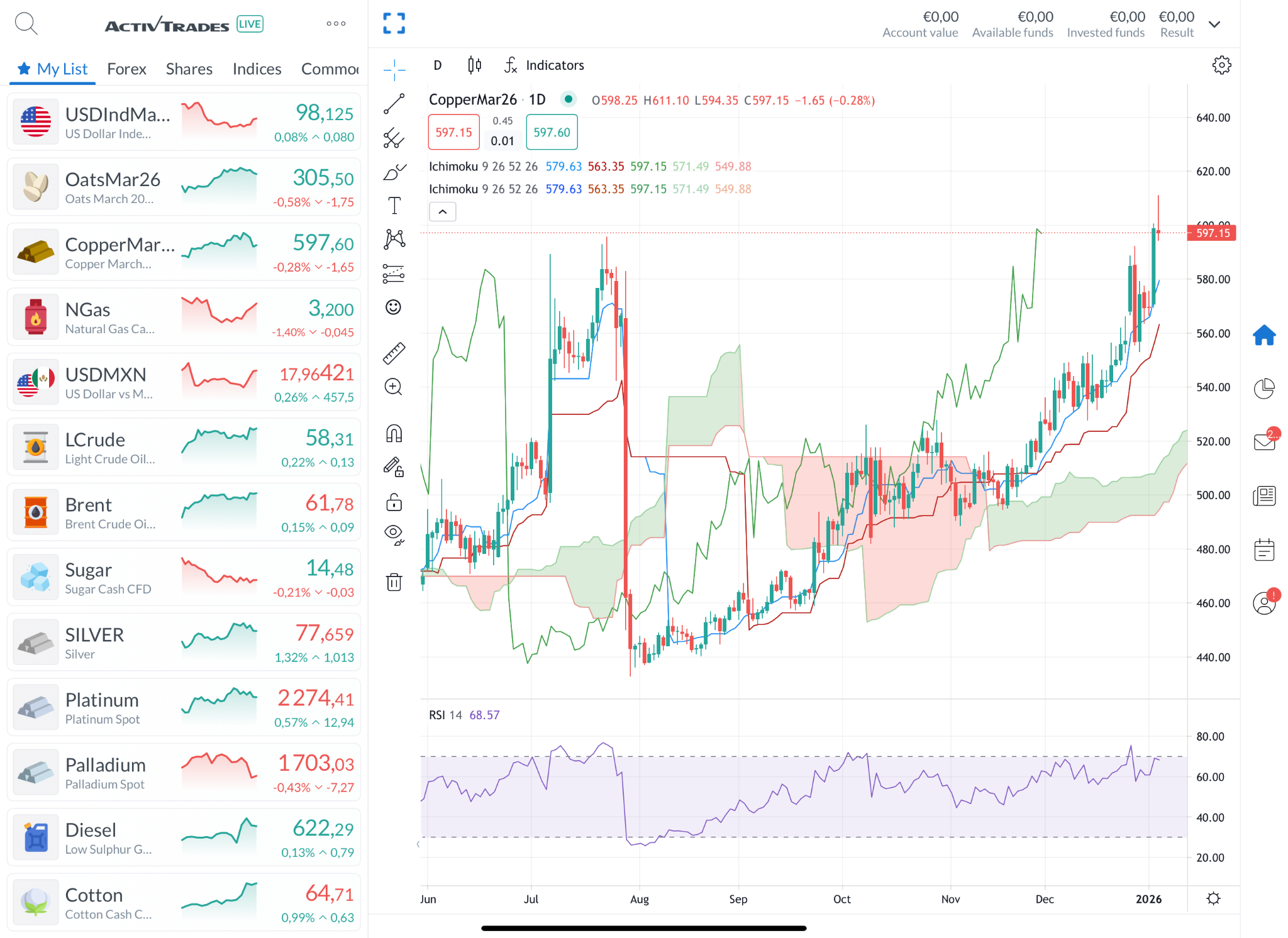
Geopolitical Tensions Are Fueling Copper’s Record-Breaking Run
Copper’s sharp rally today can partly be underpinned by rising geopolitical risks that threaten the security of supply for critical minerals over the long run. Recent developments have heightened concerns about the stability of global supply chains at a time when demand for industrial metals remains strong.
The US-led capture of Venezuelan leader Nicolás Maduro has emerged as a key geopolitical flashpoint. Beyond its immediate political implications, the move signals a broader shift in US foreign and economic policy under President Trump, aimed at reshaping the global order and reinforcing strategic control over essential resources. Venezuela holds significant mineral reserves, and heightened uncertainty around its political future has amplified fears of potential supply disruptions across Latin America.
More broadly, investors seem to be reassessing the resilience of global metals supply chains in an environment that appears increasingly fragmented. Strategic competition between major powers is driving efforts to secure domestic or allied sources of raw materials, raising the risk of reduced cross-border flows and higher long-term production costs. For Copper, which is heavily concentrated in a small number of producing regions, such fragmentation increases vulnerability to geopolitical shocks.
Global Copper Shortfalls Could Provide Long-Term Price Support
Structural tightness in the global Copper market is also emerging as a key pillar underpinning prices, with trade policy uncertainty, declining inventories outside the US, and repeated supply disruptions reinforcing expectations of persistent shortfalls.
Copper Price Forecast
Every new Copper analysis as it publishes, today's technical signal and key levels, live price — on one page.
See all Copper forecastsThe prospect of U.S. tariffs on refined Copper seems to continue to distort global markets. President Trump has intensified these concerns by directing the Department of Commerce to complete a full market assessment by June 30, 2026—a move widely interpreted as the final prerequisite before a formal decision on refined metal duties
While refined Copper was initially exempted from levies last year—temporarily halting shipments—the announcement that tariffs could be revisited prompted a renewed rush to redirect material toward the US. As a result, domestic prices once again began trading at a premium, incentivising inflows. US Copper imports surged in December to their highest level since July according to Bloomberg, reflecting this renewed arbitrage.
Earlier proposals from the Department of Commerce outlined a potential 15% tariff starting in 2027 (and 30% in 2028), although the White House has yet to formally confirm the timeline. Even without a final decision, the prospect of tariffs has already altered global trade flows. Shipments have been increasingly diverted toward the US, tightening availability in other traditional trading hubs and raising the risk of regional shortages.
This shift is clearly visible in inventory data: Copper stockpiles within Comex-monitored warehouses have surged past the 500,000-short-ton threshold following a relentless 44-day streak of net inflows. By contrast, inventories in London Metal Exchange warehouses have nearly halved over the past year, despite remaining above the cyclical low reached in June. The growing imbalance between US and non-US inventories highlights how policy uncertainty alone can reshape physical market dynamics.
Futures markets also seem to confirm tightening Copper supplies. Copper in the London Metal Exchange (LME) has moved into a “backwardation,” with Copper spot prices carrying a $42 premium over three-month contracts, usually indicating urgent demand for the physical metal. Similarly, widening spreads on the Comex exchange suggest the market expects physical availability to remain constrained for the foreseeable future.
Supply disruptions have compounded these pressures. According to the Shanghai Metal Market, a series of accidents, operational setbacks, and external shocks throughout 2025 curtailed production growth across multiple major producing regions. These included a nationwide power outage in Chile in February, a mining accident at Kazakhstan’s East Zhezkazgan mine in March, and temporary shutdowns at key Chilean operations such as Sierra Gorda and Carmen de Andacollo due to safety incidents and mechanical failures. Peru’s Antamina mine was briefly taken offline following an accident in April, while seismic activity forced repeated suspensions at the Kakula underground mine starting in May.
Further disruptions followed in June, when Canadian wildfires led Hudbay Minerals to suspend production at the Snow Lake polymetallic mine. In July, fatal accidents at China’s Wunugetushan Copper-Molybdenum Mine and Canada’s Red Chris mine resulted in operational halts. In August, an earthquake at Codelco’s El Teniente mine caused multiple fatalities and forced activity suspensions near the affected area. September brought additional setbacks, including mechanical failures at Chile’s Mantoverde mine, a deadly tailings leak at Indonesia’s Grasberg operation that prompted a production suspension, extended shutdowns at Teck Resources’ Quebrada Blanca mine, and the closure of Hudbay’s Constancia plant in Peru amid widespread protests.
Pressure is also evident further down the supply chain. Smelters have faced growing difficulty securing sufficient concentrate, leading miners to push for record-low treatment and refining charges. This dynamic can also be interpreted as another sign of constrained upstream supply.
Longer term, structural deficits appear increasingly difficult to avoid. According to the International Energy Agency, Copper is heading toward a supply shortfall that could reach 30% by 2035, making it one of the most vulnerable materials within global supply chains supporting the energy transition and artificial intelligence development. The IEA attributes this outlook to declining ore grades, rising capital costs, and lengthy project development timelines, all of which limit the industry’s ability to respond quickly to rising demand.
Market concentration is also intensifying. The top three refining nations now control 86% of the processing capacity for major energy minerals—up from 82% in 2020—with the vast majority of this growth concentrated in the hands of two large players: China and Indonesia. China remains the dominant refiner, leading processing capacity for 19 of the 20 strategic minerals identified by the IEA in key sectors such as energy, defence and artificial intelligence. Excluding China from supply calculations leaves the rest of the world capable of meeting only around half of its own demand for battery metals and rare earths, according to the agency, underscoring the Copper market’s exposure to trade restrictions, geopolitical shocks, and extreme weather events.
How to Take Advantage of the Rise in Copper Prices
For traders, Copper futures is often seen as the most direct and flexible way to gain exposure to the red metal. Futures contracts allow market participants to speculate on Copper prices for delivery at a predetermined price and date, often offering high liquidity and tight spreads. These instruments are particularly well suited to respond quickly to macroeconomic data, shifts in inventories, geopolitical developments, or changes in trade policy.
For investors seeking a more accessible and diversified approach, exchange-traded funds can provide an efficient alternative. Copper ETFs typically track the price of Copper through a basket of futures contracts or by holding shares in Copper-related companies. They offer exposure without the operational complexity of futures trading and can be bought and sold like equities on major exchanges. This makes them suitable for medium to long-term investors, or less advanced investors, looking to benefit from rising prices while limiting single-asset risk. iShares Copper and Metals Mining and WisdomTree Copper are some examples of such ETFs.
A third approach, primarily suited to long-term investors, is direct investment in Copper-producing companies. Mining equities offer leveraged exposure to Copper prices, as rising prices can translate into higher revenues and improved margins, particularly for low-cost producers. Investors can gain exposure across different stages of the value chain. Major global players such as Glencore, Anglo American, BHP, Freeport-McMoRan, and Codelco are often viewed as core holdings within this segment, although company-specific risks must be taken into consideration.
Sources: Wall Street Journal, Reuters, Bloomberg, Yahoo Finance, SP Global, IEA, Shanghai Metal Market