Volatility Drives Technical Reactions
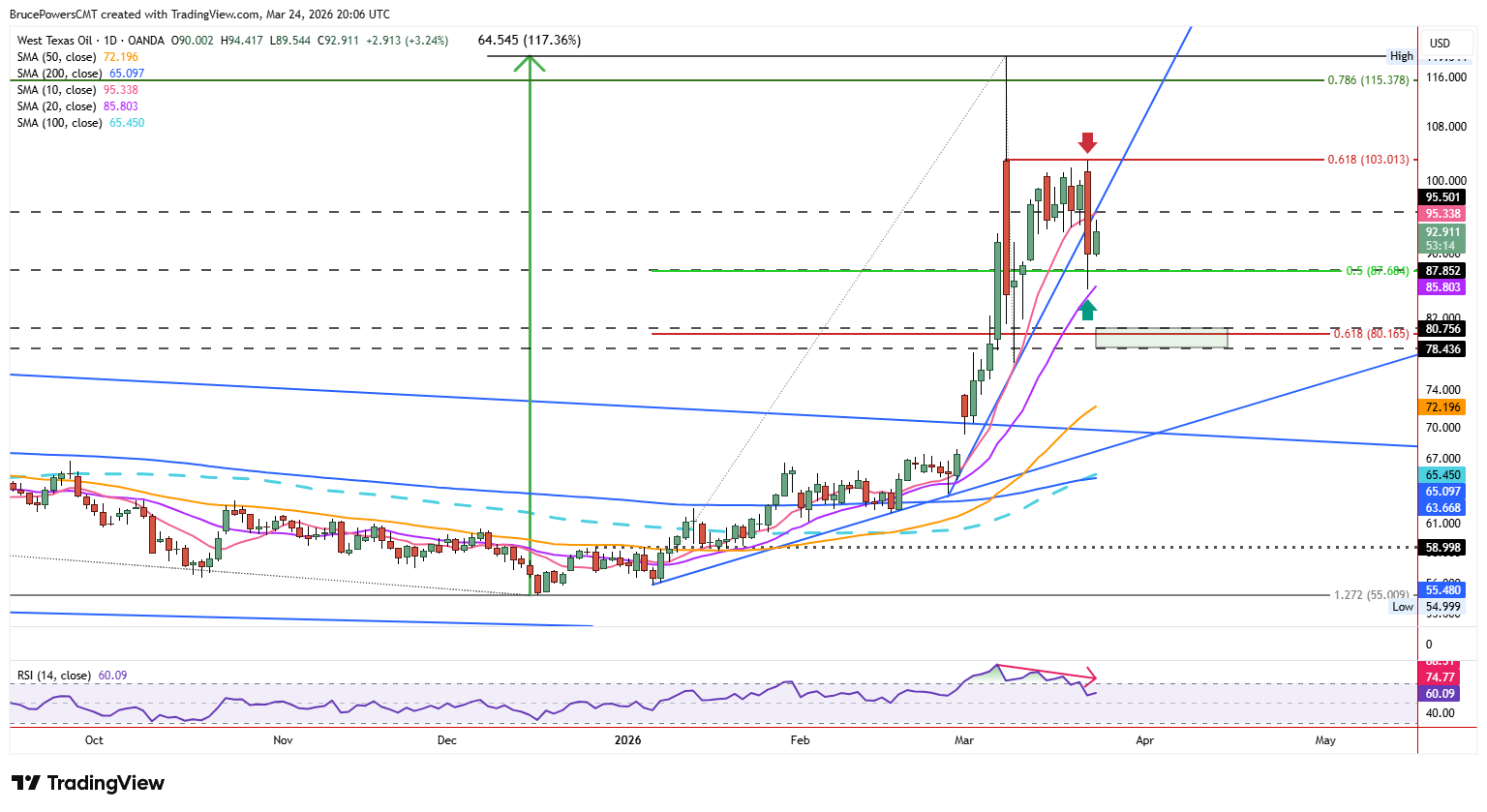
Despite heightened volatility, crude oil continues to recognize key technical levels. It briefly rose to a new trend high of $102.87 on Monday, before sellers regained control. That advance reached a 61.8% Fibonacci retracement level before the decline, dropping through support to an eight-day low of $85.50 before a subsequent bounce.
The recent downturn from the peak resulted in a breach of the 10-day moving average – an indicator that had provided support since its recovery in late February. This movement also led to a violation of an established uptrend line and completed a 50% retracement at $87.68. Additionally, the relative strength index (RSI) showed bearish divergence during the recent bounce, signaling sustained selling pressure.

20-Day Average Emerges as Key Support
Support for Monday was found near the rising 20-day moving average, currently at $85.80. Since it was recognized by the market and follows a failure of support at the 10-day average, the 20-day average now becomes the primary trend indicator. Therefore, the rising 10-day average at $95.35 may now serve as a resistance zone. Tuesday’s high of $94.42, which resulted in an inside day, tested that resistance, but further attempts may also occur.
Consolidation After Spike Highs
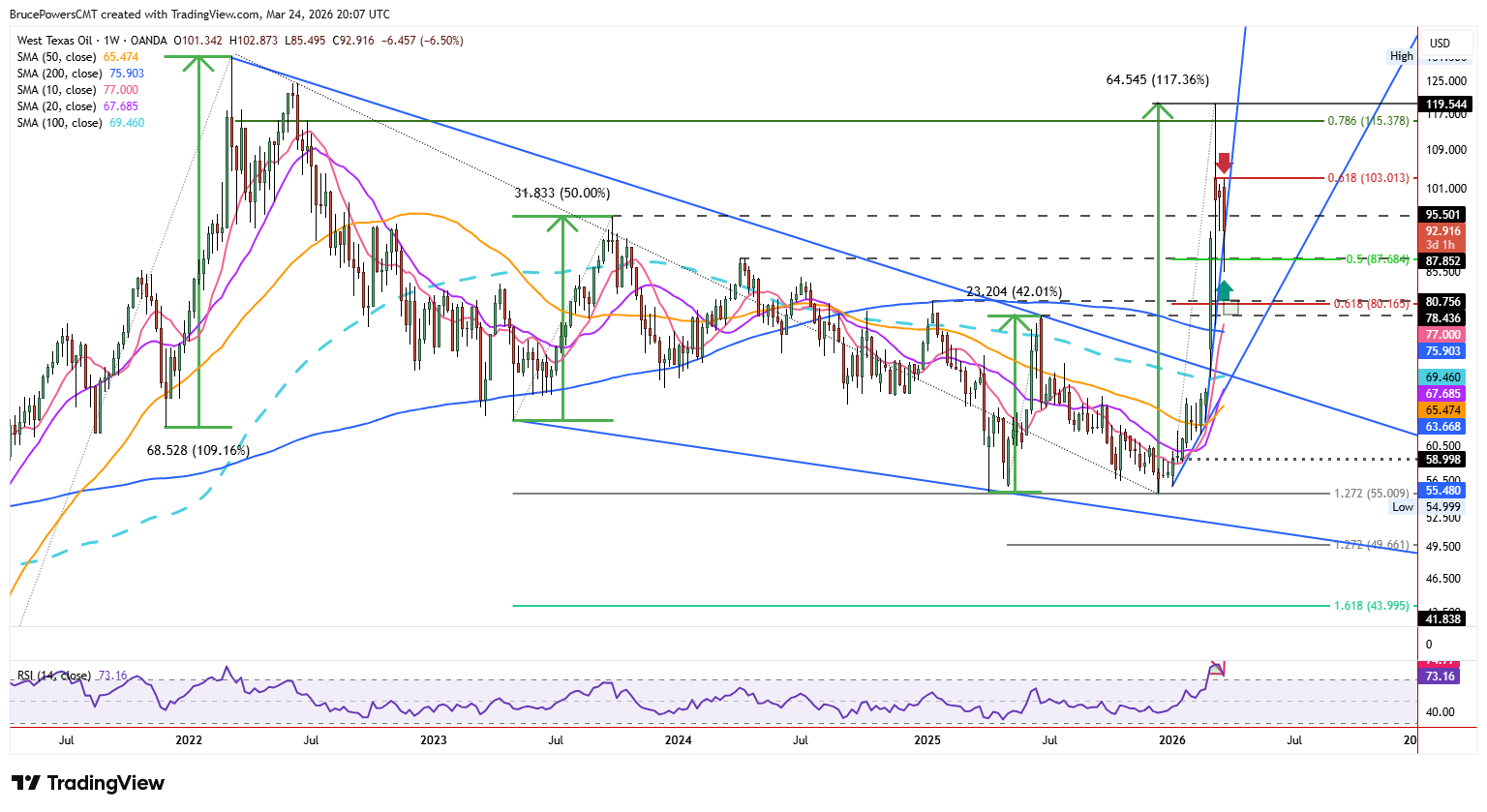
Price action following the spike high to $119.54 two weeks ago has led to lower volatility and consolidation. Both support and resistance are defined at $85.78 and $102.87, respectively, while the 10-day average provides a tighter resistance band. Consolidation will persist until a decisive breakout of the range occurs, but the bias remains to the upside as long as support holds above the 20-day average.
Potential Lower Targets if Support Breaks
Moreover, if the 20-day average is broken, followed by a drop below the $85.50 low, the 61.8% Fibonacci retracement near $80.17 becomes the next lower target. It is supported by prior swing highs from January 15 and 23, respectively. Together, these levels extend the potential support range from $80.76 to $78.44, providing traders with a defined risk zone.
Weekly Chart Signals Bearish Pressure
When considering the weekly chart, crude oil shows a bearish engulfing candlestick pattern, with bearish implications confirmed if there is a weekly close below last week’s low of $92.72. Note that the pattern began with a failed breakout above last week’s high of $101.83, underscoring the persistent bearish pressure.
WTI Crude Oil Price Forecast
Every new WTI Crude Oil analysis as it publishes, today's technical signal and key levels, live price — on one page.
See all WTI Crude Oil forecastsIf you’d like to know more about how commodity markets work, please visit our educational area.