
The Bank of Japan’s October meeting minutes revealed discussions about raising interest rates to the neutral rate, currently between 1% and 2.5%. USD/JPY fell 0.38% to 155.783 in early trading on Wednesday, December 24, while 10-year Japanese Government Bond (JGB) yields climbed to 2.034%.
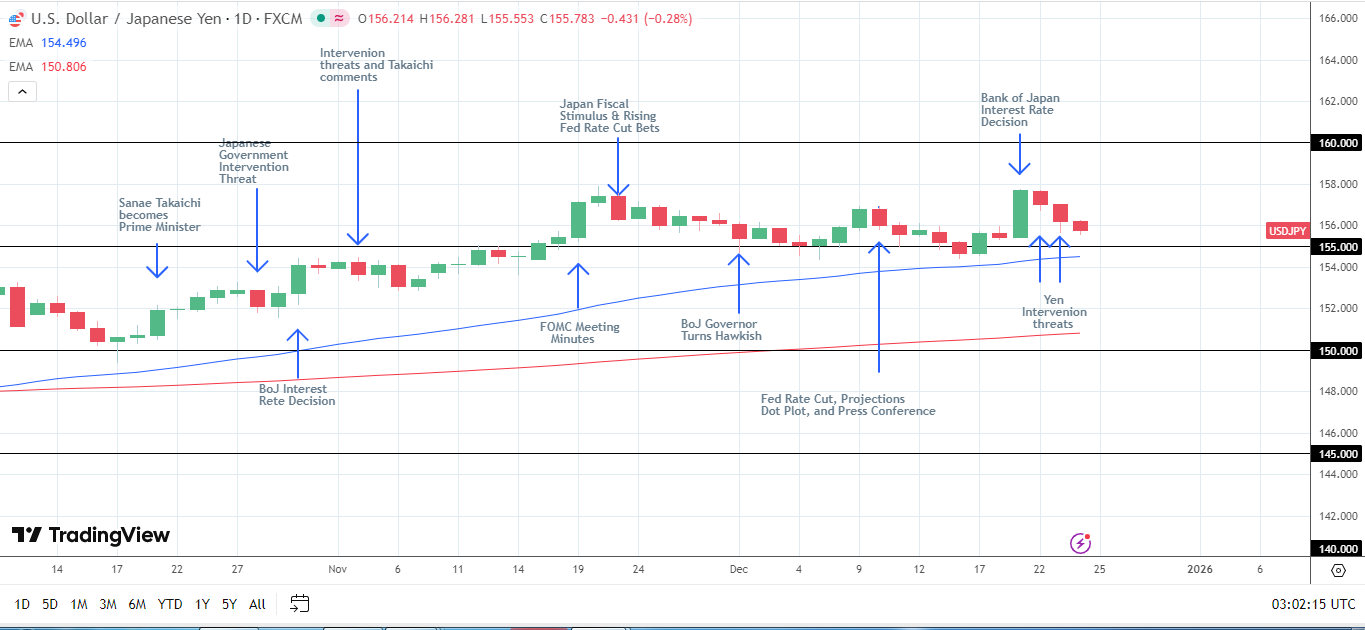
Uncertainty about the BoJ’s neutral interest rate, neither accommodative nor restrictive, and talk about moving toward policy normalization, weighed on US stock futures. However, the losses were modest, given that USD/JPY remained above 155, easing fears of a yen carry trade unwind.
Despite the morning pullback, the outlook remains constructive for US equity futures, with strong economic momentum in Q3 countering concerns over sticky inflation.
Below, I’ll outline the key market drivers, the medium-term outlook, and the key technical levels traders should watch.

Bank of Japan Meeting Minutes Reveal a Hawkish Undertone
The Bank of Japan’s October meeting minutes garnered more interest than usual on Wednesday, given last week’s interest rate hike.
Discussions about price stability, wage growth, and easing US tariff-related risks to the Japanese economy highlighted key considerations for policymakers going into 2026. An improving macroeconomic backdrop and rising prices would likely support further rate hikes.
The meeting minutes stated that the Bank would continue to raise rates, given that real interest rates were at significantly low levels, contingent on economic activity and prices aligning with the Bank’s outlook.
A more hawkish BoJ rate path would narrow US-Japan rate differentials in favor of the yen, making yen carry trades less profitable. However, third-quarter GDP and price deflator numbers from the US tempered bets on a March Fed rate cut, easing risks of a yen carry trade unwind. Notably, the Nikkei 225, a barometer of Asian market sentiment, rose 0.22% in morning trading.
Given these market dynamics and sentiment toward the Fed and the BoJ’s rate paths, the outlook for US stock futures remains bullish.
Dow Jones Price Forecast
Every new Dow Jones analysis as it publishes, today's technical signal and key levels, live price — on one page.
See all Dow Jones forecastsUS Labor Market in Focus
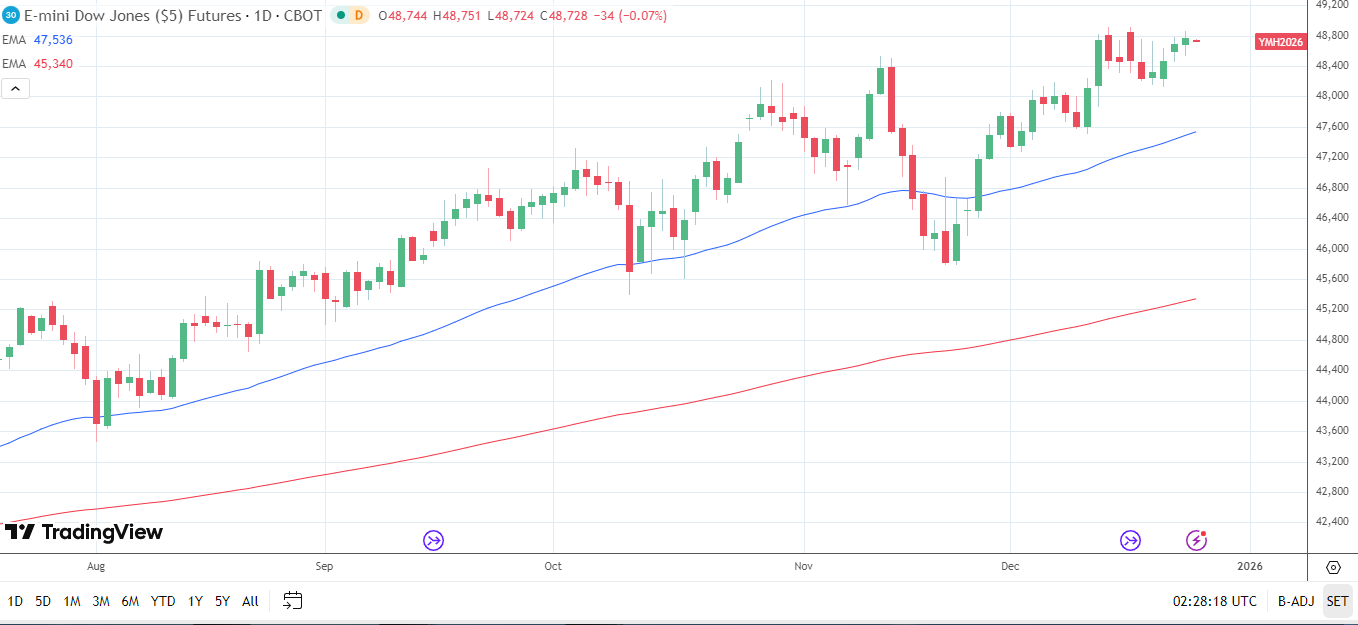
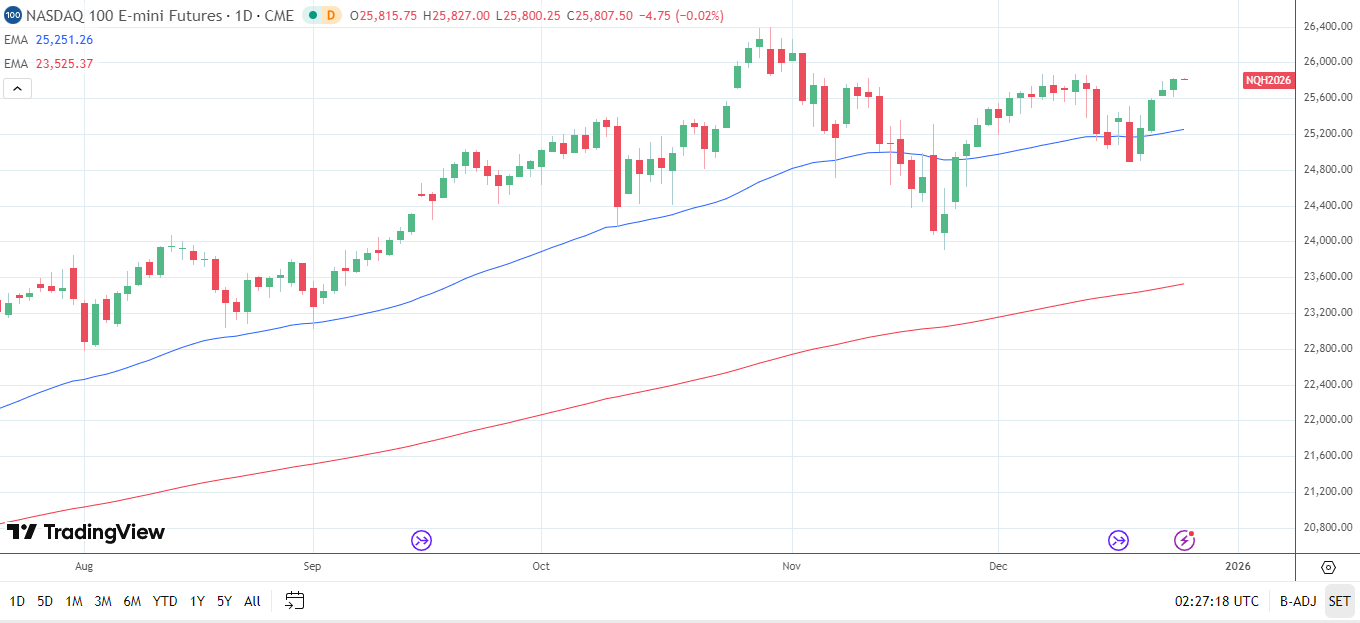
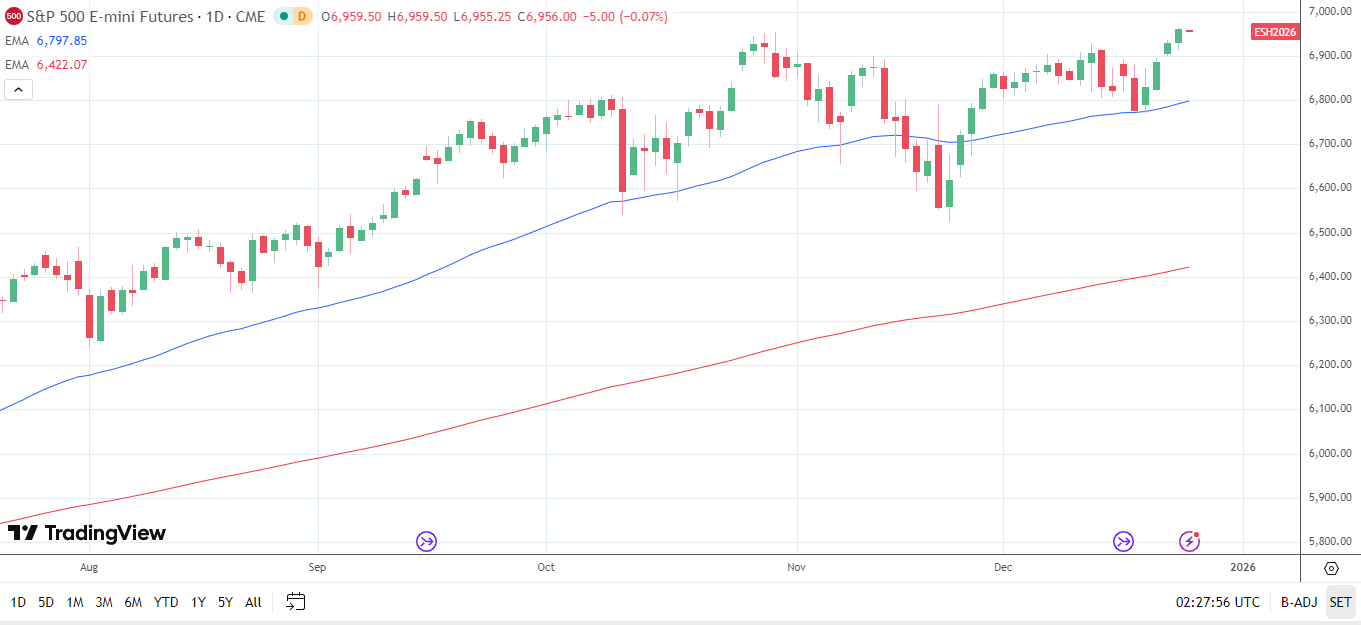
US futures saw modest losses during the Asian morning session on Wednesday, December 24. The Nasdaq 100 E-mini and the S&P 500 E-mini fell 5 points and 5 points, respectively, while the Dow Jones E-mini slipped 34 points.
Later on Wednesday, US jobless claims data will influence market bets on a March Fed rate cut and risk sentiment. Economists forecast initial jobless claims to drop from 224k (week ending December 13) to 223k (week ending December 20).
A sharper drop in claims would dampen expectations of a March Fed rate cut, weighing on US equity futures. However, any downside would be modest, given expectations of Fed Chair Powell’s successor favoring lower interest rates and the US economy’s strength.
Key Technical Levels for Dow Jones, Nasdaq 100, and S&P 500
Despite the Wednesday morning pullback, the Dow Jones E-mini, the Nasdaq 100 E-mini, and the S&P 500 E-mini remained above their 50-day and 200-day EMAs. The EMAs indicated a positive medium-term bias, aligning with the constructive short- to medium-term outlook.
Near-term trends will hinge on US data, Fed chatter, and Bank of Japan rhetoric. Key levels to monitor include:
Dow Jones
- Resistance: The December 12 record high of 48,917, and then 49,000.
- Support: 48,500 and then the 50-day EMA (47,536).
Nasdaq 100
- Resistance: 26,000 and then the October 30 record high of 26,399.
- Support: the 50-day EMA (25,251) and then 24,500.
S&P 500
- Resistance: the December 23 record high of 6,964, and then 7,000.
- Support: the 50-day EMA (6,798) and then 6,500.
Bullish Medium-Term Outlook Hinges on Central Bank Policy Signals
In my opinion, the short-term outlook remains bullish given the alignment of technical indicators and fundamentals. Meanwhile, expectations of an incoming Fed Chair supporting loose monetary policy, reinforce the positive medium-term outlook.
Nevertheless, several events would likely derail the positive medium-term outlook, including:
- Bank of Japan announces a neutral interest rate of between 1.5 and 2.5%, triggering a yen carry trade unwind.
- Better-than-expected US data and hawkish Fed rhetoric temper bets on a Fed rate cut.
Conclusion: Outlook Bullish
In summary, robust US GDP data and a cautious BoJ support a bullish short- to medium-term outlook for US stock futures.
However, over the next 72 hours, traders should monitor USD/JPY trends, intervention threats, and the Nikkei 225. Intervention threats and hawkish BoJ chatter could send JGB yields higher and USD/JPY lower, challenging the constructive bias. Japan’s Finance Minister Satsuki Katayama threatened action against excessive moves.
Key levels include a USD/JPY drop below 150 and 10-year JGBs sustainably at the December 22 high of 2.1%. These levels would likely trigger a Nikkei 225 sell-off, spilling over to the US markets.
Meanwhile another potential tailwind for US stock futures would be upcoming tax cuts that are likely to boost consumer spending. Strong private consumption would boost the economy, given its roughly 65% contribution to US GDP. US tax cuts and strong business investment into AI would likely send US equity futures to new highs.
Follow our live coverage and consult the economic calendar for real-time market updates.