Hope & Hostility
Things are still very much up in the air, despite traders pricing in the end of this war. The defining tension remains the contradictory messaging, moving back and forth between optimism and military action in the Strait. Monday saw President Trump describe negotiations with Tehran as ‘proceeding nicely’, with Iranian officials echoing the sentiment, which naturally boosted risk appetite. Oil gapped sharply lower at the open, with both Brent and WTI trading south of US$100/barrel. Equity markets also gapped higher.
However, that optimism was almost immediately tested. The US confirmed it carried out what it characterised as ‘self-defence strikes’ against Iranian missile launch sites and vessels attempting to lay mines in the Strait. Iranian state media confirmed the attacks south of Larak Island and reported casualties. Brent, which had tumbled about 10% on Monday, pared some of these losses this morning, currently trading around US$95/barrel – a reminder of just how fragile this ceasefire remains. This morning has also seen Asia-Pac stocks pare gains, European equity index futures are down, and the USD is bid – a somewhat different picture to yesterday.
Personally, as I have said a number of times now, I would exercise caution against reading too much into either the positive diplomatic signals or the renewed strikes in isolation. The reality is that both can coexist in this environment, and trading based on these signals is challenging to say the least.
Macro Spotlight: Aussie CPI & RBNZ Update in Focus
Asia-Pac trading on Wednesday welcomes the April Australian CPI inflation data at 1:30 am GMT, closely followed by the RBNZ rate decision at 2:00 am GMT.
Aussie CPI: A Miss Could Accelerate an Unwind
For the Aussie data, economists expect the YY headline CPI to decelerate to 4.4% from 4.6% in March (est. range between 4.8% and 4.1%), while the YY trimmed mean figure is forecast to tick higher to 3.4% from 3.3%. I do want to highlight that the Aussie data are monthly, not quarterly, which is generally more important to the RBA. Of relevance, you may also recall that the latest RBA meeting saw the central bank state that it would now take its time to assess the data before moving again. Coupled with the April Aussie labour data, which came in disappointing, markets are now pricing in 22 bps of tightening, down from a whopping 60 bps a month ago!
Because of the recent RBA shift and jobs data, a big miss could see traders further price out tightening and prompt some traders to unwind their long positioning – the AUD is one of the most overstretched currencies to the upside right now.
RBNZ: Less About the Decision, More About the Signal
For the RBNZ, markets are pricing in just 6 bps of tightening ahead of the event (~80% probability of a hold versus ~20% chance of a hike), implying the central bank is likely to remain on hold at 2.25% – unchanged since November 2025. Yet despite that near-term inertia, year-end pricing tells a very different story: 71 bps of hikes are implied, making RBNZ market pricing among the most hawkish globally. This is a meaningful and striking contrast, and one made more interesting still by the NZD‘s strong bearish positioning.
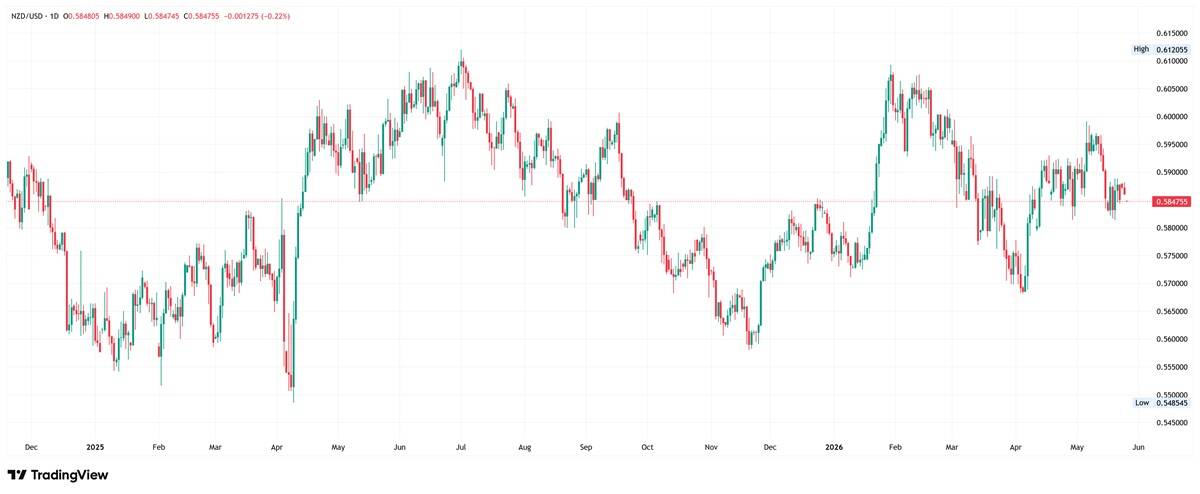
Both 5Y and 10Y market-based New Zealand inflation expectations have increased quite considerably since March, which could be one of the drivers behind the 6 bps of tightening priced in for this meeting. While I think a hike is still very unlikely given GDP growth tracking below the RBNZ’s latest projections – Q4 25 grew at a meagre pace of 0.2% down from 0.9% in Q3 – and the loosening jobs market, if they do surprise with a 25 bp increase, I expect a strong move to the upside in NZD, a run higher amplified by an unwind of short positioning.
Bringing It Together: AUD/NZD in the Crosshairs
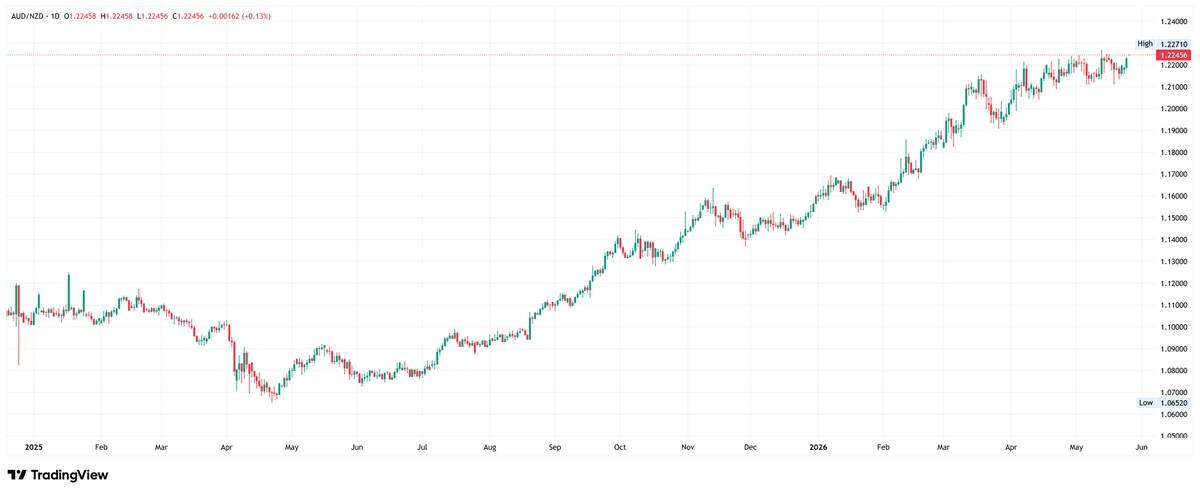
With AUD (NZD) positioning overstretched to the upside (downside), a surprise RBNZ hike or hawkish hold – particularly if accompanied by softer-than-expected Aussie CPI – could open the door to AUD/NZD shorting opportunities. One factor worth flagging here is that some officials were already advocating for a more proactive response as far back as the April meeting, so a surprise hike cannot be entirely dismissed.
If we do get a hold decision, the focus will be on the rate statement’s language and the updated economic projections – the Monetary Policy Statement. For example, if central bank officials revise their terminal OCR forecast up and lift their end-2026 rate path, I would read this as bullish NZD.
Written by FP Markets Chief Market Analyst Aaron Hill