Sell America Trade Taking Hold; JGBs Rebound on Katayama Comments
Despite equity index futures showing a modest rebound, yesterday’s risk-off environment has left its mark.
This risk-off trade stemmed primarily from the US President’s recent announcement of 10% tariffs on several European countries, set to come into effect at the beginning of February, over his ‘desire’ to buy Greenland for ‘national security reasons’. Regardless of the motives, the threat is real and is stirring markets. The EU is reportedly in talks to impose tariffs of around €100 billion should Trump follow through on his latest threats.
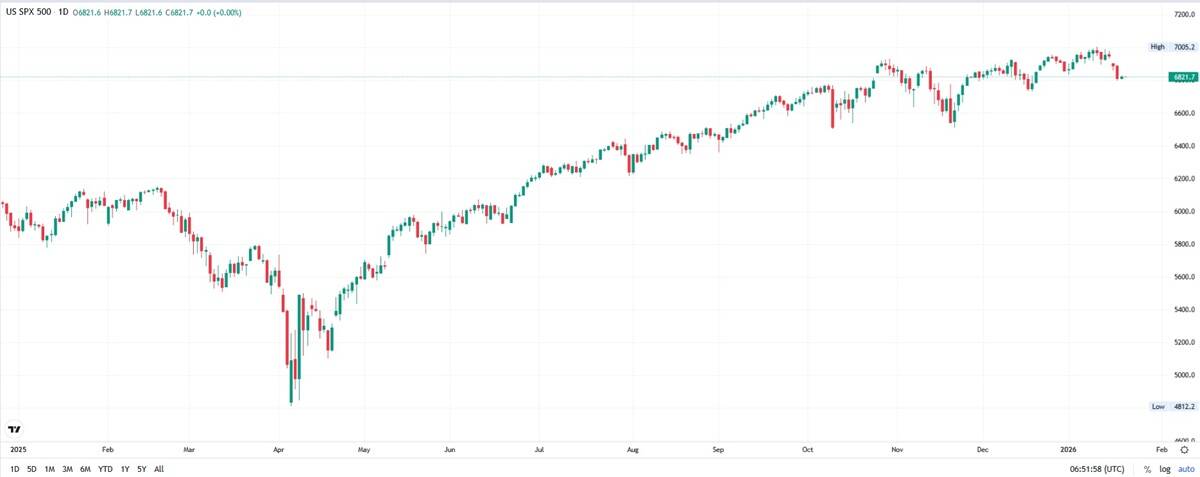
Major US Stock benchmarks plunged about 2.0% on Tuesday, with the S&P 500 notching up its worst performance since October last year. Likewise, US Treasuries took a hit, and the USD index dipped a toe under its 50-day SMA at 98.96.
As you would expect, the VIX has risen to 20.00. A setup I watch particularly closely is the combination of the VIX and the S&P 500. You will often find that when the VIX closes north of the upper boundary of the Bollinger Band (set to two standard deviations), dip-buyers tend to step in on the S&P 500, preferably bolstered by technical support. You will note that the market index is currently shaking hands with the 50-day SMA around 6,829.
In addition to geopolitical tensions, fiscal concerns out of Japan added fuel to the fire, sending JGB investors to the exit door and lifting longer-dated yields to record levels – this also impacted US markets. The selloff was triggered by Prime Minister Sanae Takaichi’s proposal to eliminate the consumption tax on food, raising concerns about Japan’s fiscal sustainability as the funding source for the tax cut remains unclear.
However, the market seems to have caught its breath overnight, eased by comments from Finance Minister Satsuki Katayama speaking from the Davos summit, who called for calm. While her comments eased selling, I get the feeling that traders want more and that ‘talk is cheap’. More direct action will likely be needed to calm investors. On that note, the USD/JPY is testing BoJ intervention levels between ¥158.00 and ¥160.00.

Davos in the Crosshairs
Today is a big one for markets as we look ahead to Trump’s speech at the WEF annual meeting at 1:30 pm GMT. However, this may be delayed following an electrical issue, causing Air Force One to return to base. His speech is particularly prominent amid mounting tensions between Europe and Washington, with neither side backing down as of writing regarding Trump’s intention to acquire Greenland. How far Trump will go to achieve this is difficult to estimate, though he recently noted that ‘you’ll find out’ when pressed on the matter.
Let’s be honest, it is anybody’s guess what he will say at today’s speech. It is supposed to be about affordability, but investors will focus on his tone regarding his feud with European allies.
GBP/USD Price Forecast
Every new GBP/USD analysis as it publishes, today's technical signal and key levels, live price — on one page.
See all GBP/USD forecastsUK Inflation Data Eyed
Here in the UK, the December CPI inflation figures land this morning at 7:00 am GMT. Both headline and core YY data are forecast to modestly accelerate by 3.3% from 3.2% in November, respectively. The BoE next meets on 5 February – its first meeting this year – with money markets almost fully pricing in a no-change decision, though around two rate cuts are implied until the year-end (-41 bps). April is looking likely for a possible rate cut, with another in Q4.
Of course, a stronger print today would likely prompt a hawkish rate repricing and is likely to be positive for GBP. However, as I mentioned yesterday, I am not keen on GBP upside, with downside likely offering more bang for your buck; therefore, I favour a miss in the data. My rationale is that disappointing numbers would underscore concerns about growth and the UK’s fiscal situation. This would also likely fully price in two cuts for the year and move April’s meeting (possibly March) firmly into the frame for a possible rate reduction.
Written by FP Markets Chief Market Analyst Aaron Hill