
The Week That WAS: US-Iran War Dominated Flows
I would be remiss if I did not begin with the Middle East conflict and elevated energy prices, which, frankly, ‘almost’ feel like familiar territory. This dominated headlines last week; the Strait of Hormuz – through which about a fifth of global seaborne Oil flows – remains all but closed, and strikes between the US, Israel, and Iran continued over the weekend.
The USD Index recorded its largest one-week gain since President Trump’s second inauguration, rallying to a high of 99.68 — a rise of 1.4% on the week. The buck is up 0.5% this morning and crossed above the 50-day SMA at 98.67. The path of least resistance for the USD remains firmly to the north. Not only is the greenback bolstered by haven demand, but also by terms of trade in the petrodollar system – as Oil rises, demand for the USD will continue to find a footing. Another layer supporting the buck, of course, is investors pricing out expectations for Fed rate cuts.
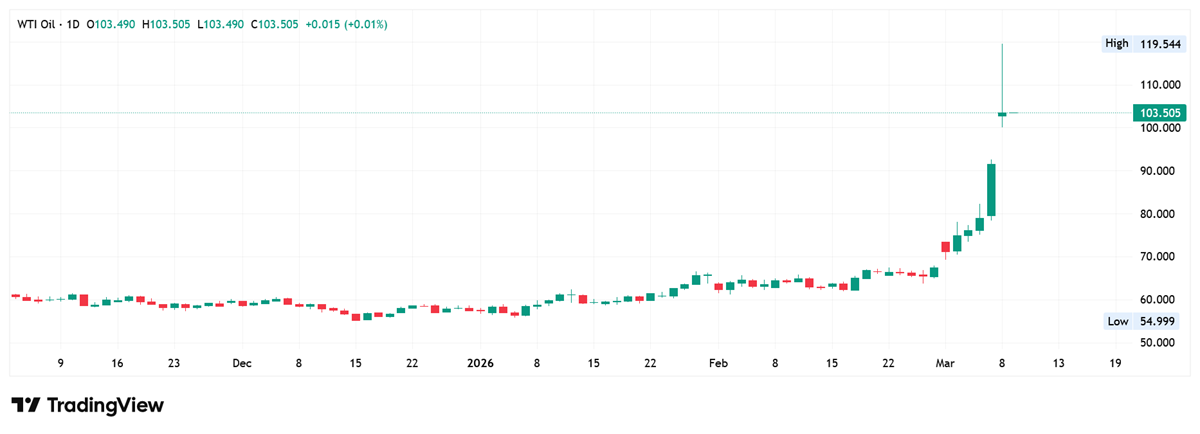
WTI Oil and Brent Crude rallied an eye-popping 35% and 27% last week, respectively. To put this into context, the rally in WTI was its largest one-week gain on record and the biggest one-week jump for Brent since early 2020. However, as of early trading this morning, both WTI and Brent are up a whopping 14% and 16% (after touching highs of US$119.50), respectively. These are just incredible moves, trading near highs seen in 2022 when Russia invaded Ukraine.
Cross-asset performance saw the CHF and JPY take a back seat in the haven trade, dropping 1.0% and 1.1% versus the USD last week, respectively. US Treasuries also failed to attract haven bids, with yields rising across the curve, though this was largely driven by rising inflation expectations.
Spot Gold’s (XAU/USD) performance also delivered a mixed picture last week, falling 4.4% on Tuesday, finding moderate respite on Wednesday, dropping again on Thursday, only to catch a bid on Friday. Across US Stock benchmarks, it was red across the board, with the Dow Jones shedding 3.2% by the close at the week’s end. However, it is important to note that during times of acute market stress, the correlation between Stocks and Gold is moderately positive.

The US Economy Shed 92,000 Jobs in February
The week wrapped up with the US February jobs report, which showed that the economy shed 92,000 payrolls – a sharp reversal from January’s downwardly revised 126,000 reading. Private payrolls also took a considerable hit, tumbling by 86,000 from 172,000, which is the worst reading since 2020. Interestingly, the manufacturing sector also cut 12,000 jobs, down from 5,000 added in the prior month. The healthcare sector was also hit quite substantially, dropping from 116,000 in January to a loss of 18,600 – a swing of 135,000 in a single month. Notably, job gains have largely been concentrated in this sector in previous reports.
Unemployment ticked higher to 4.4% from 4.3%, with the labour force participation rate also slipping to 62.0% – meaning that even with fewer people actively looking for work, the headline unemployment rate still rose. In other words, the labour market would look worse if all those ‘discouraged workers’ were still counted.
Wages rose 0.4% MM – matching January but was above the 0.3% consensus – with YY up 3.8%, bettering 3.7% expected and prior. However, this provided the markets with little comfort, given the overall picture.
While yields and the USD traded lower immediately after the report was released, the sell-off was short-lived. I noted this was a strong possibility ahead of the release, simply due to the buck remaining bolstered on haven demand, easing Fed-rate expectations, and the currency being overstretched to the downside. I felt the more bang for your buck was on a beat, which would feed into that haven bid.
One payroll is unlikely to change the Fed, and I am expecting the central bank to hold steady again this month. However, last week’s jobs data puts the central bank in a tricky spot: grappling with a loosening labour market and heightened price pressures, especially amid the Middle East conflict. The rally in energy markets has triggered fresh worries about price pressures and prompted investors to pare back expectations for Fed rate cuts. As of writing, money markets are pricing in just 44 bps of easing by year-end, down from 57 bps a week ago, though up from 37 bps on Thursday.
Given this dovish repricing and the particularly weak US payrolls numbers out on Friday, attention will shift to this week’s US inflation data.
Brent Oil Price Forecast
Every new Brent Oil analysis as it publishes, today's technical signal and key levels, live price — on one page.
See all Brent Oil forecastsThe Week That IS: US Inflation Data
Despite the US-Iran conflict remaining front and centre for market sentiment – which could very well overshadow any data this week – US inflation numbers and their implications for Fed policy will still be on the watchlist for many market participants. We have the February CPI inflation report landing on Wednesday at 12:30 pm GMT, and the all-important January PCE inflation release on Friday at 12:30 pm, which the Fed tracks more closely.
YY headline (core) CPI inflation data is expected to remain unchanged at 2.4% (2.5%), with a 0.3% MM increase from 0.2% in January at the headline level and to cool to 0.2% on the core front from 0.3%. For the YY headline PCE inflation, economists expect a moderate deceleration to 2.8% from 2.9%, and the YY core print forecast to remain unchanged at 3.0%.
Although the surge in energy prices took hold last week and this morning, this, of course, will not be included in the upcoming data. However, we have to account for the fact that Oil markets have been on the front foot for most of the year, and investors are concerned about the implications for inflation now.
Heading into the events, you may also recall that the Fed remains divided but continues to lean hawkish, with patience the key theme right now and that the bar to cut is essentially rising. I think it is safe to say that Governor Waller and Governor Stephen Miran will vote to cut rates this month, particularly after Waller noted that he may be open to holding the target rate steady if jobs indicate a more ‘solid footing’, which we clearly did not get on Friday. Of note, the Fed’s blackout period started on Saturday and will end a day after the Fed’s rate announcement on 18 March.
Ultimately, higher-than-expected inflation figures this week will support the Fed’s ‘no rush’ stance, potentially reinforcing yields and the USD, while exerting downward pressure on Stocks and Gold. Remember, the USD is expected to stay bid on haven demand amid the US-Iran conflict, and this, combined with a ‘still’ overextended USD to the downside and easing Fed rate-cut expectations, suggests a possible rise in the USD on a positive report.
Other Key Data on the Docket This Week
Friday 13 March
- UK MM GDP data for January at 7:00 am GMT
Economists estimate that GDP grew by a meagre 0.1%, matching December’s 0.1% gain.
- Canadian employment data for February at 12:30 pm GMT
Unemployment is forecast to increase by 6.7% in February, from 6.5% in January. In terms of employment change, the Canadian economy is expected to have lost 15,000 jobs, following a 24,800 fall in the previous month.
- US GDP growth rate (preliminary estimate) for Q4 25 at 12:30 pm GMT
Based on early forecasts, economists estimate that real GDP growth grew by an annualised rate of 1.4% in Q4 25, matching the first estimate released last month.
- US JOLTS job openings data for January at 2:00 pm GMT
Economists estimate that job openings decreased to 6.5 million in January, from 6.54 million in December.
Written by FP Markets Chief Market Analyst Aaron Hill