
Gold (XAU) prices fell on Thursday as the U.S. dollar strengthened and concerns over geopolitics increased after President Trump’s comments. These comments indicate that the potential long-lasting nature of the conflict with Iran would continue. Investors considered the US dollar safe haven asset amid increasing fears of prolonged conflict.
Historically, a stronger dollar negatively impacts the price of gold as gold becomes more expensive for international consumers when the dollar is at premium. Therefore gold price retreated from its recent high levels and demonstrated some near term selling pressure despite global geopolitical risks.
Additionally, economic news created mixed messages for precious metals. Labor statistics showed that the jobless claims dropped to 202k. However, there were reports of greater number of layoffs along with a widening trade deficit. The ambiguity surrounding these statistics adds to economic uncertainty and may have negative implications for precious metals.
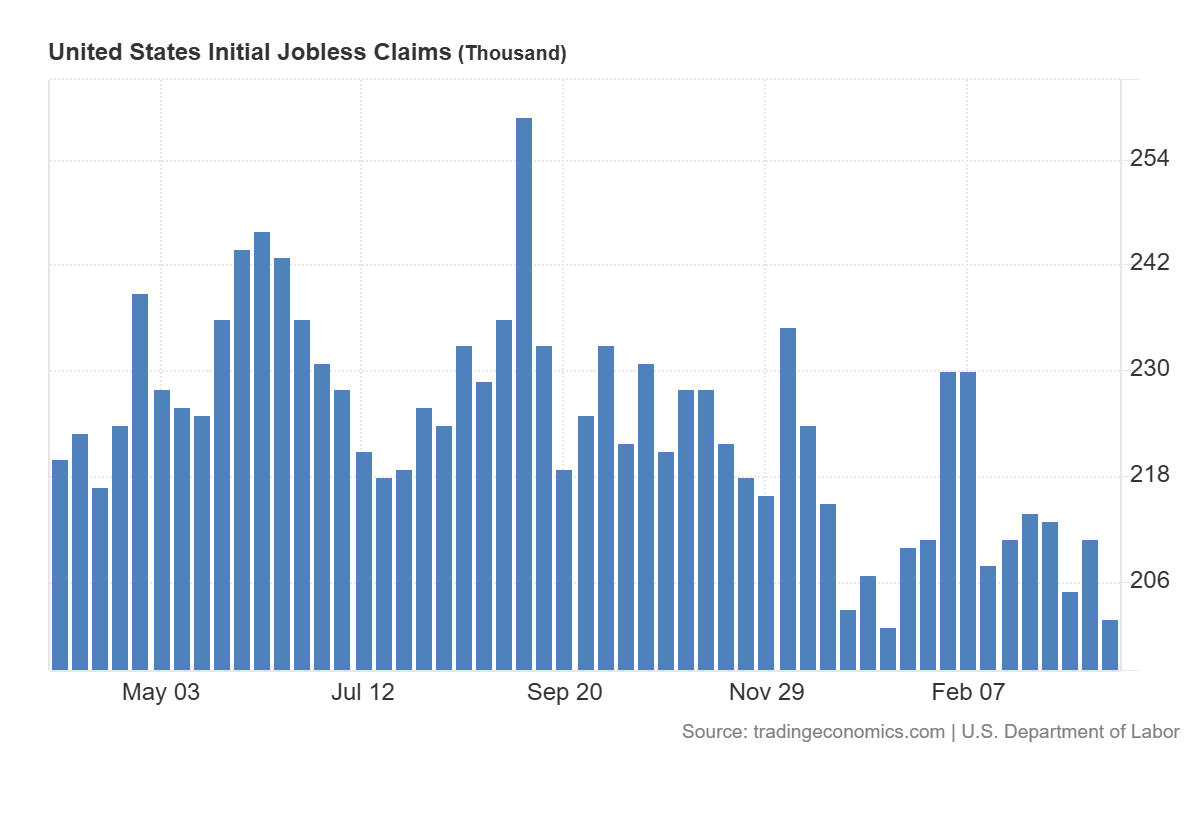
Moreover, the U.S. Treasury Yields remained stable, limiting upward price pressure on gold. Additionally, comments by the Federal Reserve indicated that they are taking a “wait and see” approach to adjusting interest rates. Although this provides little current support for gold, the long term uncertainty remains and so does the uncertainty surrounding the issues in the Middle East.
Attention will now shift to the US NFP data scheduled for release on Friday. This is one of the largest influences on gold and silver in the short term. If this data comes in higher than what was expected then it can strengthen the dollar and place additional downward pressure on gold and silver (XAG). However if the labor market data does not meet expectations, then it may create less upward momentum for the dollar and pressure precious metals prices.

Gold Technical Analysis: Bullish Structure Holds as Price Defends Key Support
The daily chart for spot gold shows that the price has rebounded from the $4,400 to $4,500 support zone and hit the $4,800 area. After hitting $4,800 resistance, the price corrected back towards $4,500, which is the strong support region.
After hitting the support, the price rebounded hard and closed at $4,676.74. Despite the correction on Thursday, the price produced a shadow on the daily candle, which indicates that buyers are still holding.
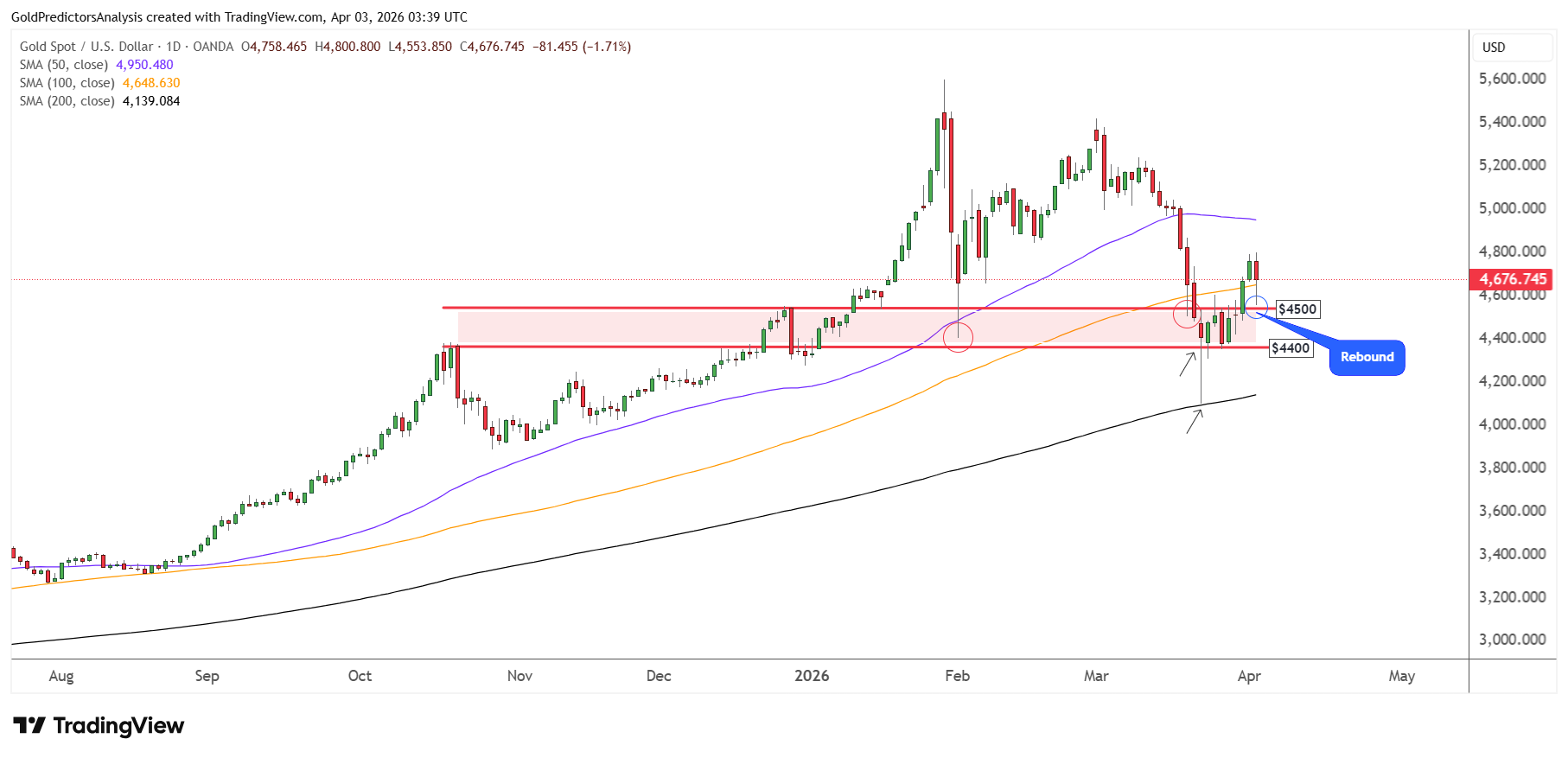
Moreover, the close was above the 100-day SMA, which keeps the bullish momentum alive. As long as the gold price holds the $4,600 level, it will likely move towards the $5,000 key area. However, a break below the $4,400 region will likely trigger a significant drop towards $4,000. Overall, the gold price is showing a bullish picture despite the ongoing uncertainty in the Middle East.
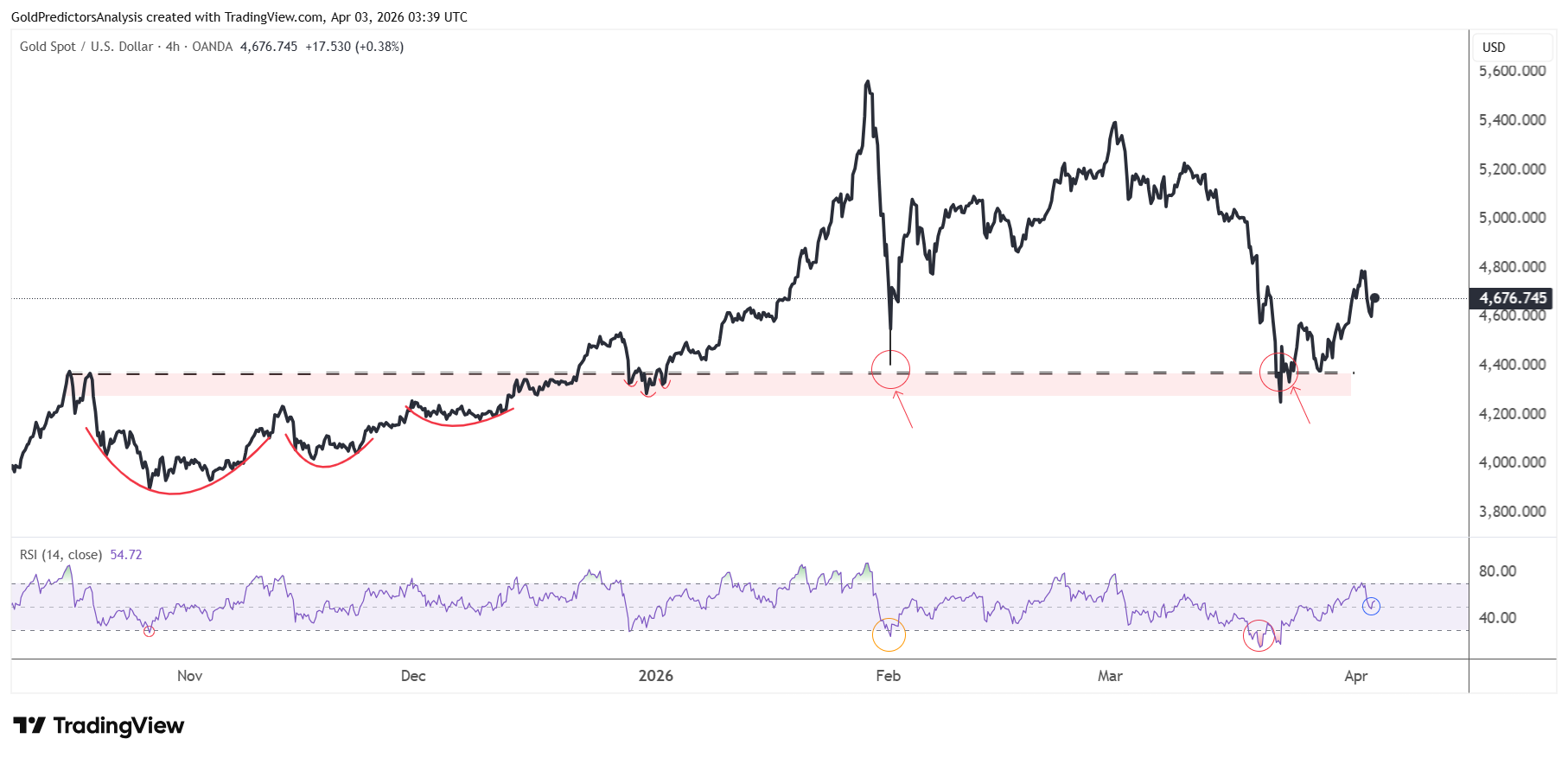
The 4-hour chart for spot gold shows the bullish structure, which is formed during Q4 2025 and Q1 2026. The correction in March 2026 has formed a strong support at the red shaded area. The emergence of cup patterns in Q4 2025 indicates bullish potential. Therefore the price may likely continue higher in the short term.
Moreover, the correction from $4,800 to $4,500 on Thursday has brought the RSI to mid-level, which indicates that the price may initiate a rebound.
Gold Price Forecast
Every new Gold analysis as it publishes, today's technical signal and key levels, live price — on one page.
See all Gold forecastsSilver Technical Analysis: Key Support Holds as Price Consolidates Before Breakout
The daily chart for spot silver shows that the price formed a bullish hammer candle within the orange zone, which is considered a significant buying area. After forming this bullish hammer, the price has rallied towards the $75 level. The correction on Thursday was also significant, but the price held the $72 level.
As long as the $72 level holds, the price may likely trend towards the $80 level in
the short term.
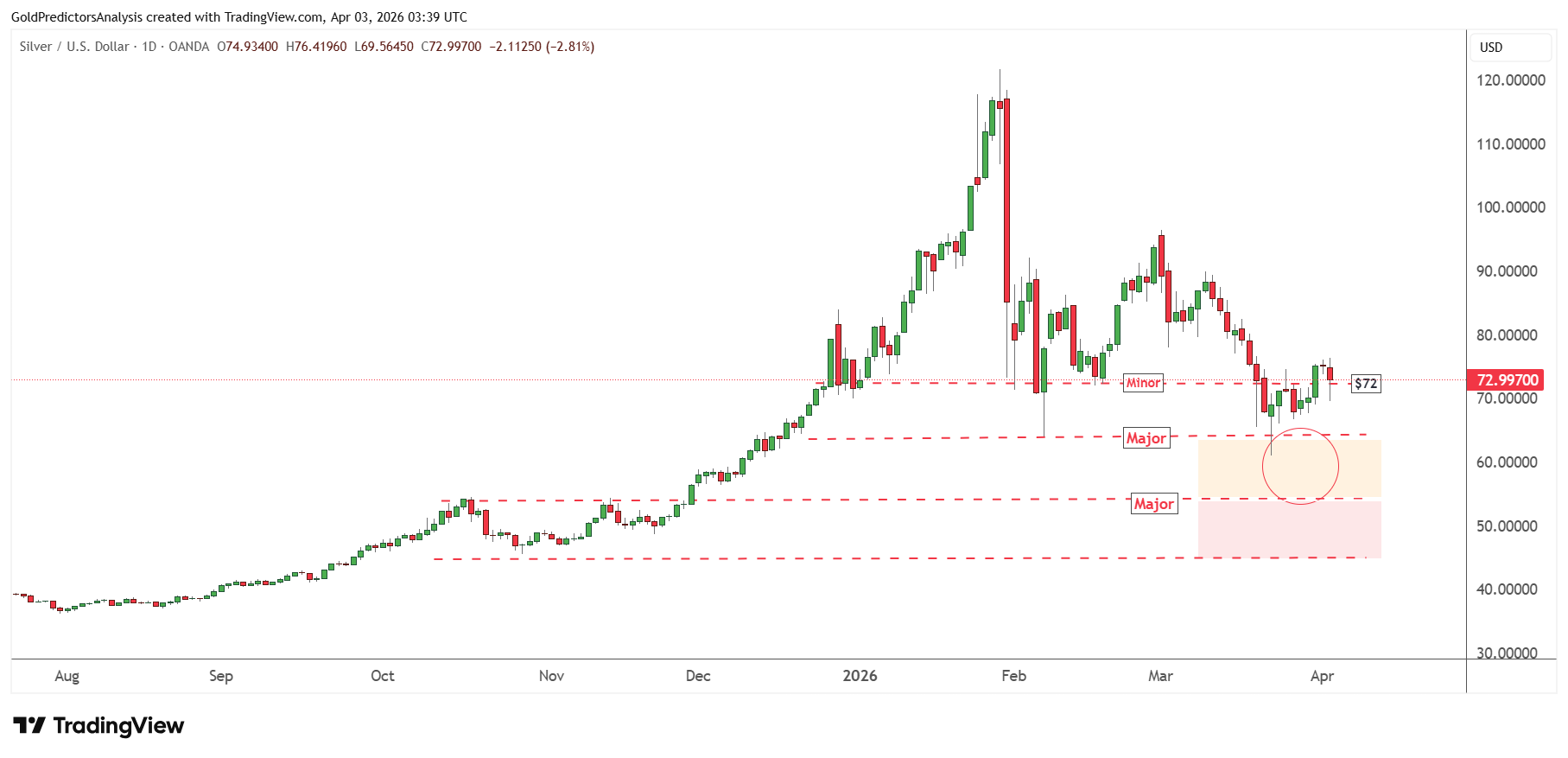
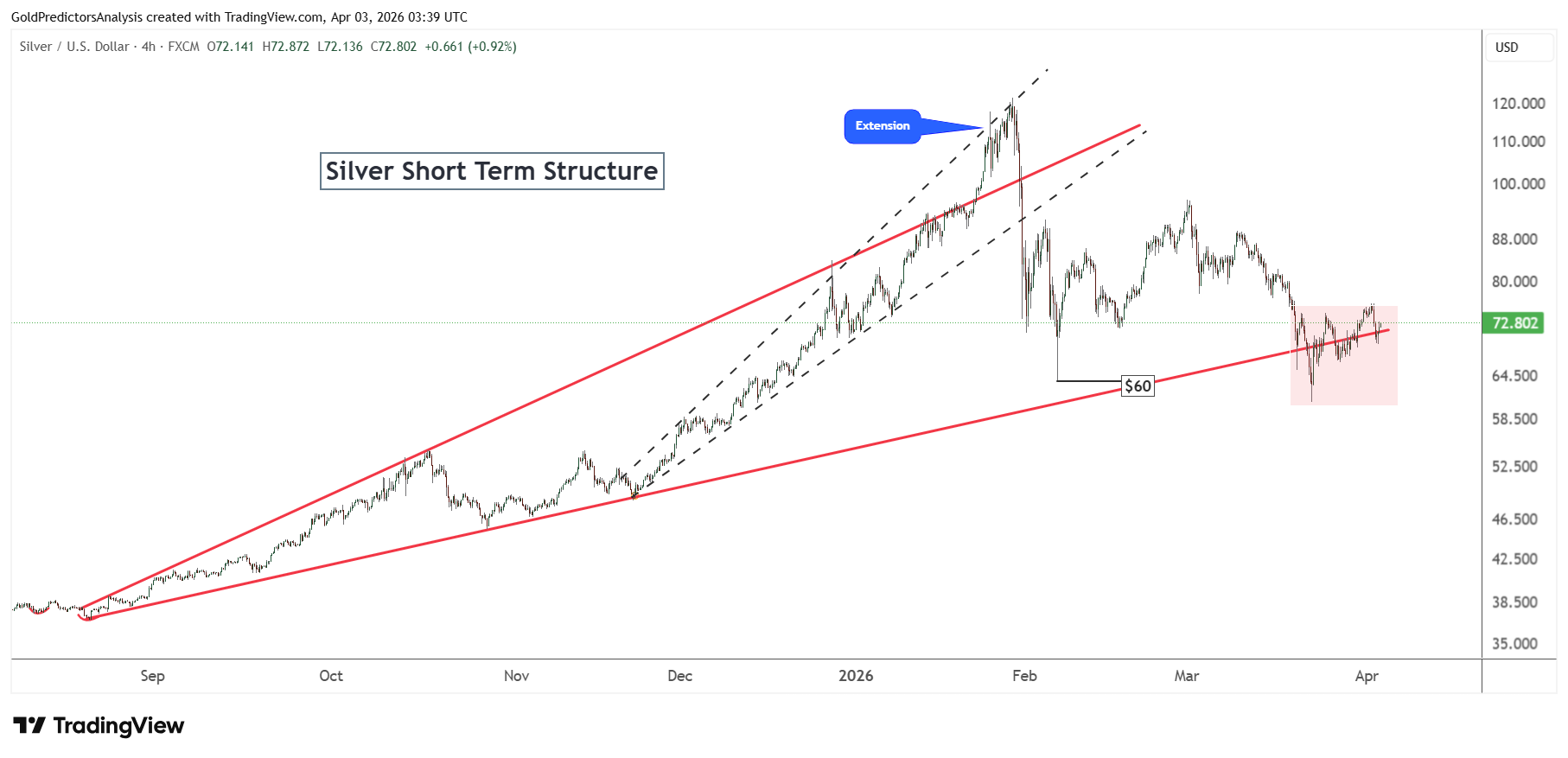
The support zone in the silver market is also highlighted on the 4-hour chart. The chart shows that the red zone is considered a key zone in the silver market. Now the consolidation in the silver price is around $60 to $75, which is the support
zone of the ascending broadening wedge pattern.
The strong consolidation within the ascending broadening wedge pattern around this zone suggests volatility in the silver market. A break above $75 will trigger a move towards $80 in the short term. However, a break below $60 will likely take the prices towards $50.
Final Words
The U.S. dollar is expected to be strong over the next few weeks due to ongoing geopolitical tensions. Therefore, gold and silver are showing strong uncertainty. However both metals hold key support at $4,000 and $60, respectively. The market focus is currently on upcoming release of NFP numbers that will likely determine the next move in the short term.
From technical perspective, gold is still supported at significant support levels and has maintained bullish chart pattern. Silver is also showing some strength above support. As long as gold and silver hold $4,000 and $60 support zones, the prices may likely trend higher. However, this move will likely be affected by the geopolitical uncertainty and how the US-Iran war unfolds.
If you’d like to know more about how to trade gold and silver, please visit our educational area.